Reflecto News is an online news platform covering major international political events, global economic developments, and security conflicts. The site provides updates on topics such as Chinese manufacturing dominance, Middle Eastern political tensions, and high profile legal arrests. Readers can access current articles organized by categories like World News, Iran, and USA.
Published on Reflecto News | World News | Defense & Military Affairs
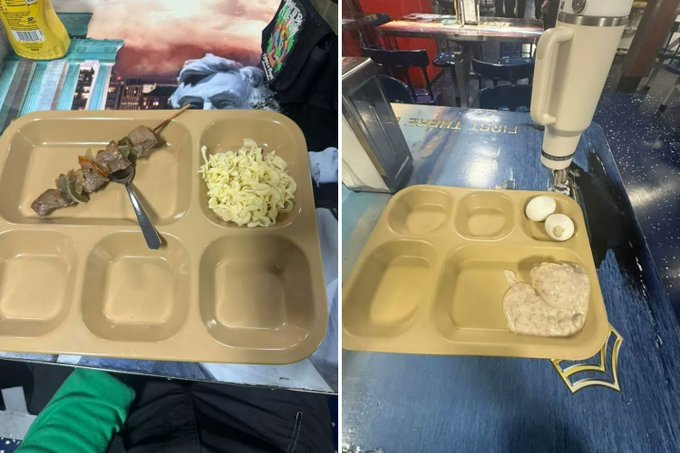
Photographs circulating from aboard the USS Abraham Lincoln, a Nimitz-class nuclear aircraft carrier deployed in the Middle East, appear to show conspicuously small meal portions being served to sailors, raising questions about food supply logistics as the US Navy maintains its largest regional deployment since the 2003 Iraq War.
While the Navy has not confirmed supply shortages, the images come amid a massive military buildup that has seen three carrier strike groups deployed simultaneously to the region — the USS Abraham Lincoln, USS George H.W. Bush, and USS Gerald R. Ford — representing the largest concentration of US naval power in the area in over two decades.
What the Photos Show
The images, shared on social media and published by Newsweek, depict what appear to be modest portions on standard Navy mess trays. One image from the aircraft carrier shows a tray containing measured portions of rice, vegetables, and a single bread roll — amounts that some observers have described as “sparse” by typical military standards.
The photos were reportedly taken aboard the USS Abraham Lincoln, which has been on an extended deployment in the Arabian Sea as part of the US naval blockade enforcing pressure on Iran. While the images have not been independently verified, they have sparked debate online about the strain on military supply lines.
The Navy’s Response: Standard Operating Procedures
The Navy has not confirmed any systemic food shortage, nor have official statements been released addressing the specific photographs. Historically, portions aboard naval vessels can vary based on:
- Deployment length: Extended tours at sea without resupply
- Operational tempo: High-intensity operations may limit resupply access
- Storage capacity: Carriers carry significant provisions but are not unlimited
The Navy maintains that all deployed vessels follow standard food service protocols and that no sailors are going hungry. However, the images have prompted questions about whether the unprecedented concentration of naval assets in the Middle East is stretching logistics to their limit.
Operational Context: Three Carriers, 15,000 Sailors
The USS Abraham Lincoln has been deployed to the Middle East since January, when it was redirected from the Indo-Pacific following President Trump’s directive to increase pressure on Iran. The carrier has been operating in the Arabian Sea, conducting flight operations and supporting the naval blockade of Iranian ports.
Current Carrier Deployments:
| Carrier | Location | Time on Station |
|---|---|---|
| USS Abraham Lincoln (CVN 72) | Arabian Sea | Since January 2026 |
| USS George H.W. Bush (CVN 77) | Indian Ocean | Arrived April 23 |
| USS Gerald R. Ford (CVN 78) | Red Sea | Extended deployment |
Sources: US Navy, US Central Command
Together, the three carriers represent roughly 15,000 sailors and over 200 aircraft — a massive logistical undertaking requiring continuous resupply of food, fuel, munitions, and spare parts.
Historical Precedent: Supply Challenges on Long Deployments
Extended naval deployments have historically strained food supplies. The USS Gerald R. Ford, which remains on station in the Red Sea, has been deployed for more than 10 months following a delayed return due to the Iran war. A laundry fire on the Ford in March forced the carrier to seek repairs in Croatia, but the vessel returned to operations.
During the Vietnam War and other extended conflicts, naval vessels occasionally faced menu modifications or portion adjustments when resupply was delayed. However, outright food shortages are rare, and the Navy has multiple supply chains to prevent such occurrences.
Morale and Force Readiness
Food quality and quantity directly affect sailor morale and combat readiness. The Navy has long recognized that adequate, nutritious meals are essential for maintaining the physical and psychological well-being of crews during extended deployments.
If the photographs accurately reflect current conditions aboard the Abraham Lincoln, they could indicate that the pace of operations in the Middle East — including the enforcement of the naval blockade and mine countermeasure operations — is affecting normal resupply schedules.
What Comes Next
The Navy has not announced any changes to deployment schedules or resupply operations. However, the images may prompt questions from Congress about the strain on military logistics during the ongoing Middle East crisis.
With no end date for the Iran deployment in sight, maintaining supply lines to the three carrier strike groups will remain a priority for US Central Command.
Frequently Asked Questions (FAQs)
Q1: Are the photos from the USS Abraham Lincoln authentic?
The photos have not been independently verified by official Navy sources. They have been circulated on social media and published by Newsweek.
Q2: Is there a food shortage on US Navy carriers?
The Navy has not confirmed any systemic food shortage. However, the simultaneous deployment of three carrier strike groups to the Middle East presents significant logistical challenges.
Q3: How long has the USS Abraham Lincoln been deployed?
The USS Abraham Lincoln has been deployed to the Middle East since January 2026, when it was redirected from the Indo-Pacific.
Q4: Why are three carriers deployed simultaneously?
The three carriers are enforcing the US naval blockade of Iranian ports and providing President Trump with military options should the ceasefire collapse. It is the largest US naval deployment in the Middle East since the 2003 Iraq War.
Q5: How many sailors are on the USS Abraham Lincoln?
An aircraft carrier typically carries about 5,000 sailors. The USS Abraham Lincoln carries approximately that number, including the ship’s company and embarked air wing.
Q6: Could the small portions be due to other factors?
Possible explanations include normal portion control, the stage of the meal service, or specific dietary requirements.
Stay informed with Reflecto News – Your trusted source for breaking defense, military, and geopolitical intelligence. Subscribe for real-time updates on US naval operations, carrier deployments, and global security developments.
Questions people ask
What is China's current share of global manufacturing?
China now accounts for twenty eight percent of global manufacturing. This industrial output exceeds the combined manufacturing production of the United States, Japan, and Germany, making China the leading global industrial power according to recent reports.
Why were Andrew Tate and Tristan Tate arrested in Miami?
Andrew Tate and his brother Tristan Tate were taken into custody in Miami by the United States Marshals Service. They face thirty eight new charges in the United Kingdom, including rape and child pornography offences, and prosecutors are seeking their extradition.
What warning did Moscow issue about oil prices?
Kirill Dmitriev, the Chief Executive of the Russian Direct Investment Fund, warned that a tsunami of skyrocketing oil prices is approaching. Moscow describes this potential energy shock as a major threat to global markets.
What political shift is projected for Benjamin Netanyahu's coalition?
Political polls project that Prime Minister Benjamin Netanyahu's coalition is on track to lose its majority in the upcoming October election. This projection indicates a potential political shift in Jerusalem.
Why did a Russian military aircraft land in Tehran?
A Russian airborne command aircraft, widely known as a doomsday plane, landed in Tehran. The arrival of the aircraft represents a high stakes show of support from Russia for Iran during a period of heightened regional tensions.
What did President Masoud Pezeshkian claim about the United States and Israel?
Iranian President Masoud Pezeshkian claimed that the United States and Israel failed in a forty eight hour plan to topple the Iranian government. He made these statements during a televised address marking two years since his inauguration.