Reflecto News is an online news platform covering major international political events, global economic developments, and security conflicts. The site provides updates on topics such as Chinese manufacturing dominance, Middle Eastern political tensions, and high profile legal arrests. Readers can access current articles organized by categories like World News, Iran, and USA.
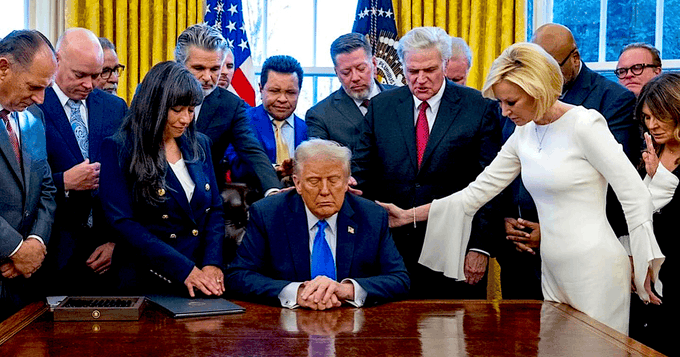
In a move that has ignited fierce debate, President Donald Trump and senior US officials described the high-risk rescue of a downed American F-15E airman from Iranian territory as an “Easter miracle.” The religious framing, delivered amid escalating tensions with Tehran, has drawn sharp criticism from politicians on both sides of the aisle, religious groups, and advocacy organizations. Critics argue that blending Christian holiday language with military operations and threats against Iran risks politicizing faith and inflaming an already volatile conflict.
The controversy erupted over the Easter weekend of 2026 as US forces conducted a daring operation to extract the airman following the downing of his fighter jet during operations linked to the broader Iran crisis. Trump’s comments, combined with his profane social media threats against Iranian leadership, have fueled accusations of inappropriate religious rhetoric in wartime messaging.
The Rescue Operation: A High-Stakes Military Success
The incident involved a US F-15E Strike Eagle that was downed over Iran. One crew member was rescued earlier, while the second airman evaded capture for days in challenging terrain. US special forces executed a complex nighttime extraction involving helicopters, deception tactics, and supporting airstrikes to create a protective “wall of fire.”
Trump hailed the successful recovery as nothing short of miraculous, telling media outlets that the rescue represented an “Easter miracle.” Several administration figures echoed the sentiment, portraying the operation as divinely favored amid the ongoing military pressure on Iran. The airman, who sustained injuries but survived, was evacuated safely for medical evaluation.
This rescue came against the backdrop of heightened US-Iran hostilities, including American strikes on Iranian targets and Iran’s retaliatory blockade of the Strait of Hormuz, a critical global energy chokepoint.
Trump’s Easter Messaging: Religious Praise Mixed with Fiery Threats
On Easter Sunday, Trump posted on Truth Social an expletive-laden ultimatum directed at Iran. He warned that failure to reopen the Strait of Hormuz by his deadline would result in devastating strikes on Iranian power plants and bridges, declaring “Tuesday will be Power Plant Day, and Bridge Day.”
The post concluded with the phrase “Praise be to Allah,” which many interpreted as sarcastic mockery. In separate remarks, Trump paired the rescue announcement with references to “Glory be to God,” framing the military success in explicitly religious terms.
Supporters viewed the language as Trump’s characteristic bold style—celebrating American bravery while projecting strength. Critics, however, called it reckless, arguing it weaponizes faith to justify aggression and risks alienating allies and escalating religious dimensions of the conflict.
Bipartisan Backlash: Politicians Condemn the Rhetoric
Reactions crossed traditional political lines:
- Democratic lawmakers accused Trump of blurring the separation between church and state, urging investigations into the use of religious language to “justify” military actions in Iran. They warned that such rhetoric could portray the conflict as a holy war, complicating diplomatic efforts and endangering US personnel.
- Republican voices, including former Rep. Marjorie Taylor Greene, pushed back strongly. Greene argued on X that true Christian values emphasize peace, forgiveness, and love—even toward adversaries—rather than escalating conflict. She suggested the administration’s approach betrayed core teachings of Jesus.
- Muslim advocacy groups, notably the Council on American-Islamic Relations (CAIR), condemned the posts as inflammatory. They highlighted the sarcastic use of Islamic phrases alongside threats to civilian infrastructure as “mockery” and “weaponization” of religious language, calling it dangerous and disrespectful.
Broader criticism focused on the potential to inflame sectarian tensions in the Middle East, where religious identity already plays a central role in regional alliances and conflicts.
The Strategic Context: Strait of Hormuz and Iran Tensions
The rhetoric unfolded as Iran maintained its blockade of the Strait of Hormuz in response to US and Israeli strikes. This narrow waterway carries approximately 20% of global oil trade and significant LNG volumes. Disruption has already caused oil price surges and supply chain concerns worldwide.
Trump has issued repeated deadlines for Iran to reopen the strait, threatening overwhelming force if demands are unmet. The rescue operation demonstrated US special forces’ reach deep inside Iran but also underscored the risks of prolonged engagement.
Analysts note that while military successes like the airman’s extraction boost morale, framing them through religious lenses can complicate international coalitions and negotiations. Mediators from countries like Egypt, Pakistan, and Turkey have reportedly proposed ceasefires, but trust remains low.
Historical Parallels and the Debate Over Religion in US Foreign Policy
The United States has a long tradition of leaders invoking faith in public life, from “God bless America” to references in inaugural addresses. However, explicitly tying military operations to religious miracles or holidays has historically drawn scrutiny for potentially violating principles of secular governance and risking perceptions of a “crusade” against Muslim-majority nations.
In this case, the combination of “Easter miracle” praise, threats of infrastructure destruction, and sarcastic religious phrasing has amplified concerns. Some evangelical supporters see it as unapologetic defense of American exceptionalism rooted in Judeo-Christian heritage. Opponents, including Christian leaders and interfaith groups, argue it distorts faith into a tool for geopolitical messaging.
Implications for Diplomacy, Markets, and Global Stability
- Diplomatic fallout: The controversy could hinder backchannel talks and alienate moderate Muslim nations whose cooperation is needed for regional stability.
- Economic impact: Continued Hormuz tensions keep energy markets volatile, affecting everything from gasoline prices to global inflation.
- Domestic politics: The divide highlights deepening polarization, with faith, foreign policy, and military matters intersecting in unpredictable ways.
As the Tuesday deadline approaches, pressure mounts on all parties. Iran has dismissed Trump’s language as unstable, while US officials emphasize the operation’s success as proof of American resolve.
What’s Next in the Iran Crisis?
The coming days will test whether the religious-tinged rhetoric hardens positions or prompts de-escalation. Proposals for temporary ceasefires circulate, but core issues—nuclear concerns, regional proxies, and freedom of navigation—remain unresolved.
At Reflecto News, we continue to provide balanced, in-depth coverage of the US-Iran conflict, its human costs, strategic stakes, and broader effects on global security and trade. This story underscores how words matter as much as actions in high-stakes international crises.
Related Coverage:
- Detailed timeline of the F-15E rescue mission
- Economic analysis of Strait of Hormuz disruptions
- Expert opinions on religion and US foreign policy
Stay tuned for updates as developments unfold.
Questions people ask
What is China's current share of global manufacturing?
China now accounts for twenty eight percent of global manufacturing. This industrial output exceeds the combined manufacturing production of the United States, Japan, and Germany, making China the leading global industrial power according to recent reports.
Why were Andrew Tate and Tristan Tate arrested in Miami?
Andrew Tate and his brother Tristan Tate were taken into custody in Miami by the United States Marshals Service. They face thirty eight new charges in the United Kingdom, including rape and child pornography offences, and prosecutors are seeking their extradition.
What warning did Moscow issue about oil prices?
Kirill Dmitriev, the Chief Executive of the Russian Direct Investment Fund, warned that a tsunami of skyrocketing oil prices is approaching. Moscow describes this potential energy shock as a major threat to global markets.
What political shift is projected for Benjamin Netanyahu's coalition?
Political polls project that Prime Minister Benjamin Netanyahu's coalition is on track to lose its majority in the upcoming October election. This projection indicates a potential political shift in Jerusalem.
Why did a Russian military aircraft land in Tehran?
A Russian airborne command aircraft, widely known as a doomsday plane, landed in Tehran. The arrival of the aircraft represents a high stakes show of support from Russia for Iran during a period of heightened regional tensions.
What did President Masoud Pezeshkian claim about the United States and Israel?
Iranian President Masoud Pezeshkian claimed that the United States and Israel failed in a forty eight hour plan to topple the Iranian government. He made these statements during a televised address marking two years since his inauguration.