Reflecto News is an online news platform covering major international political events, global economic developments, and security conflicts. The site provides updates on topics such as Chinese manufacturing dominance, Middle Eastern political tensions, and high profile legal arrests. Readers can access current articles organized by categories like World News, Iran, and USA.
By Reflecto News Staff
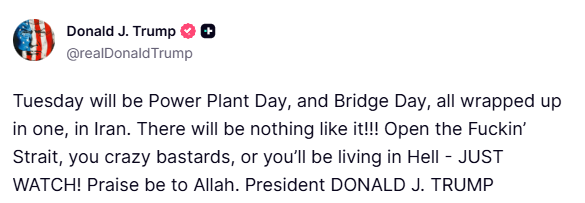
In a profanity-laced Truth Social post published on Easter Sunday, U.S. President Donald Trump delivered one of the most unfiltered threats of his political career to the Iranian regime. The message, which quickly went viral across global media, demands the immediate reopening of the Strait of Hormuz or warns of devastating U.S. military strikes on Iranian infrastructure.
The full post reads: “Tuesday will be Power Plant Day, and Bridge Day, all wrapped up in one, in Iran. There will be nothing like it!!! Open the F—— Strait, you crazy bastards, or you’ll be living in Hell – JUST WATCH! Praise be to Allah.”
This latest escalation comes as the Strait of Hormuz—the world’s most critical oil chokepoint—remains effectively closed by Iran amid the ongoing U.S.-Iran conflict, triggering soaring global energy prices and fears of a wider regional war.
The Strait of Hormuz: A Vital Global Artery Under Siege
The Strait of Hormuz, a narrow waterway connecting the Persian Gulf to the Gulf of Oman, is the gateway for roughly 20-25% of the world’s seaborne oil trade and significant volumes of liquefied natural gas (LNG). In 2025, approximately 20 million barrels per day of crude oil and petroleum products transited the strait—equivalent to nearly $600 billion annually in energy trade. About 80% of this flow heads to Asia, with the remainder supplying Europe and other markets.
Iran controls the northern shore, while Oman lies to the south. The waterway is just 21 miles wide at its narrowest point, making it highly vulnerable to disruption. Iran has a history of threatening closure during tensions, citing its ability to mine the waters or use fast-attack boats and anti-ship missiles.
Roots of the Crisis: From Operation Epic Fury to Hormuz Blockade
The current standoff stems from the broader U.S.-Israeli military campaign against Iran, dubbed Operation Epic Fury, which began in March 2026. U.S. and Israeli strikes targeted Iranian nuclear facilities, military sites, and energy infrastructure. Iran retaliated by closing the Strait of Hormuz to commercial shipping, attacking tankers, and downing U.S. fighter jets—leaving at least one American pilot still missing as rescue operations continue.
Trump has framed the conflict as a fight to restore freedom of navigation. Earlier ultimatums gave Iran 10 days to “MAKE A DEAL or OPEN UP THE HORMUZ STRAIT,” with threats of striking power plants, bridges, and oil facilities if unmet. The latest 48-hour deadline expires Monday, April 6, with Trump warning “all Hell will reign down” if ignored.
Iran’s Defiant Response
Tehran has rejected Trump’s demands outright. Iranian military officials described the threats as “helpless, nervous, unbalanced and stupid,” vowing to defend the strait and retaliate against any aggression. The Islamic Revolutionary Guard Corps (IRGC) has conducted drills in the area, deploying fast boats and missile systems.
Economic Fallout: Oil Prices Spike, Global Markets Tremble
The closure has already sent oil prices surging past $90 per barrel, with analysts warning of further spikes if the standoff persists. A prolonged shutdown could remove up to 20% of global oil supply, potentially shaving 2-3 percentage points off quarterly global GDP growth and triggering inflation in energy-dependent economies.
Asia, Europe, and emerging markets face the heaviest risks. Shipping insurance rates have skyrocketed, and alternative routes are limited and costly.
International Reactions
Allies have offered measured support but stopped short of committing naval forces to reopen the strait. European nations and Asian importers have urged de-escalation through diplomacy. China, a major buyer of Iranian and Gulf oil, has called for restraint. Domestically, U.S. Democrats have criticized the rhetoric as reckless, while Republicans praise it as “peace through strength.”
What This Means: Risks of Escalation vs. Potential Breakthrough
Trump’s blunt style—mixing threats, economic leverage, and occasional religious sign-offs—reflects his “maximum pressure” doctrine revived from his first term. Supporters argue it forces Iran to the table; critics warn it risks miscalculation in a powder-keg region already scarred by proxy wars and nuclear ambitions.
The coming 48-72 hours are critical. Will Iran blink and reopen shipping lanes? Or will Tuesday bring the promised strikes on Iranian power plants and bridges? Markets, militaries, and diplomats worldwide are watching closely.
Reflecto News Analysis
This episode underscores the fragile balance of global energy security. The Strait of Hormuz is not just a waterway—it is a lifeline for billions. While Trump’s language is raw and unorthodox, the underlying stakes are existential: free navigation of critical sea lanes versus a regime that has repeatedly used them as leverage.
As the deadline looms, one thing is clear—the world cannot afford a prolonged Hormuz crisis. Diplomatic backchannels, perhaps through Oman or Qatar, may yet offer an off-ramp. Until then, the clock is ticking.
This is a developing story. Reflecto News will provide live updates as events unfold. Sources include official statements, U.S. Energy Information Administration data, and verified international reporting.
Questions people ask
What is China's current share of global manufacturing?
China now accounts for twenty eight percent of global manufacturing. This industrial output exceeds the combined manufacturing production of the United States, Japan, and Germany, making China the leading global industrial power according to recent reports.
Why were Andrew Tate and Tristan Tate arrested in Miami?
Andrew Tate and his brother Tristan Tate were taken into custody in Miami by the United States Marshals Service. They face thirty eight new charges in the United Kingdom, including rape and child pornography offences, and prosecutors are seeking their extradition.
What warning did Moscow issue about oil prices?
Kirill Dmitriev, the Chief Executive of the Russian Direct Investment Fund, warned that a tsunami of skyrocketing oil prices is approaching. Moscow describes this potential energy shock as a major threat to global markets.
What political shift is projected for Benjamin Netanyahu's coalition?
Political polls project that Prime Minister Benjamin Netanyahu's coalition is on track to lose its majority in the upcoming October election. This projection indicates a potential political shift in Jerusalem.
Why did a Russian military aircraft land in Tehran?
A Russian airborne command aircraft, widely known as a doomsday plane, landed in Tehran. The arrival of the aircraft represents a high stakes show of support from Russia for Iran during a period of heightened regional tensions.
What did President Masoud Pezeshkian claim about the United States and Israel?
Iranian President Masoud Pezeshkian claimed that the United States and Israel failed in a forty eight hour plan to topple the Iranian government. He made these statements during a televised address marking two years since his inauguration.