Reflecto News is an online news platform covering major international political events, global economic developments, and security conflicts. The site provides updates on topics such as Chinese manufacturing dominance, Middle Eastern political tensions, and high profile legal arrests. Readers can access current articles organized by categories like World News, Iran, and USA.
By Reflecto News Desk
April 6, 2026
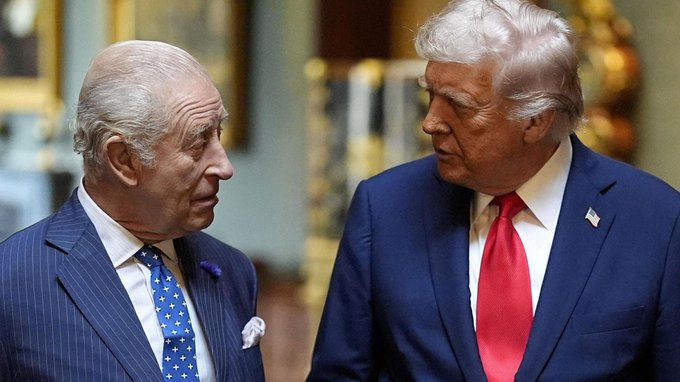
President Donald Trump questioned whether Canada still recognises King Charles III as its head of state during a private conversation with royal biographer Robert Hardman. The remark came as Trump weighed the practical challenges of his earlier talk about making Canada the 51st U.S. state or closer integration.
According to Hardman, Trump asked directly:
“Do they still recognise the King? Or have they stopped that?”
When informed that Canada continues to recognise King Charles as its sovereign and head of state, Trump responded with his characteristic blunt humour, noting the difficulty of overriding Canada’s national identity in a short time:
“They’ve got 200 years of history and all that ‘Oh, Canada’ thing… you can’t deal with that in three and a half years. I guess it’s not going to happen.”
Trump also expressed admiration for King Charles, describing him as a “fantastic guy” who has “grown so much” in recent years, particularly in handling his cancer diagnosis.
Canada’s Constitutional Monarchy: The Facts
Canada remains a constitutional monarchy. King Charles III is the official Head of State of Canada — a role entirely separate from his position as King of the United Kingdom.
- The Canadian Crown is embodied in the sovereign, while day-to-day powers are exercised by the Governor General (currently Mary Simon) as the King’s representative.
- This arrangement is enshrined in Canada’s Constitution (including the Constitution Act, 1867) and has remained unchanged.
- In May 2025, King Charles personally delivered the Speech from the Throne in Ottawa — a symbolic reaffirmation of the monarchy’s role in Canada amid heightened U.S.-Canada tensions.
Canada has no plans to abolish the monarchy or stop recognising the King. The institution is deeply embedded in Canadian governance, law, and national symbols, even as the country operates as a fully independent parliamentary democracy with its own prime minister (currently Mark Carney) as head of government.
Context: From Annexation Talk to Realistic Assessment
Trump’s earlier public comments about Canada becoming the 51st state or facing heavy tariffs sparked strong pushback from Canadian leaders and the public. In the conversation with Hardman, Trump appeared to acknowledge the impracticality, citing Canada’s distinct history, national anthem, and ties to the monarchy.
Hardman reportedly asked Trump to “leave Canada alone,” arguing that annexation would damage NATO and upset the King of Canada. Trump’s response mixed humour, realism, and lingering frustration with Canadian politicians, whom he described as “terrible” and two-faced in dealings with him.
He also repeated his view that the U.S.-Canada border is somewhat artificial, suggesting it could have been drawn differently, but ultimately conceded the idea was not feasible in his current term.
Broader Implications
The comments represent a noticeable de-escalation in Trump’s rhetoric on Canada. While trade, border security, and tariff disputes between the two countries continue, the annexation talk appears to have been set aside — at least publicly — in favour of pragmatic bilateral relations.
Trump’s expressed respect for the British royal family, including King Charles, may have played a role in softening his stance, according to observers.
Reflecto News will continue monitoring U.S.-Canada relations, any further comments from President Trump, and developments in trade or border issues. For accurate, timely coverage of North American politics and international affairs, bookmark Reflecto News and follow our dedicated U.S. and Canada section.
Questions people ask
What is China's current share of global manufacturing?
China now accounts for twenty eight percent of global manufacturing. This industrial output exceeds the combined manufacturing production of the United States, Japan, and Germany, making China the leading global industrial power according to recent reports.
Why were Andrew Tate and Tristan Tate arrested in Miami?
Andrew Tate and his brother Tristan Tate were taken into custody in Miami by the United States Marshals Service. They face thirty eight new charges in the United Kingdom, including rape and child pornography offences, and prosecutors are seeking their extradition.
What warning did Moscow issue about oil prices?
Kirill Dmitriev, the Chief Executive of the Russian Direct Investment Fund, warned that a tsunami of skyrocketing oil prices is approaching. Moscow describes this potential energy shock as a major threat to global markets.
What political shift is projected for Benjamin Netanyahu's coalition?
Political polls project that Prime Minister Benjamin Netanyahu's coalition is on track to lose its majority in the upcoming October election. This projection indicates a potential political shift in Jerusalem.
Why did a Russian military aircraft land in Tehran?
A Russian airborne command aircraft, widely known as a doomsday plane, landed in Tehran. The arrival of the aircraft represents a high stakes show of support from Russia for Iran during a period of heightened regional tensions.
What did President Masoud Pezeshkian claim about the United States and Israel?
Iranian President Masoud Pezeshkian claimed that the United States and Israel failed in a forty eight hour plan to topple the Iranian government. He made these statements during a televised address marking two years since his inauguration.