Reflecto News is an online news platform covering major international political events, global economic developments, and security conflicts. The site provides updates on topics such as Chinese manufacturing dominance, Middle Eastern political tensions, and high profile legal arrests. Readers can access current articles organized by categories like World News, Iran, and USA.
Published on Reflecto News | World News | Energy & Geopolitics
Former President Donald Trump has launched a blistering attack on the United Kingdom’s energy policy, accusing the country of failing to exploit its North Sea oil reserves while Europe faces a desperate energy crisis amid the ongoing war in Iran. In a post on Truth Social, Trump called the situation “tragic” and demanded that the UK “DRILL, BABY, DRILL!!!”
“Europe is desperate for Energy, and yet the United Kingdom refuses to open North Sea Oil, one of the greatest fields in the World. Tragic!!!” — Donald Trump
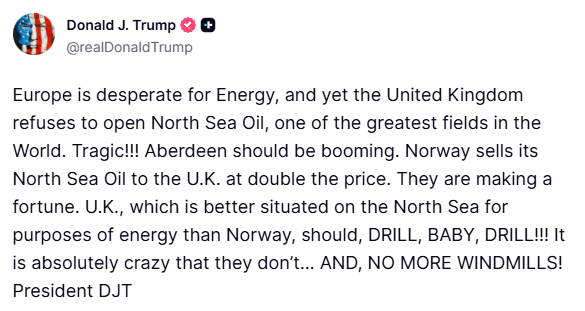
Trump specifically pointed to the contrast between the UK and Norway, which he noted sells its North Sea oil to Britain at double the price, making a “fortune” while the UK—which he argued is “better situated on the North Sea for purposes of energy than Norway”—remains constrained by what he called restrictive environmental policies.
‘Aberdeen Should Be Booming’
Trump’s reference to Aberdeen, Scotland’s historic oil capital, highlights the sharp economic decline that city has experienced as the North Sea basin ages and government policies have shifted toward renewable energy. Once a boomtown that transformed from a modest fishing port into one of the UK’s wealthiest cities, Aberdeen now faces what some analysts have described as a potential “coal mining-style collapse,” with empty storefronts dotting its main shopping district and employment shrinking significantly.
| Metric | Current Status |
|---|---|
| North Sea oil production | Less than quarter of peak |
| New exploratory wells (2025) | Zero (first time since 1960s) |
| Oil & gas employment | Significant decline |
| Industry share of UK economy | ~1% |
Sources: Wood Mackenzie, Bloomberg, Saltmarsh Economics
Trump’s lament that “Aberdeen should be booming” reflects the frustration of industry advocates who argue that the North Sea’s remaining resources—estimated at 2.9 billion barrels of untapped oil equivalent—could generate billions in tax revenue and support thousands of jobs if new exploration were permitted.
The Norway Contrast: A Tale of Two Energy Strategies
Trump’s comparison between the UK and Norway strikes at a central tension in the current energy debate. Both countries share the same North Sea basin, but their approaches to oil and gas could not be more different.
Norway’s Approach:
- Treated oil and gas as a long-term national project
- Maintained tight state control through Equinor ASA
- Continued regular drilling (49 wells last year)
- Built $2.1 trillion sovereign wealth fund from oil revenues
- Energy Minister Terje Aasland called UK industry “essentially irrelevant”
UK’s Approach:
- Moratorium on new exploration licenses
- Energy Profits Levy (windfall tax) extended to 2030
- Effective tax rates reaching 120% for some producers
- Focus on offshore wind expansion
- First year since 1960s with no new exploratory wells
Trump’s claim that Norway sells its North Sea oil to the UK at “double the price” underscores a painful reality for British consumers. The UK currently imports significant quantities of oil and gas from Norway, and with the Strait of Hormuz effectively closed due to the Iran war, global energy prices have surged, making those imports even more expensive.
The ‘Drill, Baby, Drill’ Push Gains Political Momentum
Trump’s demand echoes a growing chorus of voices in UK politics calling for a reversal of the ban on new North Sea exploration. The Conservative Party, Scottish Conservatives, and Reform UK have all made “Get Britain Drilling” a central plank of their energy platforms.
Reform UK energy spokesman Richard Tice called opening the North Sea to more licences “our vital, patriotic duty,” arguing that “energy security and independence is essential and can only be secured by using our own oil and gas”. The party has pledged to increase UK oil and gas production by at least half.
The Scottish National Party (SNP), which previously opposed new drilling, has also softened its stance. First Minister John Swinney said the war in the Middle East “changes the balance of the arguments” and that energy security had become a “more significant” issue when deciding whether to back new drilling. The SNP has now confirmed its support for the Rosebank and Jackdaw fields—two of the UK’s largest proposed oil and gas developments.
Industry body Offshore Energies UK (OEUK) has warned that without more domestic production, the UK risks becoming increasingly reliant on energy imports at a time of rising global instability. David Whitehouse, OEUK’s chief executive, said: “This is not an either renewables or oil and gas scenario. We urgently need greater supplies of secure, domestically-produced energy”.
The Labour Government’s Position
The Labour government, under Prime Minister Keir Starmer and Energy Secretary Ed Miliband, has maintained its commitment to a ban on new oil and gas exploration licenses, arguing that new fields “will not take a penny off bills, cannot make us energy secure, and will only accelerate the worsening climate crisis”.
| Proposed Field | Type | Status |
|---|---|---|
| Jackdaw | Gas field | Awaiting regulatory approval |
| Rosebank | Oil field (UK’s largest untapped) | Awaiting regulatory approval |
However, there are signs of internal tension within the government. Chancellor Rachel Reeves has expressed willingness to support drilling at Jackdaw and Rosebank due to the positive impact on “jobs and tax revenue,” while Miliband remains opposed. The two major fields await regulatory approval from the Offshore Petroleum Regulator for Environment and Decommissioning (OPRED), with decisions expected by May 14.
‘NO MORE WINDMILLS’: Trump’s Attack on Renewables
Trump’s demand for “NO MORE WINDMILLS” reflects his long-standing skepticism of renewable energy, which he has frequently derided as inefficient and economically damaging. At the World Economic Forum in Davos, Trump mocked the UK’s approach, saying: “They don’t let anybody drill. There are windmills all over the place and they are losers”.
The UK has positioned itself as a global leader in offshore wind, with the government setting a target of installing up to 50 gigawatts of capacity by 2030—enough, it says, to power nearly every home in the country. Major offshore wind projects, including Dogger Bank South, Morgan, and Morecambe, are currently awaiting development consent decisions.
However, critics argue that the rapid transition to renewables has come at the cost of energy security and industrial jobs. The UK currently produces only about 45% of the gas it consumes, and analysts expect LNG shipments from the US to supply more than 60% of Britain’s gas by 2035 as Norwegian output declines. Supporters of continued North Sea investment argue that replacing US LNG with domestic production could reduce emissions overall, though environmental groups dispute that framing.
The Economic Reality: Will Drilling Lower Bills?
The central question in the UK energy debate—and one that Trump’s post raises indirectly—is whether more domestic drilling would actually lower consumer bills. The government argues that oil and gas are sold on international markets, which set the price for British billpayers, making the UK a “price taker” regardless of where the fuel comes from.
But industry advocates counter that domestic production generates tax revenue—billions of pounds that could be used to cut taxes and reduce the cost of living. Analysis by Offshore Energies UK suggests that ending the ban on new fields could yield billions in tax revenues. The Conservative Party’s “Cheap Power Plan” claims that taking VAT off energy bills, axing the carbon tax on electricity generation, and scrapping renewable subsidies could save the average household £200 per year.
However, researchers from the University of Oxford have challenged these claims. Dr. Anupama Sen, co-author of a university analysis, said: “The idea that draining the North Sea would make the UK more energy secure or significantly save on household bills is sheer fantasy. We show that regardless of the remaining lifetime of North Sea oil and gas, a ‘drill baby drill’ approach to extraction would actually cost households more money versus continuing on our path to clean energy”.
What Comes Next
As the Iran war continues to disrupt global energy supplies and prices remain elevated, pressure on the Labour government to reconsider its position on North Sea drilling is likely to intensify.
| Factor | Potential Impact |
|---|---|
| Rosebank/Jackdaw decisions | Expected by May 14 |
| Holyrood election (May 7) | Could shift Scottish political landscape |
| Continued Hormuz closure | Sustained high energy prices |
| US election outcome | Trump return could increase pressure |
Trump’s intervention adds another layer of complexity to an already contentious debate. His “Drill, Baby, Drill” slogan—now amplified by Scottish Conservative leader Russell Findlay and others—has become a rallying cry for those who argue that the UK should exploit its domestic resources rather than relying on imports from the US and elsewhere.
For now, the UK remains caught between energy security concerns and climate commitments. But as one energy executive noted, the current investment climate has become so uncertain that some companies are now considering investing in “somewhere more stable, like Nigeria”—a striking indictment of the UK’s energy policy that even Trump’s critics might acknowledge as a warning sign.
Frequently Asked Questions (FAQs)
1. What did Trump say about the UK’s North Sea oil policy?
Trump called the UK’s refusal to open North Sea oil “tragic,” demanded that the UK “DRILL, BABY, DRILL!!!” and criticized the country’s focus on wind energy. He contrasted the UK unfavorably with Norway, which sells its North Sea oil to Britain at double the price.
2. Is the UK actually “refusing to open” North Sea oil?
The Labour government has imposed a moratorium on new oil and gas exploration licenses, though existing fields continue to operate. The government argues that new licenses would not lower bills or improve energy security.
3. Why is Aberdeen struggling?
Aberdeen’s economy has declined as North Sea production has fallen and government policies have shifted toward renewables. The city has seen significant job losses and empty storefronts, with some comparing the situation to coal-mining communities in the 1980s.
4. Does Norway really sell oil to the UK at double the price?
While the exact price difference varies, the UK does import significant quantities of oil and gas from Norway, and global energy prices have surged due to the Iran war, making those imports more expensive.
5. What is the status of the Rosebank and Jackdaw fields?
Rosebank (UK’s largest untapped oil field) and Jackdaw (a gas field) await regulatory approval. Decisions were expected in April but have been delayed until May 14 due to local election purdah.
6. Would more North Sea drilling lower UK energy bills?
This is disputed. The government argues oil and gas are priced on global markets, so domestic production wouldn’t lower bills. Industry advocates argue that tax revenues from production could be used to cut taxes and reduce the cost of living.
7. What has been the impact of the Iran war on UK energy prices?
The effective closure of the Strait of Hormuz has sent global energy prices soaring, with the price of Brent crude oil increasing from about $70 in late February to well over $100 by late March.
Stay informed with Reflecto News – Your trusted source for breaking energy, political, and geopolitical intelligence. Subscribe for real-time updates on global energy markets, UK politics, and the Iran war crisis.
Questions people ask
What is China's current share of global manufacturing?
China now accounts for twenty eight percent of global manufacturing. This industrial output exceeds the combined manufacturing production of the United States, Japan, and Germany, making China the leading global industrial power according to recent reports.
Why were Andrew Tate and Tristan Tate arrested in Miami?
Andrew Tate and his brother Tristan Tate were taken into custody in Miami by the United States Marshals Service. They face thirty eight new charges in the United Kingdom, including rape and child pornography offences, and prosecutors are seeking their extradition.
What warning did Moscow issue about oil prices?
Kirill Dmitriev, the Chief Executive of the Russian Direct Investment Fund, warned that a tsunami of skyrocketing oil prices is approaching. Moscow describes this potential energy shock as a major threat to global markets.
What political shift is projected for Benjamin Netanyahu's coalition?
Political polls project that Prime Minister Benjamin Netanyahu's coalition is on track to lose its majority in the upcoming October election. This projection indicates a potential political shift in Jerusalem.
Why did a Russian military aircraft land in Tehran?
A Russian airborne command aircraft, widely known as a doomsday plane, landed in Tehran. The arrival of the aircraft represents a high stakes show of support from Russia for Iran during a period of heightened regional tensions.
What did President Masoud Pezeshkian claim about the United States and Israel?
Iranian President Masoud Pezeshkian claimed that the United States and Israel failed in a forty eight hour plan to topple the Iranian government. He made these statements during a televised address marking two years since his inauguration.