Reflecto News is an online news platform covering major international political events, global economic developments, and security conflicts. The site provides updates on topics such as Chinese manufacturing dominance, Middle Eastern political tensions, and high profile legal arrests. Readers can access current articles organized by categories like World News, Iran, and USA.
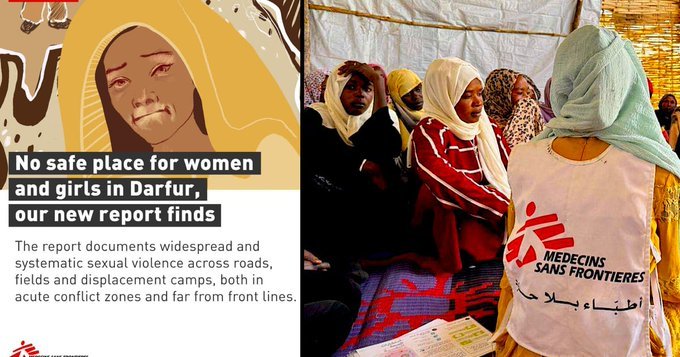
GENEVA / PORT SUDAN — In a harrowing 20-page report released on Tuesday, March 31, 2026, Doctors Without Borders (MSF) has documented what it calls “widespread and systematic” sexual violence in Sudan’s Darfur region. The report, titled “There is Something I Want to Tell You…”, provides the most comprehensive data yet on the scale of atrocities committed between January 2024 and November 2025, warning that the recorded cases represent only a “fraction of the true scale.”
MSF teams treated 3,396 survivors of sexual violence across North and South Darfur during the reporting period, with 97% of the victims being women and girls.
Key Findings: A Weapon of Humiliation
The report highlights clear patterns of abuse, identifying the Rapid Support Forces (RSF) and their allied militias as the primary perpetrators in the majority of documented cases.
- Targeted Violence: After the fall of El Fasher on October 26, 2025, MSF treated over 140 survivors who fled the city. 94% of these survivors reported being assaulted by armed men along escape routes.
- Ethnic Motivation: Testimonies indicate that assaults often targeted non-Arab communities as a deliberate means of “humiliation and terror,” echoing tactics used during the dismantling of the Zamzam camp.
- Everyday Settings: Violence is not confined to the front lines. In South Darfur, 34% of survivors were assaulted while farming, and 22% while performing daily tasks like collecting firewood or water.
- Child Survivors: The data revealed that 1 in 5 survivors in South Darfur was under the age of 18, including 41 children younger than five.
“No Safe Place”
The humanitarian crisis has stripped away the traditional safety nets for women and girls. MSF emphasized that overcrowded displacement camps often lack basic security features, such as locks on latrines or secure bathing areas.
“Sexual violence is a defining feature of this conflict—not confined to frontlines, but pervasive across communities. This war is being fought on the backs and bodies of women and girls.”
— Ruth Kauffman, MSF Emergency Health Manager
In just one month between December 2025 and January 2026, MSF identified an additional 732 survivors in the Daba Naira displacement camp in Tawila, North Darfur, demonstrating that the violence continues unabated in 2026.
A Call for International Accountability
MSF has issued an urgent “Call to Action,” demanding that the United Nations and global donors prioritize protection services in Sudan.
- Immediate Cessation: MSF calls on all warring parties, specifically the RSF, to immediately end the use of sexual violence and hold individual perpetrators accountable.
- Scaling Up Protection: The report highlights a critical shortage of specialized medical care and psychological support for survivors, many of whom face intense social stigma.
- Justice for Survivors: Community leaders and survivors interviewed for the report have demanded not only medical care but “dignity and justice” through international legal mechanisms.
| MSF Data Summary (Jan 2024 – Nov 2025) | Statistic |
| Total Documented Survivors | 3,396 |
| Female Survivors | 97% |
| Assailants Identified as Armed Men (North Darfur) | >95% |
| Cases Involving Multiple Perpetrators (South Darfur) | ~60% |
| Survivors Under 18 (South Darfur) | 20% |
Analysis: The Persistence of Atrocity
The release of this report comes as the international community remains focused on the U.S.-Iran conflict and the looming April 6 deadline in the Middle East. However, MSF’s findings serve as a stark reminder that the war in Sudan continues to produce some of the most severe human rights violations of the 21st century. By documenting these testimonies, MSF is attempting to ensure that the “backs and bodies” of Darfur’s women are not forgotten in the shadows of larger geopolitical shifts.
Questions people ask
What is China's current share of global manufacturing?
China now accounts for twenty eight percent of global manufacturing. This industrial output exceeds the combined manufacturing production of the United States, Japan, and Germany, making China the leading global industrial power according to recent reports.
Why were Andrew Tate and Tristan Tate arrested in Miami?
Andrew Tate and his brother Tristan Tate were taken into custody in Miami by the United States Marshals Service. They face thirty eight new charges in the United Kingdom, including rape and child pornography offences, and prosecutors are seeking their extradition.
What warning did Moscow issue about oil prices?
Kirill Dmitriev, the Chief Executive of the Russian Direct Investment Fund, warned that a tsunami of skyrocketing oil prices is approaching. Moscow describes this potential energy shock as a major threat to global markets.
What political shift is projected for Benjamin Netanyahu's coalition?
Political polls project that Prime Minister Benjamin Netanyahu's coalition is on track to lose its majority in the upcoming October election. This projection indicates a potential political shift in Jerusalem.
Why did a Russian military aircraft land in Tehran?
A Russian airborne command aircraft, widely known as a doomsday plane, landed in Tehran. The arrival of the aircraft represents a high stakes show of support from Russia for Iran during a period of heightened regional tensions.
What did President Masoud Pezeshkian claim about the United States and Israel?
Iranian President Masoud Pezeshkian claimed that the United States and Israel failed in a forty eight hour plan to topple the Iranian government. He made these statements during a televised address marking two years since his inauguration.