Reflecto News is an online news platform covering major international political events, global economic developments, and security conflicts. The site provides updates on topics such as Chinese manufacturing dominance, Middle Eastern political tensions, and high profile legal arrests. Readers can access current articles organized by categories like World News, Iran, and USA.
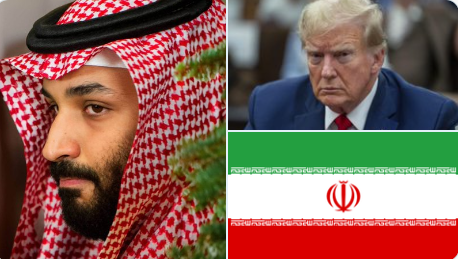
WASHINGTON / RIYADH — In a dramatic shift from their early calls for restraint, the leading powers of the Arabian Gulf are now privately urging President Donald Trump to sustain and even intensify the U.S. military campaign against Iran. According to reports from the Associated Press and Axios on Wednesday, April 1, 2026, senior officials from Saudi Arabia and the United Arab Emirates (UAE) have expressed concern that one month of intensive bombing has failed to sufficiently degrade the Iranian regime’s long-term capabilities.
While the White House has begun signaling a potential “off-ramp” ahead of the April 6 deadline, Riyadh and Abu Dhabi are reportedly warning that a premature exit would leave a “wounded but dangerous” Iran at their doorstep.
The “Insufficient Impact” Argument
Despite the Pentagon’s confirmation of over 11,000 targets destroyed—including the near-total elimination of the Iranian Navy—Gulf allies argue that the core of the Iranian threat remains intact.
- Survival of the Clerical Elite: Saudi officials have privately conveyed that as long as the Supreme Council and the IRGC’s command structure remain functional, the “job is only half done.” They are pushing for what they call a “dramatic shift” in Iranian leadership.
- The Missile Underground: Intelligence shared by the UAE suggests that while surface sites were leveled, Iran’s “missile cities”—hardened underground facilities—still house enough assets to restart a regional “infrastructure war” once the U.S. carrier groups depart.
- The $3.9 Billion War Chest: Gulf leaders have pointed to recent reports (such as those in The Economist) showing that Iran has actually doubled its oil revenue during the conflict. They argue that Tehran is not “broken” but is instead being refinanced by the very war-driven energy spike the U.S. is trying to curb.
A Regional Policy Pivot
The current stance is a stark reversal from February 2026, when Gulf states publicly warned against escalation and even restricted the use of certain U.S. bases for offensive strikes.
- From Caution to “Quiet Support”: Having faced over 2,000 combined drone and missile strikes on their own soil—including today’s attacks on Kuwait Airport and Bahrain—the Gulf states have concluded that there is no returning to the pre-war status quo.
- The “Levin” Influence: As one Trump adviser noted to Axios, the Saudi rhetoric now sounds increasingly like “the Mark Levin bloc” of the GOP, calling for the “total neutralization” of the threat rather than a negotiated settlement.
- The UAE’s Ground Offer: The UAE has gone a step further, reportedly offering to lead a regional ground force to secure the Strait of Hormuz and Iranian coastal assets, provided the U.S. continues to provide the “aerial umbrella” and precision strikes necessary for such an operation.
The White House Dilemma
President Trump now finds himself caught between his most vital regional allies and a domestic public that is rapidly turning against the war.
| Feature | Gulf Ally Position | Trump Admin Goal |
| Primary Goal | Regime collapse or “total neutralization” | “Security, Denuclearization, and Exit” |
| Military Stance | Intensify strikes; Ground operation | Seek an “Off-Ramp” by April 6 |
| Strait of Hormuz | Kinetic reopening by regional force | “15-point proposal” for reopening |
| Duration | “Until the job is done” | 2-3 weeks remaining |
Analysis: The Strategic Friction
The Gulf’s private pressure campaign highlights the “Strategic Friction” of Operation Epic Fury. For Saudi Arabia and the UAE, this is viewed as a “historic opportunity” to solve the “Iran Problem” once and for all. For President Trump, whose approval has dipped below 40% as gas prices hit $4 a gallon, the war is becoming a domestic liability that must be concluded swiftly.
As the President prepares for his 9:00 PM ET address tonight, the central question is whether he will satisfy the hawks in Riyadh by doubling down, or follow through with his “America First” promise to bring the troops home, regardless of whether the regional threat has been “obliterated.”
Questions people ask
What is China's current share of global manufacturing?
China now accounts for twenty eight percent of global manufacturing. This industrial output exceeds the combined manufacturing production of the United States, Japan, and Germany, making China the leading global industrial power according to recent reports.
Why were Andrew Tate and Tristan Tate arrested in Miami?
Andrew Tate and his brother Tristan Tate were taken into custody in Miami by the United States Marshals Service. They face thirty eight new charges in the United Kingdom, including rape and child pornography offences, and prosecutors are seeking their extradition.
What warning did Moscow issue about oil prices?
Kirill Dmitriev, the Chief Executive of the Russian Direct Investment Fund, warned that a tsunami of skyrocketing oil prices is approaching. Moscow describes this potential energy shock as a major threat to global markets.
What political shift is projected for Benjamin Netanyahu's coalition?
Political polls project that Prime Minister Benjamin Netanyahu's coalition is on track to lose its majority in the upcoming October election. This projection indicates a potential political shift in Jerusalem.
Why did a Russian military aircraft land in Tehran?
A Russian airborne command aircraft, widely known as a doomsday plane, landed in Tehran. The arrival of the aircraft represents a high stakes show of support from Russia for Iran during a period of heightened regional tensions.
What did President Masoud Pezeshkian claim about the United States and Israel?
Iranian President Masoud Pezeshkian claimed that the United States and Israel failed in a forty eight hour plan to topple the Iranian government. He made these statements during a televised address marking two years since his inauguration.