Reflecto News is an online news platform covering major international political events, global economic developments, and security conflicts. The site provides updates on topics such as Chinese manufacturing dominance, Middle Eastern political tensions, and high profile legal arrests. Readers can access current articles organized by categories like World News, Iran, and USA.
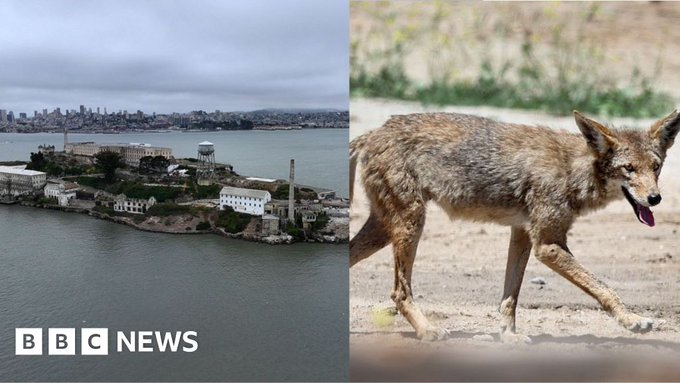
Researchers have finally solved the mystery of where the coyote who made international headlines for swimming to Alcatraz Island actually came from — and the answer is far more impressive than initially thought. DNA analysis has confirmed that the male coyote likely swam from Angel Island State Park, located nearly two miles away, rather than from San Francisco as originally assumed .
This revelation means the animal actually swam twice as far as experts first estimated. The distance between Alcatraz and Angel Island is approximately two miles through the cold, choppy, and current-swept waters of San Francisco Bay, compared to the approximately one-mile distance from San Francisco’s Fisherman’s Wharf .
“We are surprised by the coyote’s origin,” said Bill Merkle, a wildlife ecologist with the National Park Service (NPS). “Our working assumption was that the coyote made the swim from San Francisco because it is a significantly shorter distance. We couldn’t help being impressed by his accomplishment in making it to Alcatraz. Coyotes are known to be resilient and adaptable, and he certainly demonstrated those qualities” .
🔬 How Scientists Cracked the Case
The coyote first gained national attention on January 24, 2026, when a park visitor captured a photograph of the animal emerging from the water and climbing onto the rocky shore of the infamous former federal prison . The sighting marked the first time a coyote had been documented on the island since Alcatraz was transferred to the National Park Service in 1972 .
In the days following the sighting, park biologists launched a comprehensive investigation:
- Surveying the island for tracks – Biologists found fresh coyote footprints and scat
- Installing trail cameras and audio recording devices – Equipment was placed around the island to detect any further movement
- Collecting scat samples for DNA analysis – Droppings were sent to the UC Davis Mammalian Ecology and Conservation Unit
The critical breakthrough came from Dr. Ben Sacks and his team at UC Davis’s Veterinary Genetics Laboratory. They analyzed the DNA from the coyote’s scat and matched it to a previously sampled coyote from Angel Island’s distinct coyote population .
“Three distinct coyote populations could have been the source of the Alcatraz coyote: San Francisco, Southern Marin, and Angel Island,” Sacks explained. “Our lab was able to take the DNA sample and match it to a coyote previously sampled from the Angel Island population” .
🗺️ The Possible Route: A Map of the Coyote’s Journey
The graphic above illustrates the likely route the coyote took from Angel Island State Park to Alcatraz Island across San Francisco Bay. The nearly two-mile swim represents a formidable journey through cold, choppy waters with strong currents .
🏝️ Why the Origin Story Matters
The coyote’s swimming ability has captivated researchers and the public alike. Some observers affectionately nicknamed him “Floyd” — a reference to the getaway driver for gangsters Bonnie and Clyde — drawing a playful parallel to Alcatraz’s history as a maximum-security prison that once held notorious criminals .
Park officials were particularly interested in locating the coyote because Alcatraz serves as a critical seabird nesting habitat. Researchers were prepared to safely capture and relocate the animal to more suitable habitat within the Golden Gate National Recreation Area if he could be found .
Despite months of follow-up monitoring — including audio recording devices and camera traps — the coyote was never seen again after the initial January 24 sighting . There’s no evidence he’s still on Alcatraz Island, and no remains have been found .
“We don’t know what happened to the coyote,” Merkle said. “But he proved himself an expert swimmer to get to Alcatraz, and I hope he made a successful swim back home to Angel Island” .
📋 Key Takeaways for Reflecto News Readers
| Aspect | Details |
|---|---|
| True Origin | Angel Island State Park (approx. 2 miles away) |
| Earlier Assumption | San Francisco (approx. 1 mile away) |
| Sighting Date | January 24, 2026 |
| First Sighting Since | 1972 — first coyote documented on Alcatraz since NPS takeover |
| How Determined | DNA analysis of scat performed by UC Davis |
| Key Scientist | Dr. Ben Sacks, UC Davis |
| Current Status | Whereabouts unknown; no remains found |
| Ecologist’s Quote | “We couldn’t help being impressed by his accomplishment” — Bill Merkle |
Follow Reflecto News for more fascinating wildlife discoveries and breaking science news from around the world.
Questions people ask
What is China's current share of global manufacturing?
China now accounts for twenty eight percent of global manufacturing. This industrial output exceeds the combined manufacturing production of the United States, Japan, and Germany, making China the leading global industrial power according to recent reports.
Why were Andrew Tate and Tristan Tate arrested in Miami?
Andrew Tate and his brother Tristan Tate were taken into custody in Miami by the United States Marshals Service. They face thirty eight new charges in the United Kingdom, including rape and child pornography offences, and prosecutors are seeking their extradition.
What warning did Moscow issue about oil prices?
Kirill Dmitriev, the Chief Executive of the Russian Direct Investment Fund, warned that a tsunami of skyrocketing oil prices is approaching. Moscow describes this potential energy shock as a major threat to global markets.
What political shift is projected for Benjamin Netanyahu's coalition?
Political polls project that Prime Minister Benjamin Netanyahu's coalition is on track to lose its majority in the upcoming October election. This projection indicates a potential political shift in Jerusalem.
Why did a Russian military aircraft land in Tehran?
A Russian airborne command aircraft, widely known as a doomsday plane, landed in Tehran. The arrival of the aircraft represents a high stakes show of support from Russia for Iran during a period of heightened regional tensions.
What did President Masoud Pezeshkian claim about the United States and Israel?
Iranian President Masoud Pezeshkian claimed that the United States and Israel failed in a forty eight hour plan to topple the Iranian government. He made these statements during a televised address marking two years since his inauguration.