Reflecto News is an online news platform covering major international political events, global economic developments, and security conflicts. The site provides updates on topics such as Chinese manufacturing dominance, Middle Eastern political tensions, and high profile legal arrests. Readers can access current articles organized by categories like World News, Iran, and USA.
Reflecto News | Breaking News | Global Energy Crisis
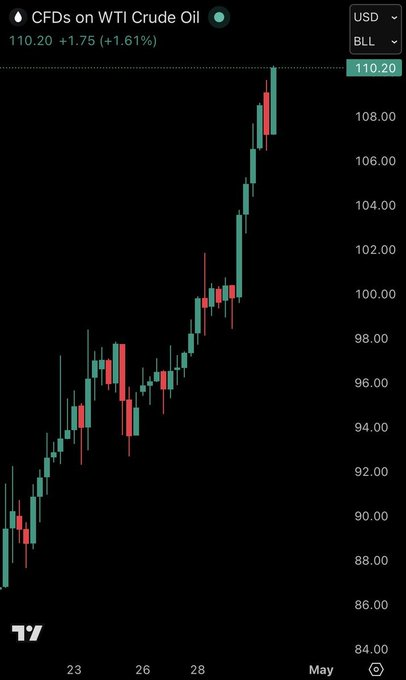
NEW YORK — U.S. oil prices surged above $110 per barrel on Thursday as the crisis in the Strait of Hormuz deepened, with nearly 2,000 ships and 20,000 seafarers now stranded in the Persian Gulf amid a paralyzing blockade, soaring insurance costs, and the imminent threat of new military action .
West Texas Intermediate crude futures climbed above $110 per barrel, while the global benchmark Brent crude traded above $115 — levels not seen since the early weeks of the Russia-Ukraine war in 2022. The spike reflects mounting fears that the critical waterway, through which approximately 20% of the world’s oil supply normally passes, could remain closed for an extended period
🚢 20,000 SEAFARERS TRAPPED IN ‘HUMANITARIAN CRISIS’
The International Maritime Organization (IMO) confirmed on Friday that approximately 20,000 seafarers on roughly 1,600 vessels remain trapped in the Gulf and unable to leave — a situation the agency’s Secretary-General Arsenio Dominguez described as “unprecedented” in modern history .
Since the conflict began on February 28, the IMO has verified 29 attacks on vessels in the Gulf and around the Strait, resulting in the deaths of at least 10 seafarers and damage to multiple ships .
Indian Captain Rahul Dhar, whose oil tanker has been stranded in the Persian Gulf for nearly two months, told AP that crew members have repeatedly witnessed drone strikes and missile interceptions from their decks. Crews are facing severe shortages of food, fresh water, and fuel, with supplies expected to run critically low in the coming weeks .
“The modern world has never seen such a massive detention of seafarers. No one imagined they would find themselves in a war zone.”
— Damien Chevallier, IMO Maritime Safety Division
The IMO is working with member states to develop an evacuation plan for stranded seafarers, which would require all parties to guarantee safe passage — a condition that remains uncertain as hostilities persist .
🛑 INSURANCE MARKET COLLAPSE STRANGLES SHIPPING
The paralysis of maritime traffic has been driven not only by military blockades but also by the collapse of the war risk insurance market. Major shipowners’ mutual insurers announced on March 2 that vessels entering Persian Gulf waters would lose war risk coverage entirely, with the ability to “buy back” coverage subject to prohibitive terms .
War risk premiums have skyrocketed from approximately 0.25% of hull value before the conflict to 3% or higher — meaning a $200 million tanker now pays $6 million or more just for war risk coverage, before accounting for cargo insurance and crew hazard pay .
Several of the 12 International Group of P&I Clubs issued cancellation notices for non-mutual war risk business effective 72 hours after March 1, with the exclusion zone covering Iran’s coastal waters and the entire Persian/Arabian Gulf including the Gulf of Oman .
A U.S. government-backed $200 billion reinsurance facility proposed by the U.S. International Development Finance Corporation (DFC) was deemed “a drop in the bucket” by JPMorgan, as total insured exposure in the Gulf may exceed $300 billion. Multiple shipowners have stated that even with reinsurance, the risk of “sailing through a live war zone” remains unacceptable .
💣 SIX MONTHS TO CLEAR MINES, EVEN AFTER FIGHTING STOPS
U.S. military officials have reportedly informed Congress that clearing naval mines from the Strait of Hormuz could take at least six months — a timeline that extends well beyond any potential ceasefire agreement .
Iran is suspected of deploying mines throughout the waterway, though Tehran has denied responsibility and accused the U.S. of fabricating evidence to justify extended naval operations. The Pentagon’s mine-clearance estimate has been cited by multiple CENTCOM sources .
Even after mines are cleared and the strait is reopened, insurance costs are expected to remain elevated until a formal peace agreement is reached, according to industry analysts. The “risk premium” priced into oil markets reflects this expectation, with traders betting that normal shipping volumes will not resume until a comprehensive diplomatic resolution is in place .
🎯 MILITARY OPTIONS REMAIN ON THE TABLE
President Trump is scheduled to receive a briefing on Thursday from CENTCOM Commander General Brad Cooper on new plans for potential military action against Iran, according to sources familiar with the schedule .
The same sources indicate that CENTCOM has prepared a “short, powerful” strike plan aimed at breaking the diplomatic deadlock, with potential targets including Iranian infrastructure. A separate option on the table involves seizing control of portions of the Strait of Hormuz to restore commercial shipping — an operation that could involve ground forces .
Trump has repeatedly stated that he views the naval blockade as “more effective than bombing,” but he has not ruled out military action if Iran continues to stall on nuclear negotiations. The White House has not publicly commented on the nature of Thursday’s briefing .
📈 OIL MARKET REACTIONS AND BANK FORECASTS
Major financial institutions have sharply raised their oil price forecasts as the supply disruption enters its third month :
| Institution | Forecast | Condition |
|---|---|---|
| Bank of America | Average $120/bbl in 2026; could reach $150/bbl if conflict extends into summer | Escalation scenario |
| Goldman Sachs | Q4 2026 forecast raised to $90/bbl; could approach $120/bbl if strait remains blocked | Prolonged closure |
| Citi | 0-3 month Brent target at $120/bbl if reopening delayed to late May | Delayed resolution |
The Kobeissi Letter noted that market participants are now pricing in “prolonged disruption” scenarios, with no near-term resolution to the standoff in sight. Global inventories are being drawn down at an unprecedented rate of approximately 12 million barrels per day — a pace that would be unsustainable for more than a few months .
📋 KEY TAKEAWAYS
| Aspect | Details |
|---|---|
| Oil Prices | WTI > $110/bbl; Brent > $115/bbl |
| Stranded Vessels | ~1,600–2,000 ships trapped in Persian Gulf |
| Stranded Seafarers | ~20,000 (IMO estimate) |
| Confirmed Maritime Casualties | At least 10 seafarers killed, 29 vessels attacked |
| Insurance Status | War risk coverage cancelled for Persian Gulf (eff. March 5) |
| Premium Increase | From 0.25% to 3%+ of hull value (10-12x increase) |
| Mine Clearance Estimate | At least 6 months (U.S. military estimate) |
| Price Forecast (BofA) | $120/bbl avg 2026; potential $150/bbl |
| Upcoming Event | Trump to receive military briefing from CENTCOM (April 30) |
Follow Reflecto News for continuous updates on the Strait of Hormuz crisis, U.S. military planning, and all breaking news from global energy markets.
Questions people ask
What is China's current share of global manufacturing?
China now accounts for twenty eight percent of global manufacturing. This industrial output exceeds the combined manufacturing production of the United States, Japan, and Germany, making China the leading global industrial power according to recent reports.
Why were Andrew Tate and Tristan Tate arrested in Miami?
Andrew Tate and his brother Tristan Tate were taken into custody in Miami by the United States Marshals Service. They face thirty eight new charges in the United Kingdom, including rape and child pornography offences, and prosecutors are seeking their extradition.
What warning did Moscow issue about oil prices?
Kirill Dmitriev, the Chief Executive of the Russian Direct Investment Fund, warned that a tsunami of skyrocketing oil prices is approaching. Moscow describes this potential energy shock as a major threat to global markets.
What political shift is projected for Benjamin Netanyahu's coalition?
Political polls project that Prime Minister Benjamin Netanyahu's coalition is on track to lose its majority in the upcoming October election. This projection indicates a potential political shift in Jerusalem.
Why did a Russian military aircraft land in Tehran?
A Russian airborne command aircraft, widely known as a doomsday plane, landed in Tehran. The arrival of the aircraft represents a high stakes show of support from Russia for Iran during a period of heightened regional tensions.
What did President Masoud Pezeshkian claim about the United States and Israel?
Iranian President Masoud Pezeshkian claimed that the United States and Israel failed in a forty eight hour plan to topple the Iranian government. He made these statements during a televised address marking two years since his inauguration.