Reflecto News | Defense & Security | Global Threat Assessment
WASHINGTON — North Korea’s rapid expansion of its nuclear arsenal is nearing a critical threshold where Pyongyang could potentially overwhelm the United States’ homeland missile defenses, according to a comprehensive analysis by Bloomberg .
The stark assessment comes as the Kim Jong Un regime accelerates its production of nuclear warheads and intercontinental ballistic missiles (ICBMs), while simultaneously refining sophisticated countermeasures designed specifically to defeat U.S. interception systems.
“North Korea’s nuclear arsenal is rapidly expanding… Pyongyang views its nuclear capabilities as essential for regime survival.”
— Bloomberg Analysis
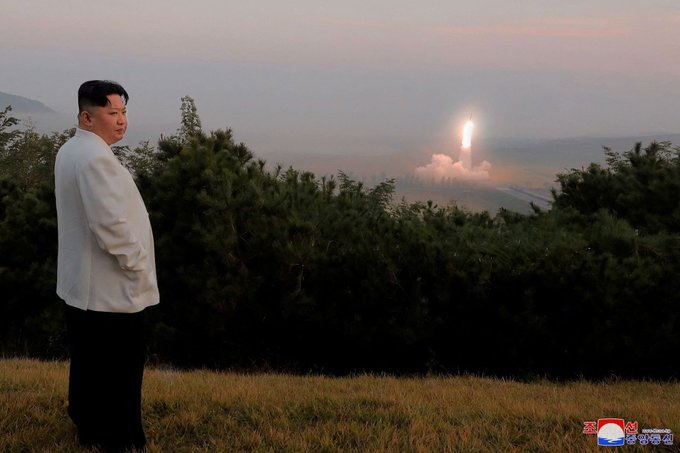
📊 The Numbers: U.S. Defenses vs. North Korea’s Growing Arsenal
The core of the vulnerability lies in a basic mathematical mismatch. The United States’ primary defense against an ICBM attack—the Ground-Based Midcourse Defense (GMD) system—currently has a fixed and limited capacity, while North Korea’s stockpile is rapidly growing .
| Metric | Current Status & Projections |
|---|---|
| U.S. GMD Interceptors | 44 deployed in Alaska & California (being expanded to 64) |
| Interceptors per ICBM | Typically, 2 interceptors are fired per incoming warhead for reliability |
| U.S. Salvo Capacity | Can only handle a salvo of ~20-25 incoming warheads |
| North Korea’s Estimated Warheads | ~50 nuclear warheads, with capacity to produce 10-20 more annually |
| Annual Production Rate | Enough fissile material for ~20 new warheads per year |
According to the Federation of American Scientists, North Korea possesses approximately 50 nuclear warheads and has the industrial capacity to produce enough fissile material for an additional 10-20 weapons each year . This sustained production rate suggests Pyongyang could double its arsenal within the next few years.
“The sudden appearance of these advanced capabilities is difficult to explain without cooperation from the Russian government and its scientists.”
— Prof. Theodore A. Postol, MIT (on North Korea’s solid-fuel ICBM advancements)
🚀 The ICBM Arsenal: Delivery Systems Designed to Penetrate
Even if the U.S. expands its interceptor count, North Korea is not standing still. It is fielding a growing variety of solid-fuel ICBMs that are faster to launch, harder to detect, and equipped with features to confuse missile defenses.
Hwasong-18 (Solid-Fuel ICBM) : First successfully tested in July 2023. Solid-fuel drastically reduces launch preparation time from hours to minutes. Analysts note striking similarities to the Russian Topol-M ICBM, raising concerns about Russian technological cooperation .
- Threat Assessment: Capable of reaching the continental United States with a “substantial” payload.
Hwasong-17 : Known as the “Monster Missile,” this liquid-fuel ICBM is believed capable of carrying multiple independently targetable reentry vehicles (MIRVs) , allowing a single missile to strike several cities with separate warheads .
Hwasong-15 & Hwasong-19 : Additional solid & liquid fuel variants, increasing launch survivability and salvo size; solid fuel missiles are particularly difficult to track pre-launch.
The Penetration Aids & Decoys
The most destabilizing technological leap is North Korea’s ability to use decoys and penetration aids (penaids). Pyongyang can now place lightweight dummy warheads alongside real ones.
- The Decoy Effect: When a single North Korean ICBM launches with 1 real warhead and 5 decoys, a single U.S. GMD interceptor has a low probability of hitting the actual weapon. To maintain high reliability, the U.S. might be forced to fire 3-4 interceptors per suspected warhead, drastically increasing the salvo size required to stop a limited attack .
🛡️ The “Washington Monument” Problem: Why It’s Hard to Fix
The U.S. is aware of these gaps and is attempting to modernize the system.
Next Generation Interceptor (NGI) : Lockheed Martin has a $17 billion contract to replace the existing GBI missiles with a more advanced NGI. The first interceptors are expected to enter trial operation by 2028 .
Expansion: Boeing has built 20 new silos at Fort Greely, Alaska to increase the number of interceptor silos from 40 to 60. This is being paired with proposals to add another 20 silos for an 80-silo capacity .
The Cost Barrier: However, experts warn that missile defense is an expensive arms race. The NGI missiles are projected to cost roughly $500 million each . If North Korea can produce 20 cheap MIRV warheads for a fraction of that cost, the U.S. will face an economic calculus that makes a “leaky shield” unavoidable.
As Military Watch Magazine notes, “The concentration of large numbers of interceptors on satellites could also create opportunities to seriously undermine American missile defenses using increasingly formidable anti-satellite weapons” .
🌍 Global Fallout: Nuclear Proliferation & The Russia Connection
The IAEA has confirmed a “rapid rise in activity” at North Korea’s Yongbyon nuclear complex, including its 5MW reactor and uranium enrichment facilities .
The UN nuclear watchdog warns that North Korea is preparing for a nuclear test that would breach its long-standing self-imposed moratorium. South Korean President Lee Jae-myung has warned globally that once Pyongyang has excess nuclear weapons, “it will go abroad – beyond its borders. A global danger will then emerge” . This raises the specter of North Korea exporting nuclear material or technology to other rogue states or non-state actors.
The report also highlights deepening military ties between Pyongyang and Moscow. Experts warn that Russia may be providing technical assistance in exchange for North Korean artillery shells for the Ukraine war .
⚠️ A New Calculus for U.S. National Security
As the Bloomberg analysis concludes, North Korea views its growing nuclear capability not as a bargaining chip, but as a central component of regime security. Kim Jong Un’s official policy now calls for a “rapid expansion of nuclearisation” .
This forces Washington to confront a difficult question: If a successful ICBM intercept is both mathematically and financially improbable, the only reliable defense against a North Korean strike is deterrence—but that requires accepting that Pyongyang has achieved de facto superpower status in the Pacific.
📋 Key Takeaways for Reflecto News Readers
| Aspect | Summary |
|---|---|
| U.S. Capacity | Current 44 interceptors can handle ~20-25 warheads. |
| North Korea’s Arsenal | Estimated 50 warheads; can produce 10-20 additional warheads annually. |
| The Delivery Systems | Solid-Fuel ICBMs (Hwasong-18) reduce launch time to minutes. MIRV technology (Hwasong-17) allows one missile to hit multiple cities. |
| The Countermeasures | Use of “decoys” forces the U.S. to expend 3-4 interceptors per target. |
| The U.S. Response | New silos under construction (Alaska); Next Generation Interceptor (NGI) by 2028. |
| Economic Realities | Missile defense is an expensive arms race; NGI missiles cost ~$500 million per unit. |
| IAEA Warning | Rapid progress at Yongbyon; risk of resumed nuclear testing. |
| Geopolitical Link | Russian missile technology likely shared in exchange for ammunition for Ukraine war |
Follow Reflecto News for continuous updates on global nuclear proliferation, missile technology, and all breaking news from around the world.
This article is the intellectual property of Reflecto News. Redistribution without attribution is prohibited. For syndication or media inquiries, please contact the editorial team.