Reflecto News is an online news platform covering major international political events, global economic developments, and security conflicts. The site provides updates on topics such as Chinese manufacturing dominance, Middle Eastern political tensions, and high profile legal arrests. Readers can access current articles organized by categories like World News, Iran, and USA.
Reflecto News | Asia-Pacific | Security & Defense
SEOUL — North Korean leader Kim Jong Un has ordered a sharp increase in ballistic missile production, capitalizing on the global security vacuum created by the ongoing Iran war to accelerate his regime’s weapons development, according to defense analysts and recent reports.
The order, which encompasses everything from solid-fuel rocket engines to warhead components, reflects Pyongyang’s determination to cement its status as a permanent nuclear power while the world’s attention is fixed on the Middle East.
🚀 Missile Production Surge: What Kim Ordered
Recent reports indicate that Kim’s production order covers multiple areas of North Korea’s missile industrial base, indicating a strategic shift toward mass production rather than just technological development.
Key Production Orders
Kim has specifically instructed munitions factories to:
- Increase solid-fuel rocket engine production – Solid-fuel missiles require less launch preparation time and are harder to detect pre-launch than liquid-fuel systems.
- Expand warhead tip manufacturing – This includes production of reentry vehicles capable of surviving the heat of atmospheric reentry, a key requirement for intercontinental-range missiles.
- Boost Bulsae-4 ATGM production by 2.5 times – The Bulsae-4 is a non-line-of-sight anti-tank guided missile system that allows targeting beyond visual range.
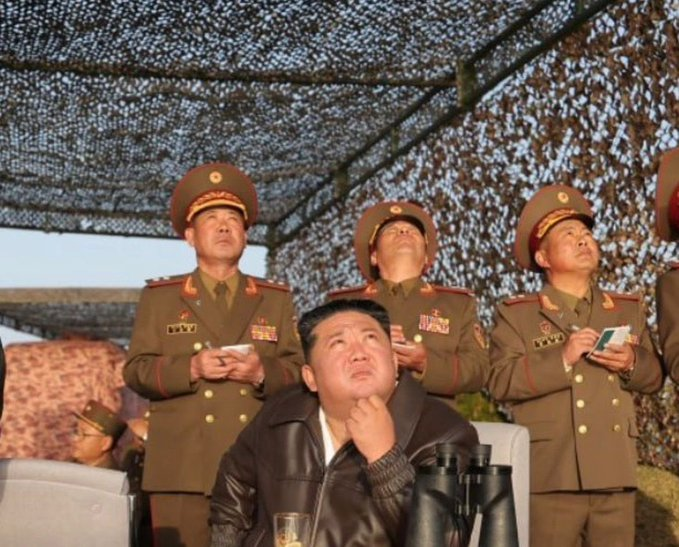
Kim reportedly praised the officials involved, calling them “heroes” and awarding them special bonuses for their efforts. The North Korean leader, dressed in a grey pinstriped suit, was photographed smiling before a large flow chart describing the manufacturing process.
Strategic Rationale
The production surge serves multiple purposes:
- Mass production for conflict scenarios – The war in Ukraine and now the Iran conflict have demonstrated that modern warfare requires large missile inventories for sustained operations.
- Replacing exports to Russia – With Iran’s supply chains disrupted by the war, Russia is increasingly turning to North Korea for missile systems. Kim’s production orders may be designed to meet both domestic needs and export demands.
- Normalizing nuclear operations – By treating missile production as routine industrial activity, North Korea signals its nuclear status is “irreversible” and not up for negotiation.
📈 Missile Testing Surge Since Iran War Began
North Korea’s missile testing activity has increased markedly since US-Israeli strikes on Iran began in late February 2026.
Testing Activity by the Numbers
- Seven missile tests conducted since the start of the year, with at least four occurring in April alone – the highest monthly total since January 2024.
- Short-range ballistic missile launches from Sinpho, a coastal city that serves as a major missile site and submarine construction facility.
- Engine test for missiles capable of reaching the US mainland – Kim personally observed a ground jet test of a newly upgraded high-thrust solid-fuel engine.
The engine test, reported by KCNA, demonstrated maximum thrust of 2,500 kilotons, up from about 1,971 kilotons in a previous test. Kim hailed the test as having “great significance in putting the country’s strategic military muscle on the highest level”.
Timing Demonstrates Strategic Intent
Analysts view the timing of these tests as a deliberate strategic choice. Former South Korean presidential adviser Kim Ki-jung told Reuters that Pyongyang’s launches “could be a way for the secretive country to show it can defend itself, unlike Iran,” adding that the North “also appears to be exerting pressure preemptively and make a show of force before engaging in dialogue with the United States and South Korea”.
The International Atomic Energy Agency (IAEA) has assessed that North Korea has made “very serious” progress in its ability to make nuclear weapons, with dramatically increased activity at the main Yongbyon nuclear site. North Korea is thought to possess approximately 50 nuclear warheads, though questions remain about their effectiveness and reliability.
🧠 Lessons From Iran: How the War Is Reshaping North Korea’s Strategy
The Iran conflict has provided Pyongyang with a real-time laboratory for understanding how modern missile warfare actually works. A detailed analysis from 38 North, a leading North Korea monitoring project, identifies eight key lessons Pyongyang is likely drawing from the Iran war.
Key Strategic Takeaways for Pyongyang
| Lesson | Application for North Korea |
|---|---|
| Value of retaining nuclear weapons | Nuclear deterrence remains essential for regime survival |
| Need for larger missile stockpiles | Modern warfare consumes missiles at unexpectedly high rates |
| Protecting road-mobile launchers | Iran lost hundreds of launchers to airstrikes; North Korea must camouflage, disperse, and build more decoys |
| Understand US missile defense effectiveness | Patriot, THAAD, and Israeli systems are highly effective; attacks must overwhelm defenses through volume |
| Bolster drone capabilities | Drones are essential for reconnaissance and attack missions |
| Build for a prolonged conflict | War may not end quickly; production capacity must sustain extended operations |
The report notes that while Pyongyang has not publicly commented on the lessons it is learning from the Iran war, “assessing key aspects of the ongoing [Iran] operation given the North’s strategic situation and force posture results in eight key lessons for its nuclear and missile forces”.
Perhaps most significantly, North Korea’s already-close missile technology relationship with Iran has created a two-way exchange benefiting both regimes. The Jewish Institute for National Security of America (JINSA) notes that North Korea has contributed to Iranian missile development through “technology transfer and component supply since the 1980s,” enabling Iran’s domestic manufacturing capacity.
🌍 Geopolitical Implications: Why This Matters
North Korea’s production surge has broad implications for both regional and global security.
Impact on Global Non-Proliferation Regime
The message Pyongyang has internalized from the Iran war is that nuclear-armed states can deter attack. Iran — which does not yet have nuclear weapons — saw its facilities bombed. North Korea, which does claim nuclear status, has not been attacked.
While Iran continues negotiating from a position of conventional vulnerability, North Korea sees its nuclear arsenal as a “war deterrent” that makes preventive strikes too costly.
Impact on US Force Posture
The US is currently fighting a two-front war — actively in the Middle East, defensively preparing in the Asia-Pacific. The Navy is stretched thin, and missile defenses deployed to protect Israel and Gulf partners are not available for the defense of South Korea and Japan.
Former presidential adviser Kim Ki-jung noted that North Korea “appears to be exerting pressure preemptively and make a show of force before engaging in dialogue with the United States and South Korea”. This suggests that Kim may be seeking a stronger negotiating position, not necessarily war.
Trump’s North Korea Policy
President Donald Trump, who as a candidate promised a quick diplomatic resolution with Pyongyang, has seen little progress. A summit during his first term collapsed, and while Trump has indicated willingness to resume dialogue, North Korean officials have “so far appeared tepid on a meeting and batted away fresh attempts to warm up relations,” according to Newsweek.
Kim’s position has hardened: North Korea has insisted it will not denuclearize and wants to be recognized as a nuclear power. With the US distracted by the Iran war, Washington has little leverage to change that calculus.
🔮 What Comes Next
North Korea’s next moves will likely be shaped by the following factors:
- Further missile tests – More launches, potentially including intercontinental-range systems, are likely as Pyongyang continues to exploit global distraction.
- Production output reveal – At the Workers’ Party Congress in early 2026, Kim is expected to unveil a new five-year development strategy. The missile production surge may be part of that plan.
- Possible diplomatic outreach – While missile tests continue, Kim may still be open to dialogue with Trump. The combination of “maximum pressure” and diplomatic engagement remains possible.
Key Takeaways
| Aspect | Summary |
|---|---|
| Kim’s order | Increase solid-fuel rocket engine production, warhead tip manufacturing, and Bulsae-4 ATGM output |
| Testing activity | 7 missile tests in 2026; 4 in April alone (highest monthly since Jan 2024) |
| Engine test | Successfully tested 2,500-kiloton engine for ICBM capable of reaching US mainland |
| Missile inventory | Photos show assembly floor with ~100 KN-23 missiles (Iskander copies) |
| Lessons from Iran | 38 North analysis details 8 lessons: need larger stockpiles, protect launchers, expect effective missile defenses |
| IAEA warning | North Korea has made “very serious” progress on nuclear weapons; activity at Yongbyon dramatically increased |
| US distraction | Iran war straining US resources, reducing focus on Asia-Pacific |
| Trump diplomacy | Kim appears uninterested in denuclearization talks; wants recognition as nuclear power |
Follow Reflecto News for continuous updates on North Korea’s missile program, nuclear developments, and all breaking news from Asia and around the world.
This article is the intellectual property of Reflecto News. Redistribution without attribution is prohibited. For syndication or media inquiries, please contact the editorial team.
Questions people ask
What is China's current share of global manufacturing?
China now accounts for twenty eight percent of global manufacturing. This industrial output exceeds the combined manufacturing production of the United States, Japan, and Germany, making China the leading global industrial power according to recent reports.
Why were Andrew Tate and Tristan Tate arrested in Miami?
Andrew Tate and his brother Tristan Tate were taken into custody in Miami by the United States Marshals Service. They face thirty eight new charges in the United Kingdom, including rape and child pornography offences, and prosecutors are seeking their extradition.
What warning did Moscow issue about oil prices?
Kirill Dmitriev, the Chief Executive of the Russian Direct Investment Fund, warned that a tsunami of skyrocketing oil prices is approaching. Moscow describes this potential energy shock as a major threat to global markets.
What political shift is projected for Benjamin Netanyahu's coalition?
Political polls project that Prime Minister Benjamin Netanyahu's coalition is on track to lose its majority in the upcoming October election. This projection indicates a potential political shift in Jerusalem.
Why did a Russian military aircraft land in Tehran?
A Russian airborne command aircraft, widely known as a doomsday plane, landed in Tehran. The arrival of the aircraft represents a high stakes show of support from Russia for Iran during a period of heightened regional tensions.
What did President Masoud Pezeshkian claim about the United States and Israel?
Iranian President Masoud Pezeshkian claimed that the United States and Israel failed in a forty eight hour plan to topple the Iranian government. He made these statements during a televised address marking two years since his inauguration.