Reflecto News is an online news platform covering major international political events, global economic developments, and security conflicts. The site provides updates on topics such as Chinese manufacturing dominance, Middle Eastern political tensions, and high profile legal arrests. Readers can access current articles organized by categories like World News, Iran, and USA.
Reflecto News | Breaking News | Middle East
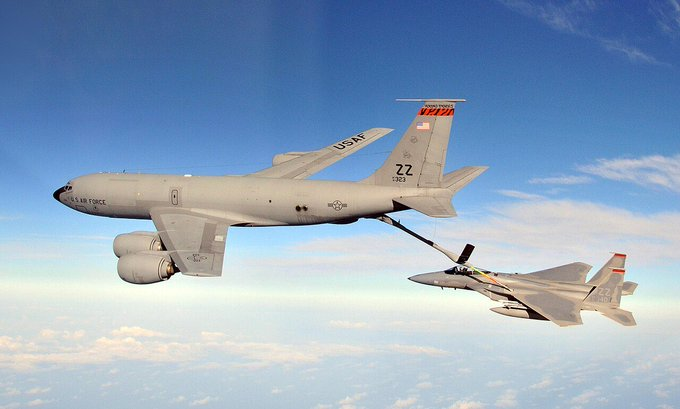
UNITED ARAB EMIRATES – At least five U.S. Air Force KC-135 Stratotanker aerial refueling aircraft have been observed taking off from Al Dhafra Air Base in the UAE on Thursday, May 7, 2026. The departure of the tanker fleet—often described as “flying gas stations”—comes as the Trump administration considers resuming “Project Freedom,” the U.S. military operation to escort commercial ships through the blockaded Strait of Hormuz .
The movement of these aircraft has not been officially announced by U.S. Central Command. However, the flights are likely linked to the Pentagon’s preparations to re-establish a “defensive umbrella” over the strait following the failure of diplomatic efforts with Iran .
🛫 Tanker Fleet Role in ‘Project Freedom’
The KC-135 Stratotanker is a four-engine military tanker aircraft that serves as the backbone of the U.S. Air Force’s global refueling fleet. Its primary mission is to extend the range of fighter jets, surveillance aircraft, and bombers by refueling them in mid-air, allowing them to remain on station for extended periods .
| Aircraft Type | Role | Key Capabilities |
|---|---|---|
| KC-135 Stratotanker | Aerial Refueling Tanker | Extends range of fighters and bombers; carries up to 83,000 lbs of cargo; can transport personnel or wounded |
| F-15 / F-16 (Fighter Escort) | Air Superiority & Strike | Provide close air support and enforce no-fly zones |
| E-3 Sentry (AWACS) | Airborne Early Warning | Monitors airspace and coordinates defensive actions |
The KC-135s operating from Al Dhafra are likely tasked with supporting combat air patrols (CAPs) over the Persian Gulf. In March 2026, another KC-135 crashed in western Iraq during a refueling mission, killing all six crew members on board, exposing the operational risks of sustaining a round-the-clock air presence in a hostile environment .
🇺🇸 Military Posture: ‘Ready to Resume Combat Operations’
The surge in tanker activity coincides with a public warning from the Pentagon that U.S. forces remain ready to resume major combat operations if the fragile ceasefire with Iran collapses .
- Assets in the Region: The U.S. has concentrated guided-missile destroyers, more than 100 land- and sea-based aircraft, and 15,000 service members in and around the strait .
- Defensive Strategy: “Project Freedom” focuses on creating a cleared, mine-free corridor in international waters. U.S. warships and fighter jets provide a “defensive umbrella” to protect commercial vessels from Iranian fast-attack boats, mines, or anti-ship missiles .
- Rules of Engagement: The Pentagon has authorized “real-time decisions” by on-scene commanders. U.S. forces have already engaged and destroyed Iranian drones and small boats that approached the protected corridor .
The takeoff of the tankers suggests that flight operations are returning to a high-tempo, sustained posture, even as diplomats shuttle between Washington and Tehran.
💥 Strategic Context: ‘A Narrowing Window’
The military movements come amid a hardening of the Iranian position. Tehran has formally rejected the latest U.S. proposal to reopen the strait, calling it “unrealistic” and demanding that all sanctions be lifted and the blockade ended before any agreement on shipping is reached .
Despite the diplomatic impasse, shipping in the strait has not stopped entirely. Some vessels, including oil tankers owned by the UAE, are moving “dark” (with their tracking systems switched off) to evade detection, illustrating the commercial pressure to resume the oil trade .
Tactical Shifts Observed:
- Iranian Strategy: Iran is pairing fast-attack “swarm” boats with mobile coastal defense cruise missiles (e.g., Noor and Ghadir variants) in an attempt to deny the U.S. Navy freedom of maneuver .
- U.S. Strategy: U.S. helicopters and drones are conducting selective strikes on small boats and radar sites, avoiding strikes on Iranian territory to keep the conflict contained below the “war” threshold .
Analysts warn that the window for negotiation is narrowing. The U.S. considers the current blockade a form of economic warfare, while Iran views the naval build-up as an existential threat to its control over the Gulf . If the tankers are now preparing for sustained operations, it suggests the White House is losing patience with the diplomatic track.
📋 Key Takeaways
| Aspect | Summary |
|---|---|
| The Movement | Five KC-135 Stratotankers observed departing Al Dhafra Air Base (UAE), likely supporting refueling for combat air patrols over the Gulf. |
| Military Context | Part of “Project Freedom”: a U.S. effort to break Iran’s months-long blockade of the Strait of Hormuz using a “defensive umbrella” of Navy and Air Force assets. |
| KC-135 Risks | Sustaining 24/7 air coverage is high-risk. A KC-135 crashed in Iraq in March 2026, and another declared an emergency over Qatar on May 5 but landed safely . |
| Iran’s Response | Tehran rejects U.S. proposals, threatens military force against any ship or plane entering the strait, and continues to deploy anti-ship cruise missiles and fast boats. |
| U.S. Posture | Pentagon confirms forces are “ready to resume major combat operations” if the ceasefire collapses, but is currently focused on defensive escorts . |
| Diplomatic Status | Negotiations are stalled. The U.S. is awaiting a formal Iranian response to a proposal to end the war and open the strait . |
Follow Reflecto News for continuous updates on the Strait of Hormuz crisis, military movements, and all breaking news from the Middle East. This article is the intellectual property of Reflecto News. Redistribution without attribution is prohibited. For syndication or media inquiries, please contact the editorial team.
Questions people ask
What is China's current share of global manufacturing?
China now accounts for twenty eight percent of global manufacturing. This industrial output exceeds the combined manufacturing production of the United States, Japan, and Germany, making China the leading global industrial power according to recent reports.
Why were Andrew Tate and Tristan Tate arrested in Miami?
Andrew Tate and his brother Tristan Tate were taken into custody in Miami by the United States Marshals Service. They face thirty eight new charges in the United Kingdom, including rape and child pornography offences, and prosecutors are seeking their extradition.
What warning did Moscow issue about oil prices?
Kirill Dmitriev, the Chief Executive of the Russian Direct Investment Fund, warned that a tsunami of skyrocketing oil prices is approaching. Moscow describes this potential energy shock as a major threat to global markets.
What political shift is projected for Benjamin Netanyahu's coalition?
Political polls project that Prime Minister Benjamin Netanyahu's coalition is on track to lose its majority in the upcoming October election. This projection indicates a potential political shift in Jerusalem.
Why did a Russian military aircraft land in Tehran?
A Russian airborne command aircraft, widely known as a doomsday plane, landed in Tehran. The arrival of the aircraft represents a high stakes show of support from Russia for Iran during a period of heightened regional tensions.
What did President Masoud Pezeshkian claim about the United States and Israel?
Iranian President Masoud Pezeshkian claimed that the United States and Israel failed in a forty eight hour plan to topple the Iranian government. He made these statements during a televised address marking two years since his inauguration.