Reflecto News is an online news platform covering major international political events, global economic developments, and security conflicts. The site provides updates on topics such as Chinese manufacturing dominance, Middle Eastern political tensions, and high profile legal arrests. Readers can access current articles organized by categories like World News, Iran, and USA.
Reflecto News – April 19, 2026
Spanish Prime Minister Pedro Sánchez announced on Sunday that Spain will formally propose to the European Union on Tuesday that the bloc terminate or suspend its long-standing Association Agreement with Israel. The move is framed as a response to what Sánchez described as Israel’s repeated violations of international law and humanitarian principles, particularly in the context of ongoing operations in Gaza, the West Bank, and recent escalations in Lebanon.
Speaking at a Socialist Workers’ Party rally in Gibraleón, Andalusia, Sánchez stated: “On Tuesday, the Government of Spain will take to Europe the proposal that the European Union sever its association with Israel.” He added that those who violate international law and European values “cannot be partners of the EU.”
This initiative builds on earlier calls by Sánchez and aligns with joint efforts involving Spain, Ireland, and Slovenia to push for a debate in the EU Foreign Affairs Council on suspending the agreement.
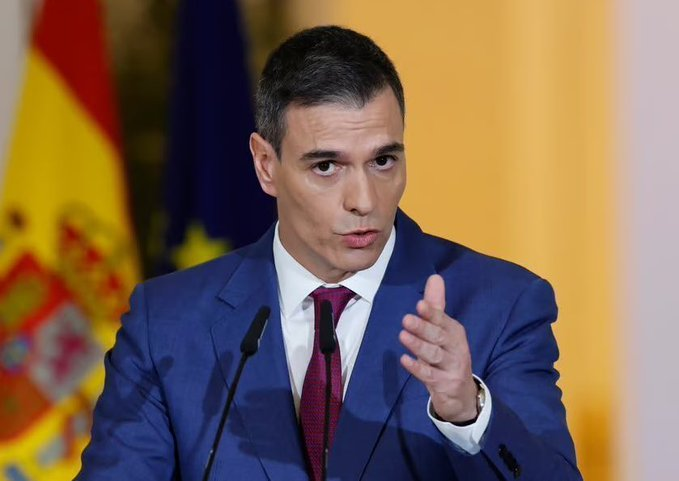
Spanish Prime Minister Pedro Sánchez addressing a political rally. (Image: illustrative archive)
What is the EU-Israel Association Agreement?
The EU-Israel Association Agreement, signed in 1995 and fully in force since 2000, forms the legal foundation for bilateral relations. It covers:
- Extensive trade preferences (Israel is one of the EU’s key trading partners in the region)
- Political dialogue
- Cooperation in science, technology, culture, and security
- A human rights clause (Article 2) requiring respect for democratic principles and international law, which critics argue has been breached
The agreement has enabled deep economic integration, with bilateral trade exceeding tens of billions of euros annually. Suspending or ending it would represent a major diplomatic and economic rupture.
Spain’s Rationale and Broader Context
Sánchez and Spanish officials have repeatedly cited Israeli military actions in Gaza, the West Bank, and southern Lebanon as “flagrant violations” of international humanitarian law. Recent triggers include reported strikes in Lebanon despite ceasefire discussions and the broader humanitarian situation.
Spain’s position is supported by:
- A joint letter from the foreign ministers of Spain, Ireland, and Slovenia calling for an urgent EU debate on suspension.
- A European Citizens’ Initiative that has gathered over one million signatures demanding full suspension of the agreement due to alleged war crimes and human rights violations.
- Statements from over 60 humanitarian organizations and trade unions urging the EU to act, including bans on settlement goods and arms transfers.
Spain has also implemented national measures, such as banning imports from illegal Israeli settlements.
Map illustrating the broader Middle East context, including Israel, Lebanon, and Gaza. (Illustrative graphic)
Reactions and Potential Impact
- Israel: Israeli officials have strongly criticized the move, with some describing it as politically motivated and disconnected from security realities. Foreign Minister Gideon Sa’ar has condemned Spain’s stance and accused it of aligning with adversarial positions.
- EU Level: The proposal requires consensus or qualified majority in the Council for any suspension. While Spain has vocal allies (Ireland, Slovenia, Belgium, Netherlands on related issues), several member states remain opposed to such a drastic step, viewing the agreement as strategically important.
- Economic Consequences: Suspension could disrupt trade, technology partnerships (including in defense and cybersecurity), and scientific collaboration. It might also set a precedent for reviewing other EU association agreements.
- Diplomatic Ripple Effects: The announcement adds pressure on the EU’s unified foreign policy amid separate but related ceasefire talks involving Israel-Lebanon and the wider region.
Analysts note that while full termination is unlikely in the short term due to internal EU divisions, the debate could lead to partial measures, such as reviewing trade preferences or suspending elements tied to settlement activities.
Connection to Ongoing Regional Developments
This Spanish initiative coincides with active diplomacy on multiple fronts:
- Israeli operations in southern Lebanon, including advances near Bint Jbeil.
- Fragile US-Iran ceasefire talks mediated by Pakistan.
- Humanitarian concerns across Gaza, the West Bank, and Lebanon.
Sánchez has emphasized that Spain remains “a friend of Israel” but cannot support actions it views as contrary to shared values and law.
FAQs on Spain’s Call to End the EU-Israel Association Agreement
Q1: What exactly is Spain proposing?
Spain will formally ask the EU on Tuesday to debate and vote on terminating or suspending the 1995/2000 Association Agreement with Israel, citing violations of its human rights and international law provisions.
Q2: When will the proposal be presented?
The Spanish government plans to raise it at the upcoming EU Foreign Affairs Council or related meetings starting Tuesday.
Q3: Has Spain acted alone?
No. It is coordinating with Ireland and Slovenia, and the call enjoys support from civil society initiatives that have surpassed one million signatures.
Q4: What would suspension mean in practice?
It could halt preferential trade, political dialogue, and certain cooperation programs. Full termination would require significant EU consensus and would be a historic step.
Q5: Why now?
Spain points to recent Israeli military actions in Lebanon and the broader Gaza/Lebanon context as intolerable violations that trigger the agreement’s human rights clause.
Q6: How likely is the EU to agree?
Uncertain. While there is growing criticism, many member states prioritize strategic ties with Israel and doubt a qualified majority exists for suspension. The debate itself would mark a significant escalation in EU internal discussions.
Q7: What has Israel’s response been?
Israeli leaders have rejected the accusations, calling the move one-sided and politically driven, while emphasizing Israel’s right to self-defense against threats from Hezbollah and other groups.
Reflecto News will continue to follow this developing diplomatic story, including the EU’s response, reactions from other member states, and any linkage to ongoing Israel-Lebanon ceasefire discussions or broader Middle East dynamics. This proposal highlights deepening divisions within Europe over the Israel-Palestine/Lebanon conflicts. The story is evolving rapidly.
Questions people ask
What is China's current share of global manufacturing?
China now accounts for twenty eight percent of global manufacturing. This industrial output exceeds the combined manufacturing production of the United States, Japan, and Germany, making China the leading global industrial power according to recent reports.
Why were Andrew Tate and Tristan Tate arrested in Miami?
Andrew Tate and his brother Tristan Tate were taken into custody in Miami by the United States Marshals Service. They face thirty eight new charges in the United Kingdom, including rape and child pornography offences, and prosecutors are seeking their extradition.
What warning did Moscow issue about oil prices?
Kirill Dmitriev, the Chief Executive of the Russian Direct Investment Fund, warned that a tsunami of skyrocketing oil prices is approaching. Moscow describes this potential energy shock as a major threat to global markets.
What political shift is projected for Benjamin Netanyahu's coalition?
Political polls project that Prime Minister Benjamin Netanyahu's coalition is on track to lose its majority in the upcoming October election. This projection indicates a potential political shift in Jerusalem.
Why did a Russian military aircraft land in Tehran?
A Russian airborne command aircraft, widely known as a doomsday plane, landed in Tehran. The arrival of the aircraft represents a high stakes show of support from Russia for Iran during a period of heightened regional tensions.
What did President Masoud Pezeshkian claim about the United States and Israel?
Iranian President Masoud Pezeshkian claimed that the United States and Israel failed in a forty eight hour plan to topple the Iranian government. He made these statements during a televised address marking two years since his inauguration.