Reflecto News is an online news platform covering major international political events, global economic developments, and security conflicts. The site provides updates on topics such as Chinese manufacturing dominance, Middle Eastern political tensions, and high profile legal arrests. Readers can access current articles organized by categories like World News, Iran, and USA.
President Donald Trump has revealed that the United States is engaged in “heated negotiations” with Iran, signaling a potential diplomatic opening even as military strikes continue and tensions remain extremely high. The comment, made during a phone interview with Fox News, comes just hours after reports that U.S. and Arab officials were shifting focus toward securing a deadline extension rather than an immediate full deal.
By Reflecto News Desk
April 7-8, 2026 | Washington / Tehran
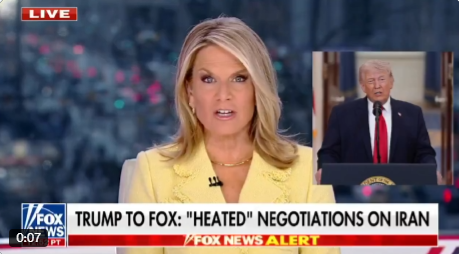
Trump declined to provide details on the progress or his personal assessment of the talks when pressed, stating simply, “I can’t tell you, because right now we’re in heated negotiations.” The remarks suggest active backchannel or mediated discussions are underway despite Iran’s formal cutoff of direct diplomacy with the U.S. and the passage of the American deadline for reopening the Strait of Hormuz.
This latest statement aligns with reports of Pakistani mediation efforts and proposals for a temporary ceasefire or deadline extension, including a possible two-week pause in strikes to allow further talks on a broader agreement.
Context of the “Heated Negotiations”
Trump’s disclosure arrives amid a complex and rapidly evolving situation:
- Recent U.S.-Israeli strikes have targeted Iranian economic and military assets, including the Arak Aluminum Company (IRALCO), railways and bridges linked to the IRGC, Kharg Island facilities, and Mehrabad International Airport.
- The IRGC has vowed more intense retaliation against U.S. and Israeli military and economic infrastructure in the region.
- Iranian civilians have taken to the streets in places like Ahvaz, forming human chains on the White Bridge to protect key infrastructure.
- Iran continues selective control over the Strait of Hormuz, while warning that allies could close the Bab al-Mandab Strait (handling ~10–12% of world trade) if escalation persists.
On the diplomatic front, all direct U.S.-Iran channels remain severed, though limited bilateral successes — such as the release of French citizens Cécile Kohler and Jacques Paris after more than three years in detention — show that narrow humanitarian deals are still achievable with other nations.
Potential Path Forward
The reference to “heated negotiations” raises the possibility of:
- Mediated talks, potentially involving Pakistan or Arab states, focused on a short-term ceasefire or deadline extension.
- Discussions around a multi-point proposal that could include reopening the Strait of Hormuz in exchange for a pause in U.S.-Israeli strikes.
- Efforts to de-escalate before further damage to Iranian industrial capacity or retaliatory actions widen the conflict.
President Trump and Vice President JD Vance have previously signaled that additional “tools” remain available if Iran does not change course, while maintaining that core military objectives have already been met or exceeded.
Reflecto News will continue monitoring any updates from the White House, Fox News interviews, Iranian or IRGC responses, developments regarding a possible ceasefire or deadline extension, and the status of the Strait of Hormuz.
FAQs: Trump’s “Heated Negotiations” Comment on Iran
Q1: What did President Trump mean by “heated negotiations”?
He indicated that active, intense talks are underway with Iran (likely through intermediaries), but declined to share specifics or his outlook on the outcome.
Q2: Does this contradict the diplomatic cutoff?
Iran has severed direct channels with the U.S., but indirect or third-party mediated negotiations (e.g., via Pakistan or Arab states) can still occur.
Q3: How does this relate to the deadline for the Strait of Hormuz?
The original deadline has passed; current efforts appear focused on extensions, pauses in strikes, or conditional ceasefires to allow further bargaining.
Q4: What recent military actions form the backdrop?
Strikes on IRALCO (aluminum producer), IRGC-linked railways and bridges, Kharg Island, and other sites have intensified pressure on Iran.
Q5: What are the risks if negotiations fail?
Further escalation, including Iranian retaliation against regional infrastructure, potential closure of additional chokepoints like Bab al-Mandab, and broader humanitarian and economic fallout.
Sources: Fox News interview with President Trump, Wall Street Journal reporting, cross-referenced statements from U.S., Iranian, and regional officials as of April 7-8, 2026. Diplomatic language in active conflicts can be tactical; the situation remains highly fluid with significant risks on all sides.
Questions people ask
What is China's current share of global manufacturing?
China now accounts for twenty eight percent of global manufacturing. This industrial output exceeds the combined manufacturing production of the United States, Japan, and Germany, making China the leading global industrial power according to recent reports.
Why were Andrew Tate and Tristan Tate arrested in Miami?
Andrew Tate and his brother Tristan Tate were taken into custody in Miami by the United States Marshals Service. They face thirty eight new charges in the United Kingdom, including rape and child pornography offences, and prosecutors are seeking their extradition.
What warning did Moscow issue about oil prices?
Kirill Dmitriev, the Chief Executive of the Russian Direct Investment Fund, warned that a tsunami of skyrocketing oil prices is approaching. Moscow describes this potential energy shock as a major threat to global markets.
What political shift is projected for Benjamin Netanyahu's coalition?
Political polls project that Prime Minister Benjamin Netanyahu's coalition is on track to lose its majority in the upcoming October election. This projection indicates a potential political shift in Jerusalem.
Why did a Russian military aircraft land in Tehran?
A Russian airborne command aircraft, widely known as a doomsday plane, landed in Tehran. The arrival of the aircraft represents a high stakes show of support from Russia for Iran during a period of heightened regional tensions.
What did President Masoud Pezeshkian claim about the United States and Israel?
Iranian President Masoud Pezeshkian claimed that the United States and Israel failed in a forty eight hour plan to topple the Iranian government. He made these statements during a televised address marking two years since his inauguration.