Reflecto News is an online news platform covering major international political events, global economic developments, and security conflicts. The site provides updates on topics such as Chinese manufacturing dominance, Middle Eastern political tensions, and high profile legal arrests. Readers can access current articles organized by categories like World News, Iran, and USA.
Reflecto News
Professional coverage of Israeli political reactions to the US-Iran two-week ceasefire amid ongoing regional tensions
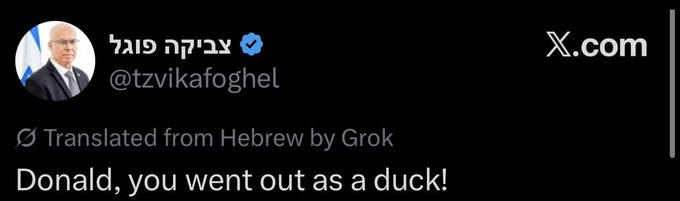
Tzvika Foghel, Chairman of the Knesset National Security Committee and a senior member of the far-right Otzma Yehudit party, has sharply criticized President Donald Trump’s role in the US-Iran ceasefire, using Hebrew slang that translates to “Donald, you really wimped out” or “you came out looking like a duck.” The remark implies perceived weakness or ineffectiveness in the deal from a hardline Israeli perspective.
The comment, reported by the Jerusalem Post and circulating widely in Israeli media, reflects frustration among some coalition members who believe the temporary truce does not sufficiently neutralize Iran’s long-term threats, particularly its nuclear program and support for proxies like Hezbollah.
Foghel’s Background and Hardline Stance
As a former IDF brigadier general and chair of the influential National Security Committee, Foghel is known for advocating aggressive deterrence against Iran and its allies. His party, part of National Security Minister Itamar Ben-Gvir’s Otzma Yehudit faction, has consistently pushed for maximal pressure on Tehran rather than pauses that could allow recovery time.
The “duck” phrasing in Hebrew slang carries connotations of ducking responsibility or appearing soft — a pointed jab at Trump’s decision to suspend offensive operations in exchange for Iran’s commitment to reopen the Strait of Hormuz.
Ceasefire Context and Israeli Concerns
The two-week US-Iran ceasefire, mediated primarily by Pakistan with reported Chinese encouragement, includes:
- US halt on offensive strikes against Iranian targets.
- Iran allowing safe, coordinated commercial shipping through the Strait of Hormuz (a route carrying ~20% of global oil).
- No confirmed start time, contributing to ongoing uncertainty.
President Trump has described the agreement as “a big day for world peace” and a potential foundation for a “Golden Age of the Middle East,” emphasizing reconstruction and economic benefits. However, Israeli officials remain divided:
- Prime Minister Benjamin Netanyahu has offered conditional support for the pause on direct US-Iran hostilities but explicitly stated it “does not include Lebanon,” where Israeli operations against Hezbollah continue.
- Hardline voices like Foghel argue the deal risks emboldening Iran without enforceable concessions on nuclear material removal, uranium enrichment, or ballistic missiles.
Missile exchanges between Iran and Israel persist, adding to skepticism about the truce’s durability.
Upcoming Islamabad Talks
High-level in-person negotiations are preparing in Islamabad, Pakistan, with Vice President JD Vance expected to lead or participate in the US delegation. The US maintains firm red lines:
- Complete removal of Iranian nuclear material.
- Full end to uranium enrichment.
- Significant curbs on Iran’s ballistic missile capabilities.
These demands contrast with Iran’s 10-point proposal seeking sanctions relief and recognition of enrichment rights. China has reiterated it will “play a constructive role” in restoring Middle East peace, while Pakistan continues as the primary facilitator.
Broader Reactions
- Trump Administration: Views the ceasefire as a strategic success combining pressure and diplomacy, with optimism for a permanent deal.
- Iran: Welcomes the pause but conditions full compliance on a halt to all regional attacks and progress toward its demands.
- Israeli Coalition Splits: While the government maintains unity on core security needs, far-right figures like Foghel and Ben-Gvir express public doubts about any perceived concessions.
- Global Markets: Oil prices have eased somewhat on hopes of Strait reopening, though volatility remains due to unresolved issues.
What Happens Next?
The two-week window will test whether diplomacy in Islamabad can bridge deep gaps on nuclear, missile, and sanctions issues. Israeli security input, including concerns voiced by figures like Foghel, is likely to influence US strategy even as Washington pursues its own objectives.
Continued hostilities in Lebanon or further Iranian missile activity could complicate the process. Extensions of the ceasefire would require mutual agreement.
Reflecto News will monitor Israeli political statements, US-Iran negotiations, and on-the-ground developments for accurate, timely updates.
FAQs: Tzvika Foghel’s Criticism of Trump and the Iran Ceasefire
Q1: What exactly did Tzvika Foghel say?
Foghel used Hebrew slang implying Trump “wimped out” or “came out looking like a duck,” criticizing the ceasefire as weak or ineffective.
Q2: Who is Tzvika Foghel?
He is Chairman of the Knesset National Security Committee, a former IDF brigadier general, and a member of the far-right Otzma Yehudit party aligned with Itamar Ben-Gvir.
Q3: Does the ceasefire cover Israeli operations in Lebanon?
No. Netanyahu has stated clearly that it does not include actions against Hezbollah.
Q4: What are the main US demands in the upcoming talks?
Removal of all Iranian nuclear material, complete end to uranium enrichment, and elimination or major reduction of Iran’s ballistic missile threat.
Q5: Where and when are the negotiations taking place?
In-person talks are scheduled in Islamabad, Pakistan, facilitated by Pakistani mediators, potentially starting soon with possible participation by Vice President JD Vance.
Q6: How has China responded to the situation?
China has vowed to continue playing a “constructive role” in restoring peace, consistent with its calls for de-escalation and stable energy flows through the Strait of Hormuz.
This episode highlights ongoing tensions within Israel’s coalition and the challenges of aligning US diplomacy with Israeli security priorities in a volatile conflict. Reflecto News remains committed to factual, professional reporting as the situation evolves. Stay tuned for further developments from Jerusalem, Washington, and Islamabad.
Questions people ask
What is China's current share of global manufacturing?
China now accounts for twenty eight percent of global manufacturing. This industrial output exceeds the combined manufacturing production of the United States, Japan, and Germany, making China the leading global industrial power according to recent reports.
Why were Andrew Tate and Tristan Tate arrested in Miami?
Andrew Tate and his brother Tristan Tate were taken into custody in Miami by the United States Marshals Service. They face thirty eight new charges in the United Kingdom, including rape and child pornography offences, and prosecutors are seeking their extradition.
What warning did Moscow issue about oil prices?
Kirill Dmitriev, the Chief Executive of the Russian Direct Investment Fund, warned that a tsunami of skyrocketing oil prices is approaching. Moscow describes this potential energy shock as a major threat to global markets.
What political shift is projected for Benjamin Netanyahu's coalition?
Political polls project that Prime Minister Benjamin Netanyahu's coalition is on track to lose its majority in the upcoming October election. This projection indicates a potential political shift in Jerusalem.
Why did a Russian military aircraft land in Tehran?
A Russian airborne command aircraft, widely known as a doomsday plane, landed in Tehran. The arrival of the aircraft represents a high stakes show of support from Russia for Iran during a period of heightened regional tensions.
What did President Masoud Pezeshkian claim about the United States and Israel?
Iranian President Masoud Pezeshkian claimed that the United States and Israel failed in a forty eight hour plan to topple the Iranian government. He made these statements during a televised address marking two years since his inauguration.