Reflecto News is an online news platform covering major international political events, global economic developments, and security conflicts. The site provides updates on topics such as Chinese manufacturing dominance, Middle Eastern political tensions, and high profile legal arrests. Readers can access current articles organized by categories like World News, Iran, and USA.
Published on Reflecto News | World News | Diplomacy & Conflict
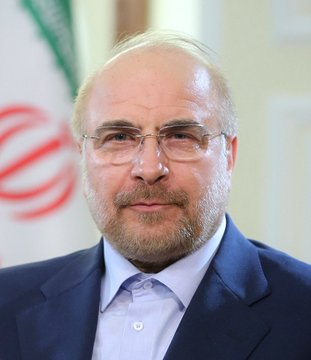
In a definitive statement that throws the future of high-stakes peace talks into serious doubt, Iranian Parliament Speaker Mohammad Bagher Ghalibaf has announced that negotiations with the United States will not commence until two key conditions are met: a full ceasefire in Lebanon and the unfreezing of Iran’s blocked assets. The declaration, made just as US and Iranian delegations were reportedly preparing to meet in Islamabad, represents a significant hardening of Tehran’s position .
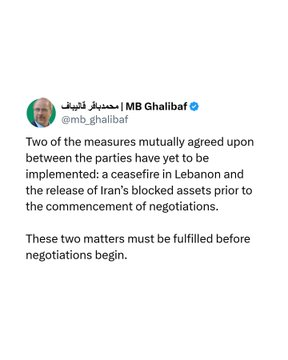
Ghalibaf, who was expected to lead Iran’s delegation to the talks, made clear that “these two matters must be fulfilled before negotiations begin” . The statement effectively puts the entire diplomatic process on hold pending action from Washington — action that the United States has so far been unwilling to take .
‘These Two Matters Must Be Fulfilled First’
Ghalibaf’s statement, carried by Iranian state media and widely reported by international news agencies, left no room for ambiguity regarding Iran’s position.
“Negotiations with the US will not begin until there is a ceasefire in Lebanon and Iran’s assets are unfrozen. These two matters must be fulfilled before negotiations begin.” — Mohammad Bagher Ghalibaf, Iranian Parliament Speaker
The parliament speaker also accused the United States of violating parts of Iran’s 10-point proposal even before the talks had officially begun. Ghalibaf cited specific issues including “the continued fighting in Lebanon, a drone incident over Fars province, and disputes over uranium enrichment rights” as evidence of what Iran describes as a pattern of “deep historical distrust” .
The 10-point proposal, presented by Iran to the United States through Pakistani mediators, reportedly includes as its first point the “cessation of aggression on all fronts, including against the Islamic Resistance of Lebanon (Hezbollah)” .
Condition 1: Ceasefire in Lebanon
The demand for a ceasefire in Lebanon directly challenges the positions of both the United States and Israel, who have insisted that the two-week ceasefire agreement announced on April 7 does not apply to Lebanese territory .
Competing Positions:
| Party | Position on Lebanon |
|---|---|
| Iran | Ceasefire must include Lebanon; no negotiations without it |
| Pakistan (Mediator) | Ceasefire applies “everywhere, including Lebanon” |
| United States | Lebanon NOT included; “separate skirmish” |
| Israel | Ceasefire “does not include Lebanon”; Hezbollah not covered |
Since the ceasefire took effect, Israeli forces have continued extensive military operations against Hezbollah targets across Lebanon. According to the Lebanese Health Ministry, Israeli strikes have killed at least 1,888 people and wounded 6,092 since the conflict began on March 2 . More than 300 people were killed in a single 24-hour period earlier this week in what was described as the deadliest day in Lebanon since the war began .
Hezbollah has responded with its own attacks, including a precision-guided missile strike on an Israeli naval base in Ashdod — one of the deepest attacks attempted by the group .
For Iran, the demand for a Lebanese ceasefire is not merely a matter of solidarity with Hezbollah. Hezbollah is Iran’s most powerful regional proxy and a core component of Tehran’s “Axis of Resistance.” Allowing its key ally to be attacked while broader US-Iran negotiations proceed would, from Tehran’s perspective, signal weakness and undermine Iran’s credibility with its network of regional partners .
Condition 2: Unfreezing Iranian Assets
The second condition — the unfreezing of Iran’s assets — is a longstanding demand that predates the current conflict. Billions of dollars in Iranian assets remain frozen in banks across South Korea, Iraq, China, and other countries as a result of US sanctions .
A senior Iranian source told TASS earlier this week that “the unfreezing of Iran’s blocked assets is a critical executive guarantee that must be realized within this two-week timeframe” . The source warned that if this condition was not met, Iran was “fully prepared to resume combat against the US and the Zionist regime — just as we have over the past 40 days, and with even greater intensity” .
Historically, asset releases have been a key component of US-Iran prisoner swaps and nuclear agreements. In a 2023 deal brokered by Qatar, the Biden administration agreed to unfreeze $6 billion in Iranian funds held in South Korea in exchange for the release of five American prisoners . Those funds were placed in restricted accounts in Doha and intended only for humanitarian goods.
In the current context, billions more in Iranian assets remain frozen. Their release would provide Tehran with significant financial relief after weeks of war and years of sanctions pressure — but would also be politically difficult for the Trump administration, which has built its Iran policy around “maximum pressure.”
The Islamabad Talks: Status Now Uncertain
Ghalibaf’s statement throws into question the status of the scheduled peace talks in Islamabad, where US and Iranian delegations were expected to meet for direct negotiations .
| Delegation | Expected Representatives |
|---|---|
| United States | Vice President JD Vance, Jared Kushner, Steve Witkoff |
| Iran | Parliament Speaker Mohammad Bagher Ghalibaf, Foreign Minister Abbas Araghchi |
| Mediator | Pakistan (Prime Minister Shehbaz Sharif) |
A source told Iran’s semi-official Fars News Agency on Thursday that “claims by some media outlets that an Iranian negotiating delegation has arrived in Islamabad… to hold talks with US officials are completely false. Negotiations remain suspended until the US upholds its commitments regarding the ceasefire in Lebanon and the Israeli regime stops its attacks” .
Ghalibaf himself cast further doubt on the talks, stating: “In such a situation, a bilateral ceasefire or negotiations is unreasonable” .
However, Iran’s ambassador to Pakistan, Reza Amiri Moghadam, sought to steady nerves, stating that despite public skepticism, a delegation would arrive for “serious talks” . The conflicting signals from Iranian officials reflect the intense internal debate in Tehran over how to approach the diplomatic process .
US Response: ‘We’ll See What They Say’
The Trump administration has not yet issued a formal response to Ghalibaf’s conditions. However, Vice President JD Vance, who departed for Islamabad on Friday, has made clear that the United States will not be “receptive” if the Iranians try to “play us” .
“If the Iranians are willing to negotiate in good faith, we’re certainly willing to extend the open hand. If they’re going to try to play us, then they’re going to find that the negotiating team is not that receptive.” — Vice President JD Vance
President Trump has also signaled that patience is limited. In a phone interview with the New York Post, Trump stated that US warships are being reloaded with “the best ammunition, the best weapons ever made” and warned that “if we don’t have a deal, we will be using them, and we will be using them very effectively” .
The president told the New York Post that “we’re going to find out in about 24 hours” whether negotiations would be successful .
The Nuclear Dispute: Enrichment Rights Remain Contentious
Beyond the two conditions Ghalibaf explicitly named, Iran and the United States remain far apart on the issue of uranium enrichment. Trump has claimed that Iran has agreed to stop enriching uranium — “everything’s gone” — while Iranian officials have publicly insisted that the country is allowed to continue enrichment under the terms of any agreement .
Trump acknowledged this discrepancy in his interview, stating: “To our face, they’re getting rid of all nuclear weapons, everything’s gone. And then they go out to the press and say, ‘No, we’d like to enrich.’ So we’ll find out” .
This fundamental disagreement over enrichment rights represents one of the most significant obstacles to any permanent agreement — and would likely need to be resolved even if the immediate conditions of a Lebanon ceasefire and asset release were met .
The Lebanon Factor: Why Iran Won’t Back Down
Iran’s insistence on a Lebanese ceasefire is rooted in strategic necessity. Hezbollah is not merely a proxy but a core component of Iran’s national security architecture .
Hezbollah’s Strategic Importance to Iran:
| Function | Description |
|---|---|
| Forward Defense | Hezbollah’s rocket arsenal deters Israeli strikes on Iran’s nuclear program |
| Regional Power Projection | The group extends Iranian influence to the Mediterranean coast |
| Asymmetric Capability | Hezbollah allows Iran to confront Israel without direct conventional war |
| Axis of Resistance Anchor | Hezbollah is the most powerful member of Iran’s regional network |
Abandoning Hezbollah — or allowing it to be destroyed while broader US-Iran negotiations proceed — would collapse Iran’s entire regional deterrence strategy. For Tehran, a ceasefire in Lebanon is not a negotiating chip but a non-negotiable strategic necessity .
A high-ranking Iranian security source told Press TV that Tehran made the cessation of Israeli attacks on Lebanon a “firm precondition” for its participation in the ceasefire negotiations with the United States .
“The unity of the resistance front was non-negotiable for Iran. Through persistent insistence and a credible threat to walk out of the talks, Iran forced the United States to compel the Zionist regime to halt its strikes on Beirut.” — High-ranking Iranian security source
The source added that the continuation of negotiations remains contingent on Israel refraining from further attacks on Beirut and its southern suburb of Dahieh, a Hezbollah stronghold. “Should the brutal regime violate this understanding and resume bombing Beirut, the negotiations will be terminated immediately,” the source warned .
The Asset Freeze: A Decades-Old Dispute
The demand for unfreezing Iranian assets is equally complex. The assets in question — billions of dollars held in foreign banks — have been frozen under US sanctions that date back decades .
Key Frozen Asset Holdings:
| Country | Estimated Amount | Status |
|---|---|---|
| South Korea | ~$6-8 billion | Frozen since 2018 sanctions reimposition |
| Iraq | ~$3-5 billion | Held in restricted accounts |
| China | Undisclosed | Subject to secondary sanctions |
| India | ~$1-2 billion | Limited access for humanitarian goods |
The 2023 prisoner swap demonstrated that asset releases are possible even in the absence of a broader diplomatic breakthrough. However, that deal was widely criticized by Republicans, including Trump, who argued that it effectively gave Iran access to billions of dollars .
For the Trump administration, agreeing to unfreeze Iranian assets would require overcoming significant political opposition — and would likely need to be paired with other concessions from Tehran, including on the nuclear file .
The 24-Hour Window: What Comes Next
President Trump has indicated that a resolution regarding the talks’ success or failure could come very quickly. “We’re going to find out in about 24 hours,” Trump told the New York Post .
As that window narrows, several scenarios are possible:
Scenario 1: Conditional Negotiations Proceed
If the United States can deliver progress on a Lebanese ceasefire — possibly by pressing Israel to scale back its operations — and signal willingness to discuss asset unfreezing, Iran may agree to proceed with negotiations despite its public conditions .
Scenario 2: Iran Boycotts the Talks
If Israeli strikes on Lebanon continue and the US shows no movement on assets, Iran could follow through on its threat to boycott the Islamabad talks entirely. This would effectively collapse the two-week ceasefire and likely trigger a return to full-scale war .
Scenario 3: Parallel Tracks
The US and Iran could agree to separate, parallel negotiations — one track focused on Lebanon and assets, another on the nuclear program and broader peace agreement. This would allow the Islamabad talks to proceed while the underlying disputes are addressed through separate channels .
Scenario 4: US Concessions
Facing the collapse of the ceasefire, the Trump administration could agree to pressure Israel to scale back its Lebanon operations and offer a pathway to asset unfreezing — likely in exchange for significant Iranian concessions on uranium enrichment and the Strait of Hormuz .
Conclusion: A Diplomatic Impasse
Iranian Parliament Speaker Ghalibaf’s statement that negotiations with the United States will not begin until there is a ceasefire in Lebanon and Iran’s assets are unfrozen represents the most serious obstacle yet to the diplomatic process. By setting these conditions — and insisting they be met before talks commence — Iran has raised the bar for engagement significantly.
The United States faces difficult choices. Pressuring Israel to halt its Lebanon operations would strain the US-Israel alliance but might preserve the broader ceasefire. Offering a pathway to asset unfreezing would require overcoming domestic political opposition but could unlock negotiations on the nuclear file.
As President Trump’s 24-hour window for an answer ticks down, the world watches to see whether diplomacy can bridge this gap — or whether Ghalibaf’s conditions will become the epitaph for a peace that never was.
Frequently Asked Questions (FAQs)
1. What conditions did Iran set for beginning negotiations with the US?
Iranian Parliament Speaker Mohammad Bagher Ghalibaf stated that negotiations will not begin until two conditions are met: a full ceasefire in Lebanon and the unfreezing of Iran’s blocked assets .
2. Does Iran consider Lebanon part of the current ceasefire agreement?
Yes. Iran maintains that the two-week US-Iran ceasefire, brokered by Pakistan, includes Lebanon. This position directly contradicts the United States and Israel, who have stated that Lebanon is not covered by the truce .
3. How much money is frozen in Iranian assets?
Billions of dollars in Iranian assets remain frozen in banks across South Korea, Iraq, China, and other countries as a result of US sanctions. Estimates range from $6-8 billion in South Korea alone, with additional billions held elsewhere .
4. Have the Islamabad talks been canceled?
The status of the talks is uncertain. Ghalibaf’s statement suggests Iran may boycott, but Iran’s ambassador to Pakistan has indicated a delegation will arrive for “serious talks.” The coming hours will be critical .
5. Who is leading the US and Iranian delegations?
The US delegation is led by Vice President JD Vance, accompanied by Jared Kushner and Steve Witkoff. The Iranian delegation is expected to be led by Parliament Speaker Mohammad Bagher Ghalibaf and Foreign Minister Abbas Araghchi .
6. What has been the human toll of the Lebanon conflict?
According to the Lebanese Health Ministry, Israeli strikes have killed 1,888 people and wounded 6,092 since the conflict began on March 2. Over 300 people were killed in a single 24-hour period earlier this week .
7. What has President Trump said about potential military action?
Trump has stated that US warships are being reloaded with “the best ammunition” and warned that “if we don’t have a deal, we will be using them, and we will be using them very effectively” .
8. Is Iran willing to compromise on uranium enrichment?
Iranian officials have publicly insisted that the country is allowed to continue enrichment under the terms of any agreement. This directly contradicts Trump’s claim that Iran has agreed to stop enriching uranium .
Stay informed with Reflecto News – Your trusted source for breaking diplomatic and geopolitical intelligence. Subscribe for real-time updates on the Iran-US negotiations, the Lebanon ceasefire crisis, and regional security developments.
Questions people ask
What is China's current share of global manufacturing?
China now accounts for twenty eight percent of global manufacturing. This industrial output exceeds the combined manufacturing production of the United States, Japan, and Germany, making China the leading global industrial power according to recent reports.
Why were Andrew Tate and Tristan Tate arrested in Miami?
Andrew Tate and his brother Tristan Tate were taken into custody in Miami by the United States Marshals Service. They face thirty eight new charges in the United Kingdom, including rape and child pornography offences, and prosecutors are seeking their extradition.
What warning did Moscow issue about oil prices?
Kirill Dmitriev, the Chief Executive of the Russian Direct Investment Fund, warned that a tsunami of skyrocketing oil prices is approaching. Moscow describes this potential energy shock as a major threat to global markets.
What political shift is projected for Benjamin Netanyahu's coalition?
Political polls project that Prime Minister Benjamin Netanyahu's coalition is on track to lose its majority in the upcoming October election. This projection indicates a potential political shift in Jerusalem.
Why did a Russian military aircraft land in Tehran?
A Russian airborne command aircraft, widely known as a doomsday plane, landed in Tehran. The arrival of the aircraft represents a high stakes show of support from Russia for Iran during a period of heightened regional tensions.
What did President Masoud Pezeshkian claim about the United States and Israel?
Iranian President Masoud Pezeshkian claimed that the United States and Israel failed in a forty eight hour plan to topple the Iranian government. He made these statements during a televised address marking two years since his inauguration.