Reflecto News is an online news platform covering major international political events, global economic developments, and security conflicts. The site provides updates on topics such as Chinese manufacturing dominance, Middle Eastern political tensions, and high profile legal arrests. Readers can access current articles organized by categories like World News, Iran, and USA.
Published on Reflecto News | World News | Middle East Conflict
In a dramatic escalation of military operations despite a fragile US-Iran ceasefire, the Israel Defense Forces (IDF) have issued an urgent evacuation warning for residents of multiple neighborhoods in Beirut’s southern suburbs, including areas adjacent to Rafic Hariri International Airport—Lebanon’s only civilian airport. The warning signals an imminent wave of airstrikes targeting what the IDF describes as Hezbollah military infrastructure embedded within the densely populated Dahiyeh district.
The evacuation order, issued by IDF Arabic-language spokesperson Avichay Adraee, covers a wide swathe of the Lebanese capital’s southern belt, an area that has served as a stronghold for the Iran-backed Hezbollah movement for decades. Hundreds of thousands of residents have already been displaced from the area following repeated Israeli warnings since the conflict escalated .
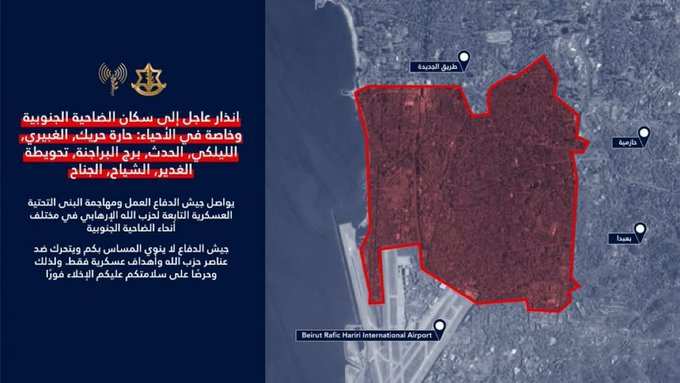
The Evacuation Order: Neighborhoods and Airport Proximity
The IDF issued the “urgent warning” via social media platform X, calling on residents to leave their homes immediately . The affected neighborhoods include:
| Neighborhood | Proximity to Airport |
|---|---|
| Haret Hreik | Adjacent to airport road |
| Hadath | Southern suburb, near airport |
| Lailaki (Laylaki) | Close to airport perimeter |
| Ghobeiry | Near airport access routes |
| Burj al-Barajneh | Refugee camp area, near airport |
| Jnah (Jná) | Coastal suburb, south of airport |
| Chiyah | Central southern suburb |
| Tahuitet el Ghadir (Tahwitat al-Ghadir) | Directly adjacent to Rafic Hariri International Airport |
The inclusion of Tahuitet el Ghadir is particularly significant, as this neighborhood lies immediately adjacent to the airport grounds . The evacuation order raises serious concerns about potential strikes near critical civilian infrastructure that serves as Lebanon’s primary international gateway.
IDF Statement: ‘No Intention to Harm Civilians’
In his statement, Adraee sought to justify the evacuation order as a precautionary measure. “The IDF continues to operate and strike at military infrastructure belonging to the terrorist organization Hezbollah in various parts of the southern suburb,” he wrote .
“The IDF has no intention of harming you; therefore, for your own safety, you must evacuate immediately,” Adraee added, reiterating language used in previous evacuation orders throughout the conflict .
This represents at least the third time the IDF has issued evacuation warnings for Beirut’s southern suburbs since the US-Iran ceasefire was announced on April 8 . Despite the warnings, several recent strikes have hit densely packed commercial and residential areas without prior notice during rush hour, leading to widespread civilian casualties .
The Ceasefire Dispute: Lebanon Excluded?
The evacuation order comes amid a deepening diplomatic dispute over the scope of the two-week ceasefire agreement between the United States and Iran, brokered by Pakistan. While Pakistani mediators and Iranian officials maintain that the ceasefire includes Lebanon, both Washington and Jerusalem have explicitly rejected this interpretation .
Israeli Prime Minister Benjamin Netanyahu has been unambiguous: the ceasefire “does not include Lebanon.” The Israeli government has made clear that its military campaign against Hezbollah will continue unabated .
This position has drawn sharp condemnation from Tehran. Iranian President Masoud Pezeshkian warned that Israel’s strikes on Lebanon constitute a “blatant violation” of the ceasefire agreement and that their continuation would “render negotiations meaningless” .
“Israel’s renewed incursion into Lebanon is a blatant violation of the initial ceasefire agreement. This is a dangerous sign of deception and lack of commitment to potential agreements. The continuation of these actions will render negotiations meaningless. Our fingers remain on the trigger. Iran will never abandon its Lebanese sisters and brothers.” — Iranian President Masoud Pezeshkian
Prior Warnings: Airport as a Potential Target
The evacuation order near Rafic Hariri International Airport follows warnings issued weeks before the current conflict escalated. In late February, Lebanese Foreign Minister Youssef Raggi disclosed that Lebanon had received indications from Israeli officials that the country’s only civilian airport could be targeted if Hezbollah became involved in a US-Iran confrontation .
“Lebanon has received signs that the Israelis could strike civilian infrastructure and maybe the [Beirut] airport,” Raggi said at the time . The Lebanese government had urged Hezbollah to desist from actions that could expose civilians and critical infrastructure to further danger .
Those warnings now appear prescient, as the IDF’s evacuation order explicitly includes neighborhoods surrounding the airport, suggesting that strikes in the area are imminent.
The Human Toll: Recent Strikes and Casualties
The evacuation order follows one of the deadliest waves of Israeli airstrikes since the conflict with Hezbollah reignited on March 2. According to Lebanese authorities:
- 254 people killed and 1,165 wounded in Israeli strikes on Wednesday alone
- 1,739 total deaths and 5,873 wounded since March 2
- Over 1 million Lebanese displaced from the south and southern Beirut suburbs
Lebanese Prime Minister Nawaf Salam declared a national day of mourning following the strikes, ordering the closure of public administrations and the lowering of flags “for the martyrs and wounded of the Israeli attacks that targeted hundreds of innocent, defenseless civilians” .
The Lebanese Red Cross dispatched 100 ambulances to evacuate the dead and transport the wounded to hospitals, but rescue operations have been hampered by traffic jams caused by the “unprecedented wave of strikes, in both number and intensity” .
Medical Crisis: Hospitals Overwhelmed
The Rafic Hariri University Hospital—located in the very area now under evacuation orders—has been overwhelmed by the influx of casualties. Doctors Without Borders (MSF) reported that its teams were responding to a mass influx of injured patients, including children .
“Patients are arriving with shrapnel injuries and heavy bleeding. One patient arrived to the hospital having lost both legs. The situation is chaotic as more people are brought in,” said Christopher Stokes, MSF’s emergency coordinator in Lebanon .
The medical charity accused Israel of “continuous attacks on civilians,” stating: “These indiscriminate strikes on highly densely populated areas are completely unacceptable. The repeated forcible displacement of people — a war crime — needs to stop” .
International Reactions: Calls for Restraint
The evacuation order and ongoing strikes have drawn sharp international reactions.
United Nations: UN Human Rights Chief Volker Turk described “the scale of the killing and destruction in Lebanon today” as “nothing short of horrific,” adding that “such carnage, within hours of agreeing to a ceasefire with Iran, defies belief” .
Germany: Chancellor Friedrich Merz warned that Israeli attacks on Lebanon could “derail the entire peace process and that must not be allowed to happen” .
Pakistan: Prime Minister Shehbaz Sharif, who brokered the US-Iran ceasefire, condemned Israel’s “ongoing aggression against Lebanon” ahead of scheduled talks in Islamabad .
Lebanon: Prime Minister Nawaf Salam contacted his Pakistani counterpart to “confirm that the ceasefire includes Lebanon to prevent a recurrence of the Israeli attacks witnessed yesterday” .
Iran: Parliament Speaker Mohammad Bagher Ghalibaf insisted that Lebanon forms “an inseparable part of the ceasefire” deal, warning that “ceasefire violations carry explicit costs and STRONG responses” .
Hezbollah’s Position: Holding Fire?
According to Lebanese sources close to Hezbollah, the group has temporarily halted its attacks against northern Israel and on Israeli troops, awaiting clarification on the ceasefire’s scope . However, the group has warned that continued Israeli strikes will prompt a resumption of its retaliatory fire.
Hezbollah is expected to issue a formal statement outlining its position on the US-Iran ceasefire and on Israel’s assertion that Lebanon is excluded from the agreement .
What Happens Next?
The evacuation order for southern Beirut suburbs signals that significant Israeli airstrikes are imminent. The inclusion of areas adjacent to Rafic Hariri International Airport raises the stakes considerably, as any damage to Lebanon’s only civilian airport would have catastrophic consequences for the country’s already devastated infrastructure and for the hundreds of thousands of people seeking to flee the violence.
Key developments to watch:
| Factor | What to Expect |
|---|---|
| Imminent Strikes | IDF expected to hit multiple targets in evacuated areas |
| Ceasefire Negotiations | US-Iran talks in Islamabad on April 10 |
| Hezbollah Response | Potential resumption of rocket attacks if strikes continue |
| Humanitarian Situation | Further displacement and medical system strain |
| Airport Status | Risk of strikes near or on civilian aviation infrastructure |
Conclusion: A Dangerous Precedent
The IDF’s urgent evacuation order for southern Beirut suburbs—including areas adjacent to Lebanon’s only international airport—represents a significant escalation in the conflict. Coming just one day after a US-Iran ceasefire was announced, it underscores the fragility of diplomatic agreements and the limits of their scope.
For the hundreds of thousands of residents of Beirut’s southern suburbs, the evacuation order brings yet another wave of displacement and fear. Many who had begun to hope for a return to their homes now face the prospect of further destruction.
As Iranian President Pezeshkian warned, “Our fingers remain on the trigger” . The coming days will reveal whether diplomatic channels can contain the conflict or whether Lebanon will be pulled deeper into a war that has already claimed thousands of lives.
Frequently Asked Questions (FAQs)
1. Which neighborhoods in Beirut have been ordered to evacuate?
The IDF ordered the evacuation of Haret Hreik, Hadath, Lailaki, Ghobeiry, Burj al-Barajneh, Jnah, Chiyah, and Tahuitet el Ghadir—the latter being directly adjacent to Rafic Hariri International Airport .
2. Why is the IDF targeting southern Beirut?
The IDF states it is targeting Hezbollah military infrastructure embedded within the southern suburbs, which have served as the group’s stronghold for decades. Israel maintains that Hezbollah operates from behind civilian cover .
3. Does the US-Iran ceasefire apply to Lebanon?
This is a major point of dispute. While Pakistan and Iran maintain that the ceasefire includes Lebanon, the United States and Israel have explicitly denied this interpretation. Israeli Prime Minister Netanyahu has stated that the “ceasefire does not include Lebanon” .
4. How many people have been killed in Lebanon since March 2?
According to the Lebanese Health Ministry, at least 1,739 people have been killed and 5,873 wounded since March 2. More than 254 people were killed on Wednesday alone .
5. Is Rafic Hariri International Airport at risk of being struck?
The evacuation order includes Tahuitet el Ghadir, a neighborhood adjacent to the airport. Prior to the conflict, Lebanese officials received warnings that Israel could target the airport if Hezbollah joined the war. This raises significant concerns about potential strikes near civilian aviation infrastructure .
6. What has been the humanitarian impact?
Over 1 million Lebanese have been displaced. Hospitals are overwhelmed, with medical charities reporting patients arriving with shrapnel injuries and heavy bleeding. The Lebanese Red Cross has deployed 100 ambulances, but rescue operations are hampered by traffic jams and ongoing strikes .
7. How has Hezbollah responded?
According to Lebanese sources, Hezbollah has temporarily halted its attacks against northern Israel, awaiting clarification on the ceasefire’s scope. However, the group has warned that continued Israeli strikes will prompt retaliation .
8. What is the international response?
The UN Human Rights Chief described the scale of killing as “nothing short of horrific.” Germany warned that Israeli attacks could “derail the entire peace process.” Pakistan condemned Israel’s “ongoing aggression.” Iran has warned that continuation of strikes will “render negotiations meaningless” .
Stay informed with Reflecto News – Your trusted source for breaking conflict and humanitarian intelligence. Subscribe for real-time updates on this developing story.
Questions people ask
What is China's current share of global manufacturing?
China now accounts for twenty eight percent of global manufacturing. This industrial output exceeds the combined manufacturing production of the United States, Japan, and Germany, making China the leading global industrial power according to recent reports.
Why were Andrew Tate and Tristan Tate arrested in Miami?
Andrew Tate and his brother Tristan Tate were taken into custody in Miami by the United States Marshals Service. They face thirty eight new charges in the United Kingdom, including rape and child pornography offences, and prosecutors are seeking their extradition.
What warning did Moscow issue about oil prices?
Kirill Dmitriev, the Chief Executive of the Russian Direct Investment Fund, warned that a tsunami of skyrocketing oil prices is approaching. Moscow describes this potential energy shock as a major threat to global markets.
What political shift is projected for Benjamin Netanyahu's coalition?
Political polls project that Prime Minister Benjamin Netanyahu's coalition is on track to lose its majority in the upcoming October election. This projection indicates a potential political shift in Jerusalem.
Why did a Russian military aircraft land in Tehran?
A Russian airborne command aircraft, widely known as a doomsday plane, landed in Tehran. The arrival of the aircraft represents a high stakes show of support from Russia for Iran during a period of heightened regional tensions.
What did President Masoud Pezeshkian claim about the United States and Israel?
Iranian President Masoud Pezeshkian claimed that the United States and Israel failed in a forty eight hour plan to topple the Iranian government. He made these statements during a televised address marking two years since his inauguration.