
Reflecto News is an online news platform covering major international political events, global economic developments, and security conflicts. The site provides updates on topics such as Chinese manufacturing dominance, Middle Eastern political tensions, and high profile legal arrests. Readers can access current articles organized by categories like World News, Iran, and USA.
Published on Reflecto News | World News | Middle East Conflict
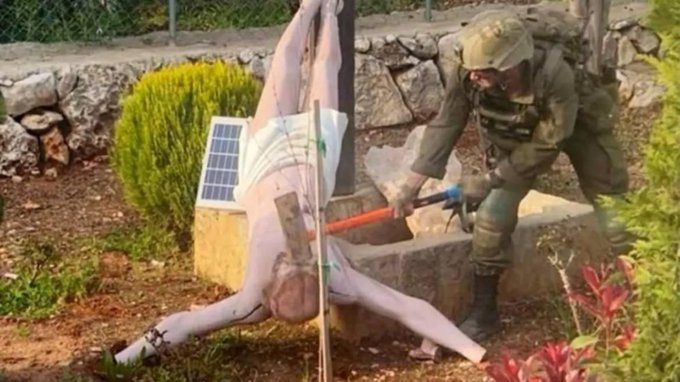
Two Israeli soldiers have been sentenced to 30 days of military detention and removed from combat duty after one was filmed smashing a statue of Jesus Christ with a sledgehammer in southern Lebanon, the Israel Defense Forces (IDF) announced on Tuesday . The incident, which occurred in the Christian village of Debel, drew swift condemnation from Israeli leaders, the Vatican, and Christian communities worldwide.
The IDF investigation found that in addition to the two soldiers directly involved—one who damaged the statue and another who photographed the act—six other troops were present at the scene and failed to intervene or report the incident . Those six soldiers have been summoned for “clarification discussions,” after which further disciplinary measures may be taken .
Incident Draws Rare Swift Military Justice
The statue, which stood on a crucifix outside a family home on the edge of Debel, was destroyed by a soldier using a sledgehammer while another recorded the act . The footage and images circulated widely on social media, prompting an immediate IDF investigation and public condemnation from Israel’s highest political and military leadership.
IDF Chief of Staff Lt. Gen. Eyal Zamir condemned the act as “unacceptable conduct and a moral failure, far exceeding any acceptable standard and contradicting IDF values and the expected conduct of its troops” . The military stated that the soldiers’ conduct “completely deviated from IDF orders and values” .
This swift and relatively harsh punishment stands in contrast to past instances of alleged misconduct. According to rights groups, this type of disciplinary action is “relatively rare” in the Israeli military . A 2025 report by the conflict-monitoring group Action on Armed Violence found that Israel had closed down or left unresolved 88% of cases of alleged misconduct in Gaza and the West Bank .
Israeli Leadership Responds
Prime Minister Benjamin Netanyahu said he was “stunned and saddened” to learn of the incident, vowing “harsh disciplinary action against the offender” . Foreign Minister Gideon Sa’ar labeled the act “grave and disgraceful” and issued an apology “to every Christian whose feelings were hurt” .
The IDF has since replaced the damaged statue, stating that troops went to Debel “in full coordination with the local community” to erect a new crucifix . The military said the Northern Command worked to coordinate the replacement “from the moment it received the report of the incident” .
Regional and Religious Condemnation
The desecration drew sharp condemnation from Christian leaders across the region and internationally. The Latin Patriarch of Jerusalem, Cardinal Pierbattista Pizzaballa, voiced “deep indignation” and “unreserved condemnation” for the act, calling it a “grave affront to the Christian faith” .
The Assembly of Catholic Ordinaries of the Holy Land noted that the incident was part of “other reported incidents of desecration of Christian symbols” in the region .
Archbishop Vincenzo Paglia, speaking to Italian broadcaster La7, offered a pointed historical reminder: “I would like to point out to Benjamin Netanyahu that Jesus himself went to Tyre and Sidon, in southern Lebanon. But he did not go there to kill; he went to multiply bread, to heal, to perform miracles – not to destroy” .
Broader Context
The incident occurred in Debel, one of the few villages in southern Lebanon where residents remained despite Israel’s military campaign against Hezbollah, which began on March 2 . The village belongs to Lebanon’s Maronite Christian community—Christians are estimated to make up around one-third of Lebanon’s population of roughly 5.5 million people .
The IDF has emphasized that its operations in Lebanon are “directed solely against the Hezbollah terrorist organization and other terrorist groups, and not against Lebanese civilians” . The military also stated that “procedures regarding conduct with religious institutions and symbols were reinforced to troops prior to their entry into the relevant areas, and will be reinforced again for all forces in the area following the incident” .
Frequently Asked Questions (FAQs)
1. What punishment did the Israeli soldiers receive?
The soldier who smashed the statue and the soldier who photographed the act were sentenced to 30 days of military detention and removed from combat duty .
2. Were other soldiers involved?
Yes. Six other soldiers were present at the scene and did not act to stop the incident or report it. They have been summoned for “clarification discussions” and may face additional measures .
3. Where did this incident take place?
The incident occurred in the Christian village of Debel in southern Lebanon, near the border with Israel .
4. Has the statue been replaced?
Yes. The IDF has replaced the damaged statue with a new crucifix, stating that troops acted “in full coordination with the local community” .
5. How did Israeli leaders respond?
Prime Minister Benjamin Netanyahu said he was “stunned and saddened” and vowed “harsh disciplinary action.” Foreign Minister Gideon Sa’ar issued an apology to Christians whose feelings were hurt .
6. How did Christian leaders react?
The Latin Patriarch of Jerusalem voiced “deep indignation” and “unreserved condemnation,” calling the act a “grave affront to the Christian faith” .
7. Is this type of punishment common in the Israeli military?
No. Rights groups say this type of swift and relatively harsh punishment is “relatively rare” in the Israeli military .
Stay informed with Reflecto News – Your trusted source for breaking conflict and diplomatic intelligence. Subscribe for real-time updates on the Israel-Lebanon front, regional security developments, and international reactions.
Questions people ask
What is China's current share of global manufacturing?
China now accounts for twenty eight percent of global manufacturing. This industrial output exceeds the combined manufacturing production of the United States, Japan, and Germany, making China the leading global industrial power according to recent reports.
Why were Andrew Tate and Tristan Tate arrested in Miami?
Andrew Tate and his brother Tristan Tate were taken into custody in Miami by the United States Marshals Service. They face thirty eight new charges in the United Kingdom, including rape and child pornography offences, and prosecutors are seeking their extradition.
What warning did Moscow issue about oil prices?
Kirill Dmitriev, the Chief Executive of the Russian Direct Investment Fund, warned that a tsunami of skyrocketing oil prices is approaching. Moscow describes this potential energy shock as a major threat to global markets.
What political shift is projected for Benjamin Netanyahu's coalition?
Political polls project that Prime Minister Benjamin Netanyahu's coalition is on track to lose its majority in the upcoming October election. This projection indicates a potential political shift in Jerusalem.
Why did a Russian military aircraft land in Tehran?
A Russian airborne command aircraft, widely known as a doomsday plane, landed in Tehran. The arrival of the aircraft represents a high stakes show of support from Russia for Iran during a period of heightened regional tensions.
What did President Masoud Pezeshkian claim about the United States and Israel?
Iranian President Masoud Pezeshkian claimed that the United States and Israel failed in a forty eight hour plan to topple the Iranian government. He made these statements during a televised address marking two years since his inauguration.