Reflecto News is an online news platform covering major international political events, global economic developments, and security conflicts. The site provides updates on topics such as Chinese manufacturing dominance, Middle Eastern political tensions, and high profile legal arrests. Readers can access current articles organized by categories like World News, Iran, and USA.
Published on Reflecto News | World News | Digital Rights & Geopolitics
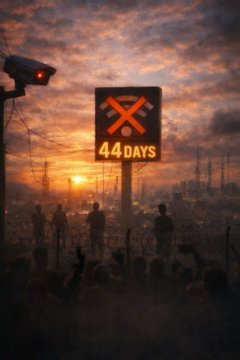
Iran’s nationwide internet blackout has entered its 44th day, setting a grim global record for the longest sustained disruption of connectivity in a sovereign state. According to data from NetBlocks, an internet observatory that tracks international cybersecurity and digital governance, the ongoing shutdown has surpassed all previous benchmarks for nationwide connectivity interference .
The blackout, which began on February 28 — the same day US and Israeli forces launched extensive airstrikes against Iran — has now exceeded 1,032 hours of sustained disruption . The previous record for a nationwide shutdown was held by Egypt during the Arab Spring in January 2011, which lasted just five days .
‘Unprecedented in a Connected Society’
NetBlocks, which has been monitoring the situation throughout the conflict, described the blackout as unprecedented in modern history.
“The human and economic impacts of the extended censorship measure continue to pile up, breaking global records for shutdowns in a connected society.” — NetBlocks
The watchdog group’s data shows network connectivity in Iran dropping from near-normal levels to approximately 1 percent in early March, where it has remained through mid-April . Most Iranian users are limited to the National Information Network, an Islamic Revolutionary Guard Corps (IRGC)-backed domestic infrastructure that hosts local content and services while blocking access to the global internet .
The Human and Economic Toll
The prolonged digital isolation has had severe consequences for Iran’s population and economy.
| Impact Category | Details |
|---|---|
| Digital economy losses | Approximately 200 trillion rials (~$126 million) |
| Broader economic impact | Approximately 2,000 trillion rials (~$1.26 billion) |
| Business disruption | Limited access to global communication platforms |
| Education impact | Students unable to access international resources |
| Healthcare challenges | Restricted access to medical information and telemedicine |
Sources: NetBlocks, preliminary estimates based on Iranian official figures
These figures, based on preliminary estimates using data from Iran’s 12-day war with Israel in 2024, likely understate the full scale of ongoing damage .
Businesses, students, and ordinary citizens have faced significant disruption as essential services and communication channels remain restricted. The blackout has also severely hampered the ability of journalists and human rights monitors to document events inside the country .
Starlink Crackdown and Arrests
During the blackout, some Iranians have attempted to bypass restrictions using Starlink, the satellite-based internet service developed by SpaceX. Starlink devices require a small satellite dish and a router, allowing users to connect without relying on fiber or mobile networks — making the service harder for governments to block or censor .
However, Iranian authorities have criminalized its use, making it punishable by prison time.
“At least 30 individuals have been detained for ‘security-related activities’ linked to the ‘enemy,’ a reference to the US and Israel.” — Iranian authorities
Iran has arrested and detained thousands of people during the war for recording US-Israeli airstrikes, accusing them of espionage and collaboration with hostile foreign powers — charges that can carry the death penalty .
State’s Whitelist Double Standard
While the general public remains restricted to Iran’s domestic National Information Network, the state has whitelisted selected users, allowing them to post on social media and shape narratives reaching the outside world . This double standard has not gone unnoticed inside Iran.
Since the two-week ceasefire took effect on April 8, ordinary Iranians have been quick to point out that the war — used as the justification for the blackout — is now on pause, removing the clerical establishment’s stated pretext for maintaining the shutdown .
Possible Easing of Restrictions?
There are signs that the blackout may soon end. According to Citna, an Iranian media platform that publishes news about information technology and the digital economy, “there is a possibility of lifting restrictions on some international internet services in the coming hours,” following decisions made by relevant authorities .
The report, which has circulated in mainstream Iranian media outlets, has not been officially confirmed. However, its publication suggests that authorities may be preparing the public for an eventual restoration of access.
The potential easing coincides with the announcement of a two-week ceasefire between Washington and Tehran, which has paused direct US-Iran military exchanges even as other fronts remain active .
A Pattern of Digital Suppression
This is not the first time Iran has imposed a nationwide internet blackout. In January, the country was subjected to a weeks-long shutdown during widespread anti-regime protests, reflecting a pattern of digital control during periods of unrest .
| Shutdown Period | Duration | Trigger |
|---|---|---|
| January 2026 | Weeks | Anti-government protests |
| February 28 – Present | 44+ days | US-Israeli airstrikes |
Iran has a long history of restricting internet access, with previous shutdowns during protests in 2019, 2022, and 2024 .
The Geopolitical Context
The blackout coincides with stalled diplomatic efforts between Tehran and Washington. Iranian Parliament Speaker Mohammad Bagher Ghalibaf expressed skepticism over the outcome of recent negotiations in Islamabad, stating that Iran entered the talks with goodwill but “due to the experiences of the two previous wars, we have no trust in the opposing side” .
Reflecting on the outcome, Ghalibaf remarked that “the opposing side ultimately failed to gain the trust of the Iranian delegation in this round of negotiations” .
Iran’s Foreign Ministry spokesperson Esmaeil Baqaei confirmed the engagement with US officials marked the longest round of negotiations over the past year, lasting approximately “twenty-four or twenty-five hours” through a Pakistani mediator . He maintained that “diplomacy never ends” and remains a tool to protect national interests, even in an atmosphere defined by “mistrust, suspicion, and doubt” following 40 days of “imposed war” .
What Comes Next
As the ceasefire holds — for now — and diplomatic efforts continue, the fate of Iran’s internet blackout remains uncertain.
| Scenario | Likelihood | Implications |
|---|---|---|
| Partial lifting of restrictions | Possible | Some international services restored |
| Full restoration of internet | Uncertain | Depends on security situation and political decisions |
| Continued blackout | Possible | Authorities may maintain controls |
| Increased Starlink usage | Likely | More Iranians may seek workarounds |
The blackout has demonstrated the Iranian regime’s ability to maintain digital isolation for an unprecedented duration. Whether the ceasefire will lead to restored connectivity — or whether the blackout will continue as a tool of state control — remains to be seen.
For now, Iran’s 44-day internet blackout stands as the longest nationwide shutdown ever recorded — a record that reflects not just the duration of the conflict but the regime’s determination to control information and suppress dissent.
Frequently Asked Questions (FAQs)
1. How long has Iran’s internet blackout lasted?
The blackout entered its 44th day on April 12, 2026, surpassing 1,032 hours of sustained disruption . This makes it the longest nationwide internet shutdown ever recorded in a sovereign state .
2. What triggered the blackout?
The restrictions were imposed on February 28, the same day US and Israeli forces launched extensive airstrikes against Iran . Authorities have maintained the blackout throughout the six-week conflict.
3. What is the previous record for an internet shutdown?
The previous record was held by Egypt during the Arab Spring in January 2011, which lasted five days .
4. Is the blackout total?
Not entirely. While the general public is restricted to Iran’s domestic National Information Network, the state has whitelisted selected users who can post on social media to shape international narratives .
5. Can Iranians access the internet through other means?
Some Iranians have gained access to Starlink, SpaceX’s satellite-based internet service, which is harder to block. However, authorities have criminalized its use, and at least 30 individuals have been detained for using it .
6. What has been the economic impact?
Preliminary estimates suggest approximately 200 trillion rials (~$126 million) in digital economy losses and around 2,000 trillion rials (~$1.26 billion) in broader economic impact, though these figures likely understate the full scale of damage .
7. Is the blackout expected to end soon?
Iranian media has reported that there is “a possibility of lifting restrictions on some international internet services in the coming hours,” though this has not been officially confirmed .
Stay informed with Reflecto News – Your trusted source for breaking digital rights and geopolitical intelligence. Subscribe for real-time updates on Iran’s internet blackout, the ceasefire, and regional developments.
Questions people ask
What is China's current share of global manufacturing?
China now accounts for twenty eight percent of global manufacturing. This industrial output exceeds the combined manufacturing production of the United States, Japan, and Germany, making China the leading global industrial power according to recent reports.
Why were Andrew Tate and Tristan Tate arrested in Miami?
Andrew Tate and his brother Tristan Tate were taken into custody in Miami by the United States Marshals Service. They face thirty eight new charges in the United Kingdom, including rape and child pornography offences, and prosecutors are seeking their extradition.
What warning did Moscow issue about oil prices?
Kirill Dmitriev, the Chief Executive of the Russian Direct Investment Fund, warned that a tsunami of skyrocketing oil prices is approaching. Moscow describes this potential energy shock as a major threat to global markets.
What political shift is projected for Benjamin Netanyahu's coalition?
Political polls project that Prime Minister Benjamin Netanyahu's coalition is on track to lose its majority in the upcoming October election. This projection indicates a potential political shift in Jerusalem.
Why did a Russian military aircraft land in Tehran?
A Russian airborne command aircraft, widely known as a doomsday plane, landed in Tehran. The arrival of the aircraft represents a high stakes show of support from Russia for Iran during a period of heightened regional tensions.
What did President Masoud Pezeshkian claim about the United States and Israel?
Iranian President Masoud Pezeshkian claimed that the United States and Israel failed in a forty eight hour plan to topple the Iranian government. He made these statements during a televised address marking two years since his inauguration.