Reflecto News is an online news platform covering major international political events, global economic developments, and security conflicts. The site provides updates on topics such as Chinese manufacturing dominance, Middle Eastern political tensions, and high profile legal arrests. Readers can access current articles organized by categories like World News, Iran, and USA.
Araghchi lands aboard symbolic “Minab168” aircraft as bloc remains divided over Iran war; UAE-Iran rift threatens consensus statement
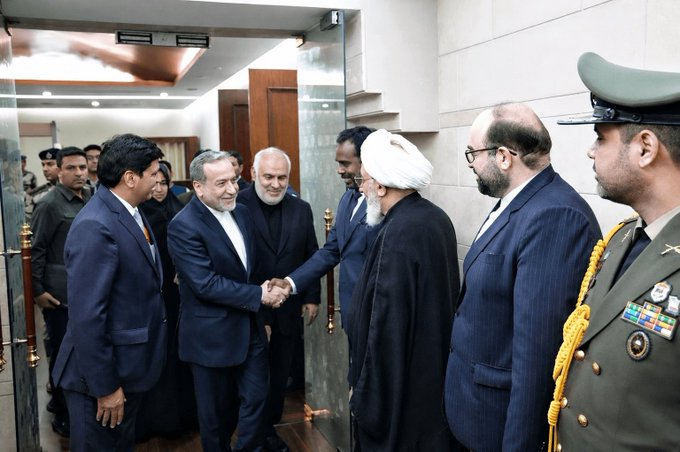
NEW DELHI — Iranian Foreign Minister Abbas Araghchi arrived in the Indian capital on Wednesday for a three-day official visit, marking Tehran’s first high-level diplomatic engagement since the outbreak of the US-Israel war with Iran more than two months ago .
Araghchi is visiting India primarily to attend a two-day meeting of BRICS foreign ministers beginning Thursday, May 14 . The Iranian top diplomat landed aboard an aircraft named “Minab168” — a symbolic reference to the 168 girls who were killed in a missile strike at a school in the southern Iranian city of Minab when the war began .
The visit comes at a critical juncture for the expanded BRICS bloc, which remains sharply divided over the West Asia conflict, with Iran and the United Arab Emirates — both members of the grouping — locked in a diplomatic standoff that has so far prevented a unified statement on the crisis .
Araghchi’s Agenda: Bilateral Talks with Jaishankar
Araghchi is scheduled to hold wide-ranging bilateral talks with his Indian counterpart, External Affairs Minister S. Jaishankar, with the escalating crisis in West Asia and the situation surrounding the Strait of Hormuz expected to feature prominently .
According to people familiar with the matter, the Indian side is likely to press for the safe passage of remaining merchant vessels through the strategic waterway, which handles roughly 20 percent of global oil and liquefied natural gas (LNG) supplies .
The Iranian foreign minister and other foreign ministers of BRICS member states are scheduled to call on Prime Minister Narendra Modi on Thursday .
“A very warm welcome to Foreign Minister of Iran, Seyed Abbas Araghchi, on his arrival in New Delhi for the BRICS Foreign Ministers’ Meeting,” External Affairs Ministry spokesperson Randhir Jaiswal said on ‘X’ .
The Minab168 Symbol: A Powerful Message
Araghchi’s arrival aboard the aircraft named “Minab168” has drawn significant attention. The aircraft’s name has become a powerful symbol inside Iran, where officials frequently invoke the Minab attack as evidence of what they describe as US-Israeli attacks on civilians .
Iranian state media has consistently highlighted the incident, which occurred in the early days of the war, as a rallying point for national sentiment. The symbolic gesture underscores Tehran’s effort to keep international attention on civilian casualties as diplomatic discussions proceed .
BRICS Divisions: UAE-Iran Rift Threatens Consensus
India, as the current chair of BRICS, is hosting the foreign ministers’ conclave ahead of the annual summit of the grouping scheduled for September in New Delhi . However, sharp differences among member states over the US-Israel war on Iran have stalled efforts to build a consensus position on the conflict .
During a meeting of the grouping’s deputy foreign ministers and special envoys on the Middle East last month, no consensus statement could be reached, largely due to differences between the United Arab Emirates and Iran . The two neighboring countries have sparred in recent weeks over Iran’s alleged attacks on energy infrastructure in the UAE .
Iranian Deputy Foreign Minister Kazem Gharibabadi, who is also in New Delhi for the BRICS meeting, explicitly acknowledged the internal divisions while speaking to journalists on Wednesday.
“We want India’s BRICS chairship to be successful. It is not a good approach to send a signal to the world that BRICS is divided,” Gharibabadi said. “One country is insisting on condemning Iran” .
Though he did not name the country directly, his remarks appeared to be aimed at the United Arab Emirates, which, along with Iran, joined BRICS during the bloc’s expansion in 2024 .
Gharibabadi further accused the UAE of enabling attacks on Iran.
“We have not attacked neighbouring countries. They handed over their territories to the US to launch attacks on us,” he said. “We never insisted that Arab countries should be condemned because they allowed their military bases to the United States” .
Araghchi’s Direct Warning to UAE
Araghchi himself signaled that the UAE would be “held to account” for what Iran describes as collusion with Israel. His warning came after Israeli Prime Minister Benjamin Netanyahu’s office disclosed a secret visit to Abu Dhabi during the war .
In a post on ‘X’, Araghchi wrote: “Netanyahu has now publicly revealed what Iran’s security services long ago conveyed to our leadership. Enmity with the Great People of Iran is a foolish gamble. Collusion with Israel in doing so: unforgivable. Those colluding with Israel to sow division will be held to account” .
Araghchi will come face to face with the UAE Minister of State for Foreign Affairs at the BRICS Foreign Ministers summit on Thursday — a meeting that is expected to be tense .
Iran’s Message to India: A Welcome for Peace Initiatives
Despite the internal BRICS tensions, Iranian officials have expressed strong appreciation for India’s role as chair and its approach to the crisis.
Gharibabadi praised India’s stance, describing New Delhi’s approach as “impartial” amid sharp divisions within the grouping .
“India has always supported peace. It is in favour of peace and stability in the region,” he said. “We will welcome whatever initiative India takes for peace” .
The Iranian deputy foreign minister reiterated Tehran’s view of India as a credible and balanced actor capable of contributing to regional stability .
Commitment to Chabahar Port Project
On the bilateral economic front, Gharibabadi reiterated Tehran’s commitment to the Chabahar port project — a strategic Indian investment that provides an alternative trade route to Afghanistan and Central Asia, bypassing Pakistan .
The Iranian official acknowledged that India faces constraints due to continuing US sanctions linked to the initiative but said Tehran would respect whatever decision New Delhi makes regarding the project’s future .
Strait of Hormuz: Safe Passage and New ‘Protocol’
One of the most pressing issues on the bilateral agenda is the status of the Strait of Hormuz, which Iran has effectively blocked to normal commercial transit since the war began .
Gharibabadi disclosed on Wednesday that Iran is working on a new “protocol” to include a financial component covering costs it incurs to make navigation safe in the Persian Gulf region .
“Iran has provided ‘free of charge services’ to international shipping in the Strait of Hormuz for decades,” Gharibabadi told journalists at the Iranian Embassy in New Delhi. However, the new protocol would include a financial component to cover Iran’s costs for ensuring safe navigation .
India is likely to press for clarity on this protocol and for assurances regarding the safe passage of Indian merchant vessels and the estimated 9 million Indian expatriates working in the Gulf region .
Who Else Is Attending the BRICS Meeting?
The BRICS Foreign Ministers’ Meeting, being held at Bharat Mandapam in New Delhi, will see participation from all member states, though with some notable exceptions .
Confirmed Participants Include:
- Russia: Foreign Minister Sergey Lavrov
- South Africa: Minister Ronald Lamola
- Brazil, China, Egypt, Ethiopia, Indonesia, UAE — represented at various levels
- China’s Absence: China’s top diplomat Wang Yi will skip the BRICS gathering because of US President Donald Trump’s ongoing state visit to Beijing, which overlaps with the meeting in New Delhi. Beijing has instead deputed Chinese Ambassador to India Xu Feihong to attend on China’s behalf .
The foreign ministers will have a joint call with Prime Minister Narendra Modi on Thursday afternoon, followed by a dinner hosted by External Affairs Minister S. Jaishankar .
Meeting Agenda: Beyond the West Asia Crisis
While the West Asia conflict is expected to dominate deliberations, the BRICS meeting has a broader agenda under India’s chairship theme: “Building for Resilience, Innovation, Cooperation and Sustainability” .
According to the Ministry of External Affairs, the two-day meeting will include:
- Session 1 (Day 1): Exchange of views on global and regional issues of mutual interest
- Session 2 (Day 1): “BRICS@20: Building for Resilience, Innovation, Cooperation and Sustainability”
- Session 3 (Day 2): Reforms of global governance and the multilateral system
South Africa’s High Commissioner to India, Professor Anil Sooklal, noted that the foreign ministers will also discuss other global hotspots, including the ongoing situation in Sudan, and receive a briefing from Russia on the Russia-Ukraine situation .
The Stakes: Will BRICS Produce a Consensus Statement?
The fundamental question hanging over the New Delhi meeting is whether the foreign ministers can overcome their differences and issue a unified statement on the West Asia conflict.
Last month’s meeting of BRICS deputy foreign ministers failed to produce any consensus, and diplomatic sources suggest that the UAE-Iran rift remains unresolved .
Gharibabadi’s public accusation that “one country is insisting on condemning Iran” suggests that the UAE is pushing for language that Tehran finds unacceptable .
For India, which has maintained what Iranian officials describe as an “impartial” stance, the failure to produce a consensus statement would be a diplomatic setback during its BRICS chairship .
However, some diplomats note that BRICS operates strictly on the basis of consensus, and the bloc has historically prioritized unity over issuing statements that could expose internal divisions .
Historical Context: BRICS Expansion and Iran’s Role
Iran formally joined BRICS in early 2024, alongside Egypt, Ethiopia, and the UAE, with Indonesia joining in 2025 . The grouping now represents 11 major emerging economies, accounting for approximately 49.5 percent of the global population, around 40 percent of global GDP, and about 26 percent of global trade .
Iran has sought to leverage its membership to expand diplomatic and trade ties, viewing BRICS as a strategic platform to counter Western-dominated financial and political institutions .
“The active presence of the Islamic Republic of Iran in mechanisms such as BRICS represents a strategic choice to strengthen genuine multilateralism, expand equitable cooperation, and participate in shaping a more just order in international relations,” Gharibabadi said on ‘X’ .
What to Watch in the Coming Days
As the BRICS Foreign Ministers’ Meeting unfolds, several key developments bear watching:
- The UAE-Iran Face-to-Face: Araghchi and the UAE minister will be in the same room — their interaction, both public and private, will signal whether any breakthrough is possible .
- Consensus Statement or Silence: Whether the meeting produces a joint statement on the West Asia crisis — or avoids the issue entirely — will indicate the bloc’s ability to function as a unified political force.
- India’s Balancing Act: As BRICS chair, India must navigate between its strategic partnership with Iran (evidenced by the Chabahar port) and its growing economic and security ties with the UAE .
- The Strait of Hormuz Protocol: Any details emerging from the bilateral talks on the new Iranian “protocol” for shipping in the strait will have immediate implications for global energy markets .
Frequently Asked Questions (FAQs)
Q1: Why is Iranian Foreign Minister Abbas Araghchi visiting India?
A: Araghchi is visiting India primarily to attend the BRICS Foreign Ministers’ Meeting being held in New Delhi on May 14-15, 2026. He will also hold bilateral talks with External Affairs Minister S. Jaishankar, focusing on the West Asia crisis and the situation in the Strait of Hormuz .
Q2: What is the significance of the “Minab168” aircraft name?
A: The aircraft name is a symbolic reference to the 168 girls who were killed in a missile strike at a school in the Iranian city of Minab during the US-Israel war on Iran. It has become a powerful symbol inside Iran, representing civilian casualties in the conflict .
Q3: Why is there tension between Iran and the UAE within BRICS?
A: The UAE and Iran have sparred over Iran’s alleged attacks on energy infrastructure in the UAE during the war. The UAE is reportedly pushing for language in any BRICS statement that condemns Iran’s actions, which Tehran rejects .
Q4: Will there be a joint BRICS statement on the West Asia crisis?
A: It remains uncertain. Last month’s meeting of BRICS deputy foreign ministers failed to produce a consensus statement due to UAE-Iran differences. While India, as BRICS chair, is pushing for unity, a joint statement is not guaranteed .
Q5: What is Iran’s position on India’s role in the crisis?
A: Iran has welcomed India’s “impartial” approach and stated it would welcome any peace initiative India undertakes. Iranian officials have described India as a “credible and balanced actor” capable of contributing to regional stability .
Q6: What is Iran’s new “protocol” for the Strait of Hormuz?
A: Iran is working on a protocol to include a financial component covering costs it incurs to make navigation safe in the Persian Gulf region, after decades of providing free-of-charge services to international shipping .
Q7: Is China attending the BRICS Foreign Ministers’ Meeting?
A: China’s top diplomat Wang Yi will not attend due to President Trump’s state visit to Beijing. China will be represented by its ambassador to India, Xu Feihong .
Q8: How long will Araghchi be in India?
A: Araghchi’s visit is scheduled for three days, beginning Wednesday, May 13. He will attend the two-day BRICS Foreign Ministers’ Meeting on May 14-15 before departing .
This is a developing story. Reflecto News will continue to provide updates on the outcomes of the BRICS Foreign Ministers’ Meeting and any joint statements issued by the bloc.
Questions people ask
What is China's current share of global manufacturing?
China now accounts for twenty eight percent of global manufacturing. This industrial output exceeds the combined manufacturing production of the United States, Japan, and Germany, making China the leading global industrial power according to recent reports.
Why were Andrew Tate and Tristan Tate arrested in Miami?
Andrew Tate and his brother Tristan Tate were taken into custody in Miami by the United States Marshals Service. They face thirty eight new charges in the United Kingdom, including rape and child pornography offences, and prosecutors are seeking their extradition.
What warning did Moscow issue about oil prices?
Kirill Dmitriev, the Chief Executive of the Russian Direct Investment Fund, warned that a tsunami of skyrocketing oil prices is approaching. Moscow describes this potential energy shock as a major threat to global markets.
What political shift is projected for Benjamin Netanyahu's coalition?
Political polls project that Prime Minister Benjamin Netanyahu's coalition is on track to lose its majority in the upcoming October election. This projection indicates a potential political shift in Jerusalem.
Why did a Russian military aircraft land in Tehran?
A Russian airborne command aircraft, widely known as a doomsday plane, landed in Tehran. The arrival of the aircraft represents a high stakes show of support from Russia for Iran during a period of heightened regional tensions.
What did President Masoud Pezeshkian claim about the United States and Israel?
Iranian President Masoud Pezeshkian claimed that the United States and Israel failed in a forty eight hour plan to topple the Iranian government. He made these statements during a televised address marking two years since his inauguration.