Reflecto News is an online news platform covering major international political events, global economic developments, and security conflicts. The site provides updates on topics such as Chinese manufacturing dominance, Middle Eastern political tensions, and high profile legal arrests. Readers can access current articles organized by categories like World News, Iran, and USA.
Reflecto News | Breaking News | US-Iran War & Transatlantic Relations
BERLIN — In a significant diplomatic rupture, German Chancellor Friedrich Merz has openly broken ranks with the United States over the Iran war, publicly questioning Washington’s strategy, admitting he cannot see a clear “exit plan,” and warning that Tehran is “negotiating very skillfully” and has proven “clearly stronger than expected.”
The remarks, which go far beyond typical allied disagreements, mark the first time a major European leader has so directly and critically assessed the Trump administration’s handling of the conflict, as Germany—feeling the acute economic pain of the war—signals that it wants the crisis resolved quickly, even if that means accepting a deal that falls short of Washington’s maximalist demands.
“This whole affair is, to say the least, ill-considered. At the moment, I cannot see what strategic exit the Americans are opting for. The Iranians are negotiating very skillfully—or rather, very skillfully not negotiating. The Iranians are clearly stronger than one thought. The Americans clearly don’t seem to have a convincing negotiating strategy.”
— Chancellor Friedrich Merz, Germany
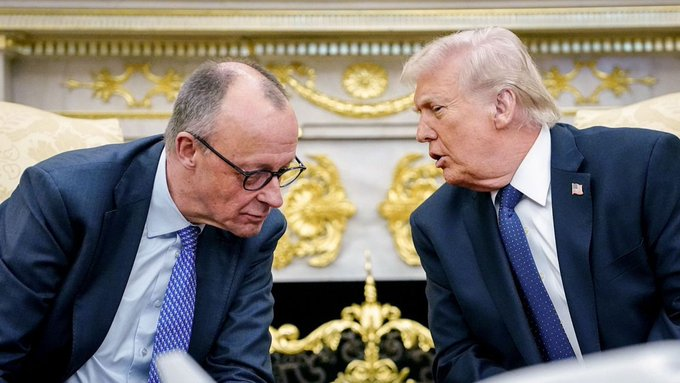
A Public Rupture: Merz’s Unprecedented Critique
Chancellor Merz’s comments, delivered while the United States and Iran remain locked in a tense diplomatic stalemate, represent a significant shift in tone from Berlin.
Historically, German chancellors—even when privately frustrated with Washington—have maintained the appearance of allied unity in public. Merz’s decision to openly question whether the United States has a viable “exit plan” breaks that convention.
The Chancellor’s acknowledgment that “the Iranians are clearly stronger than one thought” directly contradicts the Trump administration’s public posture, which has consistently minimized Iranian resilience. Washington has framed the naval blockade and continued military pressure as steadily weakening Tehran—a narrative Merz’s assessment implicitly rejects.
By stating that the United States lacks a “convincing negotiating strategy,” Merz is effectively arguing that Washington’s maximum-pressure approach has failed to produce a breakthrough, and that Tehran is outmaneuvering the United States diplomatically even as the U.S. Navy enforces a blockade of Iranian ports .
‘Ill-Considered’: The War’s Origins and Unintended Consequences
Merz’s characterization of the entire affair as “ill-considered” is a direct reference to the war’s origins. The conflict began on February 28, 2026, with joint U.S.-Israeli strikes on Iranian nuclear facilities. European leaders, including Merz, were not consulted beforehand and have privately expressed frustration that they were presented with a fait accompli.
From Berlin’s perspective, the war has produced few of the benefits Washington promised:
| U.S. Wartime Objective | Current Status |
|---|---|
| Suspend Iran’s uranium enrichment for at least a decade | Iran continues to enrich uranium |
| Remove Iran’s stockpile of enriched uranium | Stockpile intact |
| Reopen the Strait of Hormuz | Strait remains effectively closed |
| Force Iranian regime change (implied, not stated) | Regime stands; Supreme Leader succession occurred |
| Demonstrate U.S. military dominance | Iran has absorbed strikes and continued fighting |
Merz’s “ill-considered” judgment implies that these outcomes were foreseeable, and that Washington launched the war without adequately planning for the possibility that Iran would not capitulate quickly. The Chancellor’s warning about the absence of a “strategic exit” suggests that Berlin believes the United States is now trapped between escalation (which could draw the region into a wider war) and accepting a deal that falls short of its stated objectives (which would be a diplomatic defeat).
‘Skillfully Not Negotiating’: Iran’s Diplomatic Triumph
Merz’s comment that Iran is “negotiating very skillfully—or rather, very skillfully not negotiating” reflects Berlin’s assessment of Tehran’s diplomatic tactics. While the United States has sent envoys to the region and canceled trips in frustration, Iran has executed a coordinated diplomatic campaign across three continents.
- Iranian Foreign Minister Abbas Araghchi has shuttled between Pakistan (twice), Oman, and Russia, holding high-level meetings with the leadership of each country
- Russia, a key Iranian strategic partner, has provided diplomatic cover at the United Nations while deepening military-technical cooperation
- China has continued to purchase Iranian oil, providing an economic lifeline despite the U.S. naval blockade
- Iran’s written proposal to Washington, delivered through Pakistani mediators, reframed the negotiation on Tehran’s terms: reopen the Strait of Hormuz and end the war first; postpone nuclear talks until later
Washington, by contrast, has struggled to maintain allied unity. The Merz comments themselves demonstrate that transatlantic cohesion on Iran policy is fracturing. And the administration has not articulated a clear plan for what happens if Iran continues to refuse direct talks .
‘Stronger Than Expected’: Iran’s Military and Economic Resilience
Merz’s observation that Iran is “clearly stronger than one thought” has two components:
Military Resilience
Despite suffering strikes on its nuclear and military infrastructure, Iran has continued to:
- Launch missile and drone attacks on U.S. and Israeli assets throughout the region
- Sustain its proxies (Hezbollah, Houthis, Iraqi militias), which continue to operate against U.S. and allied targets
- Maintain control of the Strait of Hormuz, blocking approximately 20% of the world’s oil supply
- Survive the transition from Supreme Leader Ali Khamenei (who was wounded on the first day of the war) to his son Mojtaba without a collapse of the regime
Economic Resilience
Despite a U.S. naval blockade that has forced dozens of tankers to turn back, Iran has continued to move some oil. The Trump administration’s stated goal of reducing Iranian oil exports to zero has not been achieved:
- Iran continues to export to China and other buyers, using a “shadow fleet” of tankers that turn off tracking transponders
- Domestic fuel production and smuggling networks have partially compensated for lost revenue
- The regime has not faced the kind of internal uprising that Washington anticipated
Merz’s public acknowledgment of Iranian resilience signals to Washington that Berlin no longer believes the U.S. strategy of economic strangulation will produce a rapid victory—and that Germany is therefore pursuing its own diplomatic assessment separate from the U.S. position .
Germany’s Economic Pain: Why Merz Wants the War Over
Publicly, Merz has couched his critique in strategic terms. But the subtext of his remarks is economic: the Iran war is hurting Germany, and Berlin wants it to end—fast.
Key economic impacts on Germany :
| Impact | Details |
|---|---|
| Energy prices | Closure of the Strait of Hormuz has spiked global oil prices, hitting Germany’s energy-intensive industrial sector |
| Inflation | German inflation remains elevated, eroding consumer purchasing power |
| Exports | Uncertainty over the war and global trade routes has dampened demand for German manufactured goods |
| Supply chains | Disruption to Red Sea and Persian Gulf shipping routes has forced German manufacturers to seek alternative logistics, at higher cost |
These pressures have translated into political pressure on Merz’s coalition. German business leaders have privately urged the Chancellor to push for a rapid resolution—even if that means accepting a deal that leaves Iran’s nuclear program intact for now, in exchange for reopening the strait and restoring energy supplies.
Merz is also feeling pressure from within his own coalition. The Greens, his coalition partner, have historically opposed military interventions and are uncomfortable with Germany’s role in providing logistical support to the U.S. war effort. Merz’s public questioning of U.S. strategy may be an attempt to placate coalition partners without formally withdrawing support from Washington .
Public Rift vs. Private Coordination: The Transatlantic Divide
Despite Merz’s public comments, Germany has not formally withdrawn from any aspect of the U.S.-led coalition. The Bundeswehr continues to provide logistical support, including the use of German bases, and Berlin remains a participant in sanctions enforcement.
But the public rift matters. The Trump administration (which has already been frustrated by European criticism) will view Merz’s comments as a violation of allied solidarity. And other European capitals—particularly Paris and London—will take note of Berlin’s willingness to break ranks.
For Iran, Merz’s comments are a diplomatic gift. Tehran can point to the German Chancellor’s critique as evidence that the U.S. position is crumbling and that European allies are no longer fully aligned with Washington. This may harden Iran’s negotiating posture .
What Merz Wants
Merz has not explicitly called for a change in U.S. policy. But his critique implies several recommendations:
- Articulate an exit strategy: Washington must be able to explain what “victory” looks like and how it will be achieved
- Engage directly: Iran’s “skillful non-negotiation” is possible because the U.S. has not forced direct engagement; Merz seems to suggest that the U.S. should be willing to talk without preconditions
- Accept a deal that postpones the nuclear issue: Merz reportedly signaled openness to Iran’s proposal to reopen the strait and end the war first, then address the nuclear program later—an approach the administration has rejected
- Share the burden: If the U.S. wants European support, it must consult Europeans on strategy, not simply inform them after decisions are made
Whether Merz’s public pressure will produce any change in Washington remains to be seen. President Trump has not responded directly to Merz’s comments, but a senior administration official told Reuters that the White House was “disappointed” by the Chancellor’s remarks and that the U.S. continues to believe its strategy is working .
Key Takeaways
| Aspect | Summary |
|---|---|
| Merz’s critique | U.S. strategy is “ill-considered”; no “strategic exit” visible |
| Iran’s strength | Tehran is “clearly stronger than expected” |
| Iran’s tactics | “Very skillfully not negotiating” — Iran outmaneuvering U.S. diplomatically |
| U.S. capability | “Doesn’t seem to have a convincing negotiating strategy” |
| German motivation | Economic pain; Merz wants war over quickly |
| Allied rift | Public break with Washington; other European capitals watching |
| Iran’s gain | Merz’s comments are a propaganda victory for Tehran |
| What Merz wants | Exit strategy, direct engagement, potentially accepting deal that postpones nuclear issue |
Follow Reflecto News for continuous updates on transatlantic divisions over Iran, Chancellor Merz’s strategy, and all breaking news from around the world.
This article is the intellectual property of Reflecto News. Redistribution without attribution is prohibited. For syndication or media inquiries, please contact the editorial team.
Questions people ask
What is China's current share of global manufacturing?
China now accounts for twenty eight percent of global manufacturing. This industrial output exceeds the combined manufacturing production of the United States, Japan, and Germany, making China the leading global industrial power according to recent reports.
Why were Andrew Tate and Tristan Tate arrested in Miami?
Andrew Tate and his brother Tristan Tate were taken into custody in Miami by the United States Marshals Service. They face thirty eight new charges in the United Kingdom, including rape and child pornography offences, and prosecutors are seeking their extradition.
What warning did Moscow issue about oil prices?
Kirill Dmitriev, the Chief Executive of the Russian Direct Investment Fund, warned that a tsunami of skyrocketing oil prices is approaching. Moscow describes this potential energy shock as a major threat to global markets.
What political shift is projected for Benjamin Netanyahu's coalition?
Political polls project that Prime Minister Benjamin Netanyahu's coalition is on track to lose its majority in the upcoming October election. This projection indicates a potential political shift in Jerusalem.
Why did a Russian military aircraft land in Tehran?
A Russian airborne command aircraft, widely known as a doomsday plane, landed in Tehran. The arrival of the aircraft represents a high stakes show of support from Russia for Iran during a period of heightened regional tensions.
What did President Masoud Pezeshkian claim about the United States and Israel?
Iranian President Masoud Pezeshkian claimed that the United States and Israel failed in a forty eight hour plan to topple the Iranian government. He made these statements during a televised address marking two years since his inauguration.