Reflecto News is an online news platform covering major international political events, global economic developments, and security conflicts. The site provides updates on topics such as Chinese manufacturing dominance, Middle Eastern political tensions, and high profile legal arrests. Readers can access current articles organized by categories like World News, Iran, and USA.
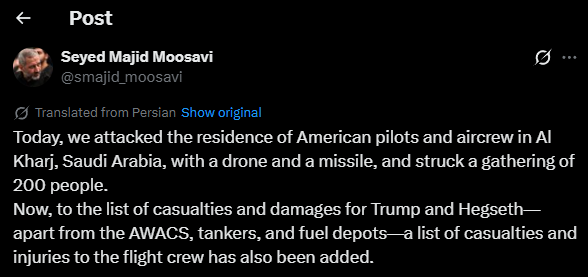
TEHRAN — In a major escalation of the “infrastructure war,” Brigadier General Majid Moosavi, Commander of the IRGC Aerospace Force, announced on Tuesday, March 31, 2026, that Iranian forces successfully targeted a residential facility housing American pilots and aircrew at the Al-Kharj (Prince Sultan) Air Base in Saudi Arabia.
The strike, which reportedly utilized a combination of precision drones and missiles, is being framed by Tehran as a direct response to the U.S.-led air campaign that has devastated Iranian infrastructure over the last month.
The Attack on “Al-Kharj”
According to General Moosavi, the operation specifically targeted a gathering of approximately 200 personnel within the housing quarters of the base.
- Targeting the “Eyes and Wings”: Moosavi stated that the mission was designed to degrade the human element of the U.S. Air Force following the reported destruction of technical assets earlier this week.
- The “Tally of Losses”: “Now, in addition to AWACS aircraft, tankers, and fuel depots, a list of casualties and injuries among flight crews has also been added to the tally of losses attributed to Donald Trump and Pete Hegseth,” Moosavi wrote in a statement shared via state-linked channels.
- Casualty Reports: While the IRGC claims a “high number” of injuries among the flight crews, Saudi civil defense authorities previously reported on similar residential strikes in Al-Kharj that resulted in civilian casualties among maintenance and cleaning staff, highlighting the volatile nature of the “collateral damage” in the region.
A Week of Attrition at Prince Sultan Air Base
The Al-Kharj facility has become the central flashpoint of the air war over the last 72 hours.
- The AWACS Destruction: On March 29, the IRGC confirmed the “complete destruction” of a U.S. E-3 Sentry (AWACS) aircraft (Registration #0005-81) at the base. The loss of this “eye in the sky” has reportedly hampered U.S. command-and-control capabilities in the Persian Gulf.
- Fuel and Logistics: Earlier strikes on March 27 focused on the base’s refueling fleet and solid-fuel storage depots, intended to ground the F-35 and F-15 squadrons operating out of the Kingdom.
- The Residential Shift: By moving targets from the runway to the barracks, the IRGC is signaling a shift toward a “personnel-focused” phase of the conflict, intended to demoralize U.S. forces ahead of the April 6 deadline.
Strategic Context: “Operation Epic Fury”
The strike on Al-Kharj is part of what the IRGC calls “Wave 86” of its retaliatory operations.
- The “Butcher” Retaliation: Tehran continues to cite the assassination of several high-ranking Iranian officials on February 28 as the legal and moral justification for its strikes on U.S. bases in Saudi Arabia, Bahrain, Kuwait, and the UAE.
- The Ground Confrontation Threat: Foreign Minister Abbas Araghchi reinforced Moosavi’s message today, stating that Iran is “prepared for any ground confrontation” should the U.S. attempt to move beyond air strikes.
| Metric of Damage (Al-Kharj) | Reported Status (March 31, 2026) |
| Aviation Loss | 1 E-3 Sentry (AWACS) Destroyed; Multiple Tankers Damaged |
| Infrastructure | Fuel Depots & Logistical Support Fleet Hit |
| Personnel | Strike on Aircrew Residence; ~200 Personnel at Site |
| U.S. Response | Secretary Hegseth admits “problematic” loss of AWACS |
Analysis: The Psychological War
By specifically naming Donald Trump and Pete Hegseth in his statement, General Moosavi is attempting to personalize the cost of the war for the American leadership. The focus on “flight crews”—some of the most highly trained and difficult-to-replace assets in the military—is a calculated move to force a reassessment of the U.S. “Maximum Pressure” strategy.
As the April 6 deadline approaches, the systematic targeting of the men and women who fly the missions suggests that Tehran is no longer content with “symbolic” strikes and is now seeking to inflict deep, structural pain on the U.S. military presence in the Middle East.
Questions people ask
What is China's current share of global manufacturing?
China now accounts for twenty eight percent of global manufacturing. This industrial output exceeds the combined manufacturing production of the United States, Japan, and Germany, making China the leading global industrial power according to recent reports.
Why were Andrew Tate and Tristan Tate arrested in Miami?
Andrew Tate and his brother Tristan Tate were taken into custody in Miami by the United States Marshals Service. They face thirty eight new charges in the United Kingdom, including rape and child pornography offences, and prosecutors are seeking their extradition.
What warning did Moscow issue about oil prices?
Kirill Dmitriev, the Chief Executive of the Russian Direct Investment Fund, warned that a tsunami of skyrocketing oil prices is approaching. Moscow describes this potential energy shock as a major threat to global markets.
What political shift is projected for Benjamin Netanyahu's coalition?
Political polls project that Prime Minister Benjamin Netanyahu's coalition is on track to lose its majority in the upcoming October election. This projection indicates a potential political shift in Jerusalem.
Why did a Russian military aircraft land in Tehran?
A Russian airborne command aircraft, widely known as a doomsday plane, landed in Tehran. The arrival of the aircraft represents a high stakes show of support from Russia for Iran during a period of heightened regional tensions.
What did President Masoud Pezeshkian claim about the United States and Israel?
Iranian President Masoud Pezeshkian claimed that the United States and Israel failed in a forty eight hour plan to topple the Iranian government. He made these statements during a televised address marking two years since his inauguration.