
Reflecto News is an online news platform covering major international political events, global economic developments, and security conflicts. The site provides updates on topics such as Chinese manufacturing dominance, Middle Eastern political tensions, and high profile legal arrests. Readers can access current articles organized by categories like World News, Iran, and USA.
Published on Reflecto News | Technology & Innovation
Chinese electric vehicle manufacturer Xpeng has announced plans to begin large-scale production of its so-called “flying car” in 2027, marking a significant step toward commercializing passenger-carrying electric vertical takeoff and landing (eVTOL) aircraft. The company has already received more than 7,000 orders for the vehicle, the majority from China, where a supportive regulatory environment has enabled rapid progress.

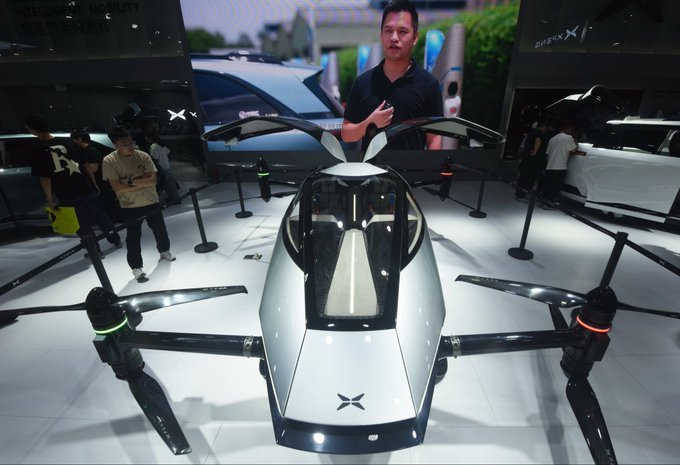
The Land Aircraft Carrier: A Modular Approach
Xpeng’s flying car, formally named the Land Aircraft Carrier, employs a modular design that solves a fundamental engineering problem that has plagued unified flying car concepts. Rather than forcing a single vehicle to both drive and fly—which requires compromising on weight and efficiency—the Land Aircraft Carrier separates the two functions.
The system consists of two distinct modules:
| Module | Function | Key Features |
|---|---|---|
| Ground Module | 6-wheeled carrier vehicle | 1,000 km driving range; functions as charging station and hangar |
| Air Module | 2-seat eVTOL aircraft | Detachable; substantially lighter without road-legal crash structures |
This separation means neither component carries the structural weight of the other. The ground module, built like a six-wheeled van, serves as a mobile hangar and charging station. The flying module, stored in the vehicle’s rear when not in use, can be deployed when the driver wants to take to the skies. The air module is a two-seat eVTOL aircraft that can be flown like a large drone or a small helicopter.
Production Timeline and Orders
Xpeng President Brian Gu, speaking to Reuters ahead of the Beijing Auto Show, confirmed the production timeline:
- 2027: Large-scale production and delivery of flying cars
- Late 2026: Mass production of humanoid robots (Iron robot)
- 2026 (ongoing) : Robotaxi trials in Guangzhou, China
The company has already received more than 7,000 orders for its flying cars, the vast majority from within China, and is currently seeking approval from the country’s aviation authorities.
China’s Regulatory Advantage
Perhaps the most significant factor enabling Xpeng’s ambitious timeline is China’s state-sponsored eVTOL infrastructure. The regulatory environment in China is unlike anything in Western markets at present.
| Region | Landing Pads | Status |
|---|---|---|
| Shenzhen, China | Over 1,200 | Operational |
| United States | Approximately 92 | Most in planning/construction |
This more supportive and agile regulatory environment has enabled Xpeng to make rapid progress that would be difficult to replicate in the United States or Europe. Cities like Shenzhen have built over 1,200 landing pads to date, while the US has only around 92, most of which remain in the planning or construction stages.
Beyond Flying Cars: Robots and Robotaxis
Xpeng’s 2027 plans extend well beyond flying vehicles. The company is positioning itself as a diversified technology company rather than merely an automaker.
Iron Humanoid Robot
Mass production of Xpeng’s “Iron” humanoid robot is expected to begin in Q4 2026, with external commercialization following in 2027. According to Gu, the robots will initially be used as receptionists or in sales to interact with customers, with broader applications expected over time. Within the next 10 to 20 years, Gu projects Xpeng’s robot business could surpass its automotive division.
Robotaxi
Xpeng will start robotaxi tests in Guangzhou this year, with 2027 projected to be a “critical year” for testing around the world with partners. The company expects to produce hundreds to thousands of robotaxis over the next 12 to 18 months.
The Volkswagen Partnership
Xpeng is not going it alone. The company has been deepening its ties with German automaker Volkswagen, which began mass production of its first jointly developed electric vehicle model, the ID.Unyx 08, in March 2026.
“There are a lot of areas that we can partner and really provide value to each other,” Gu said, adding that Xpeng was also open to partnerships with other automakers. “We need to be nimble and willing to partner with different players in different regions”.
Global Ambitions
Xpeng’s ambitions extend far beyond China. The company currently operates in about 60 countries outside China and generated approximately 10% of its sales volume and 15% of its revenue from overseas markets in 2025.
Gu has set a striking target: within the next five to 10 years, more than 50% of the company’s revenue should come from outside China. That suggests the flying car—once production scales—will be offered in markets beyond China, regulatory hurdles permitting.
Xpeng’s Global Targets:
| Metric | 2025 Actual | 5-10 Year Target |
|---|---|---|
| Overseas sales volume share | ~10% | >50% |
| Overseas revenue share | ~15% | >50% |
| Countries operated | ~60 | Expanding |
Sources: Reuters, Xpeng president Brian Gu
A Tesla-Style Strategy
Industry observers have noted that Xpeng’s strategy increasingly resembles Tesla’s in almost every detail: a focus on in-house technology development, humanoid robotics, autonomous driving, and now flying vehicles.
“Take a step back and this is a company that has truly brought the concept of ‘magic happens’ to the modern automotive industry,” one analysis noted. The company is building a diversified technology portfolio that extends far beyond traditional transportation.
The Development Pipeline
| Product | Production Start | Initial Use Case |
|---|---|---|
| Iron humanoid robot | Q4 2026 | Reception and customer interaction |
| Land Aircraft Carrier (flying car) | 2027 | Personal transportation for early adopters |
| Robotaxi | 2026-2027 (testing) | Autonomous ride-hailing in China |
Sources: Xpeng, Reuters
The Bigger Picture: Personal Air Travel Becomes Practical
For decades, flying cars have been a staple of science fiction, tantalizingly out of reach. Xpeng’s modular approach—separating the ground vehicle from the aircraft—sidesteps the engineering trade-offs that have made unified flying cars impractical.
The result is a system that could actually work: a six-wheeled electric van that carries a detachable two-seat eVTOL in its rear. You drive to a landing pad, deploy the flying module, and take to the skies without carrying the weight of the ground vehicle’s crash protection, suspension, and wheels.
With more than 7,000 orders already in hand and a regulatory environment in China that is actively building eVTOL infrastructure, Xpeng’s 2027 timeline may be more realistic than skeptics assume. Whether the rest of the world can catch up with China’s infrastructure lead remains an open question.
Frequently Asked Questions (FAQs)
1. What is Xpeng’s flying car called?
It is formally named the “Land Aircraft Carrier.” It is a modular vehicle pairing a six-wheeled ground unit with a detachable two-seat eVTOL (electric vertical takeoff and landing) aircraft stored in the rear.
2. When will Xpeng start mass producing flying cars?
Xpeng expects to begin large-scale production and delivery of its flying cars in 2027.
3. How many orders has Xpeng received for the flying car?
The company has received more than 7,000 orders, the majority from China.
4. Is Xpeng also building humanoid robots?
Yes. Xpeng’s “Iron” humanoid robot is expected to enter mass production in Q4 2026, with external commercialization following in 2027.
5. How is Xpeng working with Volkswagen?
Volkswagen began mass production of its first jointly developed EV model with Xpeng in March 2026. The two companies see “tremendous potential” for expanded cooperation.
6. Will Xpeng sell flying cars outside China?
Xpeng has set a target of generating more than 50% of its revenue from outside China within the next decade. The company currently operates in about 60 countries and intends to expand.
7. How does China’s regulatory environment compare to the US?
China is far ahead. Shenzhen alone has built over 1,200 landing pads for eVTOL aircraft, while the US has only around 92, most still in planning.
Stay informed with Reflecto News – Your trusted source for breaking technology and innovation intelligence. Subscribe for real-time updates on electric aviation, autonomous vehicles, and global technology trends.
Questions people ask
What is China's current share of global manufacturing?
China now accounts for twenty eight percent of global manufacturing. This industrial output exceeds the combined manufacturing production of the United States, Japan, and Germany, making China the leading global industrial power according to recent reports.
Why were Andrew Tate and Tristan Tate arrested in Miami?
Andrew Tate and his brother Tristan Tate were taken into custody in Miami by the United States Marshals Service. They face thirty eight new charges in the United Kingdom, including rape and child pornography offences, and prosecutors are seeking their extradition.
What warning did Moscow issue about oil prices?
Kirill Dmitriev, the Chief Executive of the Russian Direct Investment Fund, warned that a tsunami of skyrocketing oil prices is approaching. Moscow describes this potential energy shock as a major threat to global markets.
What political shift is projected for Benjamin Netanyahu's coalition?
Political polls project that Prime Minister Benjamin Netanyahu's coalition is on track to lose its majority in the upcoming October election. This projection indicates a potential political shift in Jerusalem.
Why did a Russian military aircraft land in Tehran?
A Russian airborne command aircraft, widely known as a doomsday plane, landed in Tehran. The arrival of the aircraft represents a high stakes show of support from Russia for Iran during a period of heightened regional tensions.
What did President Masoud Pezeshkian claim about the United States and Israel?
Iranian President Masoud Pezeshkian claimed that the United States and Israel failed in a forty eight hour plan to topple the Iranian government. He made these statements during a televised address marking two years since his inauguration.