Reflecto News is an online news platform covering major international political events, global economic developments, and security conflicts. The site provides updates on topics such as Chinese manufacturing dominance, Middle Eastern political tensions, and high profile legal arrests. Readers can access current articles organized by categories like World News, Iran, and USA.
Reflecto News | Technology & Energy | China
BEIJING — China is actively testing a prototype nuclear reactor compact enough to be carried on a truck, according to a leading scientist involved in the project .
The reactor, described as the “world’s first 10-megawatt vehicle-mounted nuclear power unit,” is being developed as a mobile “power bank” that could operate for decades without refuelling, according to Wu Yican, chief scientific adviser to the Institute of Nuclear Energy Safety Technology at the Hefei Institute of Physical Science .
The technology is being positioned as a solution to “battery anxiety” across a range of applications, including remote regions, island power, emergency backup, ship propulsion, space systems, and—critically—powering AI computing and data centres . An output of 10 MW would be sufficient to run a medium-sized AI data centre .
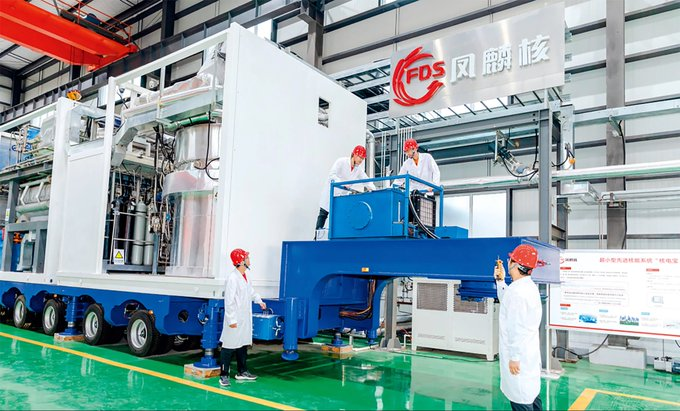
☢️ How It Works: A Truck-Sized Reactor
The prototype represents a radical departure from traditional nuclear power plants. According to Wu, the reactor is designed to be “approachable, flexible and intelligent”—capable of meeting diverse future energy demands while maintaining exceptional safety standards .
A 10 MW vehicle-mounted reactor is, however, distinct from China’s larger small modular reactors (SMRs), such as the Linglong One (ACP100) . That 125 MW reactor—designed for grid power—is nearing commercial operation in Hainan and is large enough to require permanent installation, though its design similarly emphasizes factory-built, modular construction .
| Aspect | Truck-Mounted Prototype | Linglong One (ACP100) |
|---|---|---|
| Power Output | 10 MW | 125 MW |
| Design | Vehicle-mounted; mobile | Fixed installation (modular) |
| Primary Use | Remote power, data centres, emergency, AI computing | Grid power, district heating, seawater desalination |
| Safety Features | “Exceptional safety in compact size” | Passive safety systems; IAEA-certified design |
| Operational Life | “Decades without recharging” | 60 years |
| Current Status | Prototype testing | Commercial operation expected early 2026 |
The key innovation of China’s SMRs—including the truck-mounted version—lies in their integrated, modular design. Unlike traditional reactors, where primary components are distributed, the reactor core and cooling systems are combined into a single unit. This eliminates large primary coolant pipes, removing the risk of a Loss-of-Coolant Accident (LOCA) from a pipe break .
The design also incorporates passive safety systems that rely on natural forces like gravity and convection, allowing the reactor to cool itself without external power or operator intervention—a critical feature for mobile or remote deployment .
🔋 A ‘Nuclear Power Bank’ for the AI Era
The testing of a truck-mounted reactor is unfolding against the backdrop of surging electricity demand from artificial intelligence. New AI data centers are estimated to require 1 to 5 gigawatts of power—comparable to the output of a large nuclear plant. These facilities need constant, uninterrupted power, and a 10 MW unit could serve as a dedicated and reliable source .
Wu’s reference to “battery anxiety” underscores the limitations of current energy storage. A nuclear unit that fits on a truck and can power a data centre for decades without refuelling bypasses the intermittency issues of renewables and the logistics of fuel delivery, while also functioning as a direct replacement for diesel generators in backup applications .
🌍 Strategic and Commercial Implications
The truck-mounted reactor, if successfully deployed, would mark a significant strategic advance. A vehicle-mounted, factory-produced reactor could theoretically be deployed anywhere a truck can reach—without the need for the extensive on-site construction that defines conventional nuclear projects.
The pace of China’s progress stands in stark contrast to Western efforts. The Linglong One, for instance, received IAEA safety approval in 2016, began construction in 2021, and is now set for 2026 operation . In the United States, by contrast, no commercial SMR has yet begun construction, and the only NRC-permitted design (NuScale) saw its flagship project cancelled after years of delays and cost increases .
Larger strategic considerations also come into play. An operational mobile nuclear reactor would:
- Provide a rapidly deployable power source for emergency or military logistics;
- Offer a decarbonisation option for remote industrial sites lacking grid access;
- Create a new category of energy export, potentially undercutting Western SMR developers.
🔮 What Comes Next
The team behind the truck-mounted prototype is actively seeking opportunities for deployment . A demonstration project could emerge as a partnership with a technology firm or as part of China’s broader strategy for decarbonised, distributed energy.
Wu has stated that the development of next-generation nuclear systems is “in full swing,” with the core principle of ensuring safety “at the source” .
📋 Key Takeaways for Reflecto News Readers
| Aspect | Summary |
|---|---|
| The Technology | China testing a 10 MW truck-mounted nuclear reactor; described as a “nuclear power bank” . |
| Applications | Remote/island power, AI data centres, emergency backup, ship propulsion, space systems; decades-long operation without refuelling . |
| Safety Design | Integrated modular design eliminates large coolant pipes; passive heat removal via natural circulation . |
| Strategic Context | Contrasts with Western SMR progress; China’s Linglong One (125 MW) starting 2026 vs. no US commercial SMR yet built . |
| Timeline | Prototype testing now; developers actively seeking deployment opportunities . |
Follow Reflecto News for continuous updates on advanced nuclear technology, Chinese energy innovation, and all breaking science news from around the world.
This article is the intellectual property of Reflecto News. Redistribution without attribution is prohibited.
Questions people ask
What is China's current share of global manufacturing?
China now accounts for twenty eight percent of global manufacturing. This industrial output exceeds the combined manufacturing production of the United States, Japan, and Germany, making China the leading global industrial power according to recent reports.
Why were Andrew Tate and Tristan Tate arrested in Miami?
Andrew Tate and his brother Tristan Tate were taken into custody in Miami by the United States Marshals Service. They face thirty eight new charges in the United Kingdom, including rape and child pornography offences, and prosecutors are seeking their extradition.
What warning did Moscow issue about oil prices?
Kirill Dmitriev, the Chief Executive of the Russian Direct Investment Fund, warned that a tsunami of skyrocketing oil prices is approaching. Moscow describes this potential energy shock as a major threat to global markets.
What political shift is projected for Benjamin Netanyahu's coalition?
Political polls project that Prime Minister Benjamin Netanyahu's coalition is on track to lose its majority in the upcoming October election. This projection indicates a potential political shift in Jerusalem.
Why did a Russian military aircraft land in Tehran?
A Russian airborne command aircraft, widely known as a doomsday plane, landed in Tehran. The arrival of the aircraft represents a high stakes show of support from Russia for Iran during a period of heightened regional tensions.
What did President Masoud Pezeshkian claim about the United States and Israel?
Iranian President Masoud Pezeshkian claimed that the United States and Israel failed in a forty eight hour plan to topple the Iranian government. He made these statements during a televised address marking two years since his inauguration.