Reflecto News is an online news platform covering major international political events, global economic developments, and security conflicts. The site provides updates on topics such as Chinese manufacturing dominance, Middle Eastern political tensions, and high profile legal arrests. Readers can access current articles organized by categories like World News, Iran, and USA.
By Reflecto News Staff
April 4, 2026
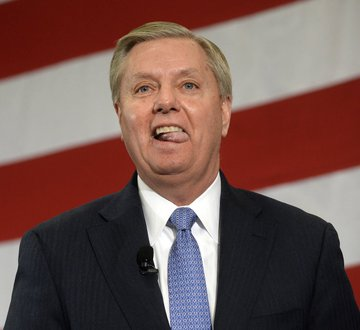
Lahore, Pakistan – U.S. Senator Lindsey Graham (R-SC) has issued a forceful endorsement of President Donald Trump’s 48-hour ultimatum to Iran, declaring that he is “completely convinced” Trump will unleash overwhelming military force if Tehran continues to impede the Strait of Hormuz or rejects a diplomatic solution.
In a statement released shortly after speaking with the president this morning, Graham warned:
“After speaking with Trump this morning, I am completely convinced that he will use overwhelming military force against the regime if they continue to impede the Strait of Hormuz and refuse a diplomatic solution to achieve our military objectives. If it’s not clear to Iran and others by now that President Trump means what he says then I don’t know when it will ever be. I completely support the 48-hour ultimatum. A massive military operation awaits Iran if they choose poorly.”
The South Carolina senator’s remarks come as the Iran war enters its sixth week, with Iran rejecting multiple ceasefire proposals and maintaining selective restrictions on the critical waterway despite recent exemptions granted to countries like Iraq.
Graham’s Message: Trump Means Business
Graham emphasized that the regime has already been “severely crippled” through ongoing U.S.-Israeli operations (referred to in some reporting as elements of “Operation Epic Fury”). He framed the ultimatum as a clear choice for Iran: pursue a diplomatic path or face escalated consequences aimed at fully securing the Strait of Hormuz and achieving broader military objectives, including further degradation of Iran’s missile and nuclear-related capabilities.
His comments reinforce Trump’s earlier Truth Social warning that failure to open the strait or reach a deal would result in “all hell will reign down on them,” with potential strikes on power plants and other strategic infrastructure.
Current Military and Diplomatic Backdrop
This strong bipartisan hawkish signal from Graham arrives amid:
- Ongoing strikes: Fresh U.S. and Israeli operations have caused massive explosions in northern Tehran, Isfahan, and other provinces, targeting remaining missile sites, air defenses, and infrastructure.
- Munitions strain: The U.S. is drawing heavily from global stockpiles of stealth cruise missiles like the JASSM-ER, with reports indicating only ~425 remain from a pre-war inventory of ~2,300 after expending over 1,000 in the first month alone. Replenishment could take years.
- Strait of Hormuz: Iran continues selective enforcement, recently exempting Iraq while keeping pressure on adversaries. Disruptions have driven global oil prices higher and contributed to elevated U.S. gas prices.
- Bushehr nuclear risks: A fourth reported strike near the coastal plant has drawn Russian condemnation as an “evil deed,” with Iranian warnings of potential radioactive fallout affecting Gulf capitals.
- Ceasefire rejections: Iran has turned down temporary truce offers, insisting on broader guarantees.
President Trump’s proposed $1.5 trillion defense budget for FY2027 reflects the high costs of sustained operations (approaching $2 billion daily) and the need to replenish depleted stocks.
Strategic map of the Strait of Hormuz and surrounding region, the focal point of Trump’s ultimatum and Graham’s warning. (Image: Institute for the Study of War)
Broader Implications
Graham’s intervention adds significant political weight behind the administration’s hardline stance, signaling unified Republican support for escalation if Iran does not comply. It also comes against a backdrop of domestic pressure on Trump, including sliding approval ratings linked to economic fallout from the war and energy price spikes, as previously highlighted in The Atlantic.
Iran has shown defiance, with Khatam al-Anbiya claiming resilience in its capabilities and continued proxy actions via Hezbollah on Israel’s northern front.
With the 48-hour clock ticking, the coming hours could prove decisive. A “massive military operation,” as described by Graham, would likely involve intensified airstrikes, naval actions to secure shipping lanes, and further depletion of precision munitions.
Reflecto News will continue monitoring statements from the White House, Tehran, and Capitol Hill, as well as any developments on the ground or in the Strait of Hormuz. Diplomatic back channels remain active, but the window for de-escalation is narrowing rapidly.
This is a rapidly developing story.
Questions people ask
What is China's current share of global manufacturing?
China now accounts for twenty eight percent of global manufacturing. This industrial output exceeds the combined manufacturing production of the United States, Japan, and Germany, making China the leading global industrial power according to recent reports.
Why were Andrew Tate and Tristan Tate arrested in Miami?
Andrew Tate and his brother Tristan Tate were taken into custody in Miami by the United States Marshals Service. They face thirty eight new charges in the United Kingdom, including rape and child pornography offences, and prosecutors are seeking their extradition.
What warning did Moscow issue about oil prices?
Kirill Dmitriev, the Chief Executive of the Russian Direct Investment Fund, warned that a tsunami of skyrocketing oil prices is approaching. Moscow describes this potential energy shock as a major threat to global markets.
What political shift is projected for Benjamin Netanyahu's coalition?
Political polls project that Prime Minister Benjamin Netanyahu's coalition is on track to lose its majority in the upcoming October election. This projection indicates a potential political shift in Jerusalem.
Why did a Russian military aircraft land in Tehran?
A Russian airborne command aircraft, widely known as a doomsday plane, landed in Tehran. The arrival of the aircraft represents a high stakes show of support from Russia for Iran during a period of heightened regional tensions.
What did President Masoud Pezeshkian claim about the United States and Israel?
Iranian President Masoud Pezeshkian claimed that the United States and Israel failed in a forty eight hour plan to topple the Iranian government. He made these statements during a televised address marking two years since his inauguration.