Reflecto News is an online news platform covering major international political events, global economic developments, and security conflicts. The site provides updates on topics such as Chinese manufacturing dominance, Middle Eastern political tensions, and high profile legal arrests. Readers can access current articles organized by categories like World News, Iran, and USA.
By Reflecto News Desk
April 6, 2026
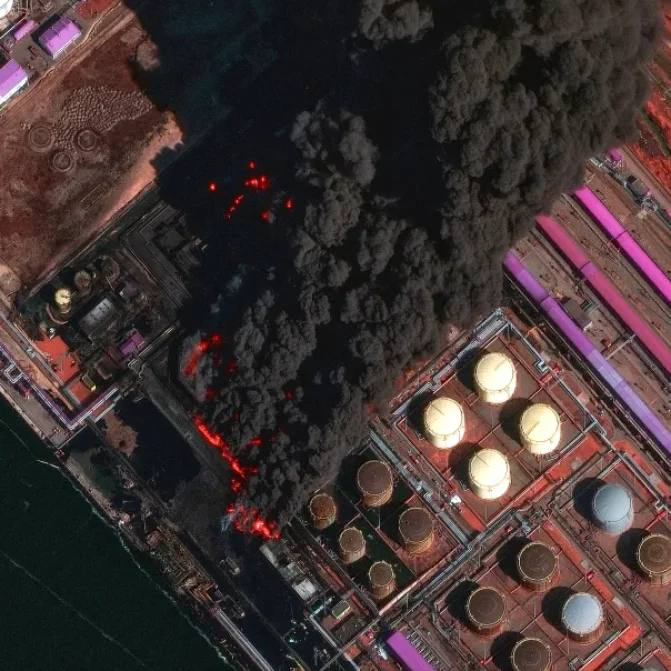
Ukrainian long-range drone strikes on Russia’s key Baltic Sea oil export terminals at Primorsk and Ust-Luga have caused massive disruptions, resulting in an estimated loss of around $1 billion in Russian oil and fuel export revenues in a single week. Fires, damaged storage tanks, and forced shutdowns slashed shipments from these ports by up to 40%, or roughly 2.3 million barrels per day (bpd) at peak disruption levels, according to industry data and media reports including the Financial Times.
The sustained campaign, which intensified in late March 2026, represents one of the most significant blows to Russia’s oil export infrastructure since the start of the full-scale war.
Satellite imagery showing smoke plumes from fires at Russian oil facilities in the Baltic region following reported drone strikes (illustrative of damage at Primorsk/Ust-Luga areas).
Details of the Strikes and Damage
Ukrainian drones targeted the ports multiple times over several days, sparking large fires in fuel storage tanks and oil loading infrastructure:
- Primorsk: Russia’s primary Baltic crude oil export port (capacity ~1 million bpd). Tanker loadings dropped sharply — from around 10 tankers per week to just 4 in the affected period. Satellite images confirmed damage to at least 40% of storage facilities in some assessments.
- Ust-Luga: A major complex handling crude oil, petroleum products, and significant volumes of naphtha (accounting for ~8% of global naphtha exports). Loadings fell dramatically (e.g., from 8 to 2 tankers in one reported week), with multiple strikes causing fires and operational halts. At least five attacks on Ust-Luga were reported in a 10-day span.
Fires forced temporary suspensions of loading operations, with smoke visible from across the Gulf of Finland. Refineries in European Russia and Siberia had to seek alternative (and costlier) export routes via rail or other ports.
Overview of industrial port infrastructure at a major Russian Baltic oil terminal (file image of similar facilities).
Economic Impact on Russia
- Revenue Loss: Approximately $970 million to $1 billion in lost oil and fuel export revenues in the week ending March 29, 2026, per Bloomberg and FT estimates. This stems from sharply reduced volumes and the need to discount cargoes or reroute them.
- Export Volume Drop: Baltic shipments (crude and products) plunged by up to 80% in the final week of March compared to the prior period in some analyses. Overall Russian seaborne oil exports saw a daily average drop of about 1.75 million bpd in the affected week.
- Broader Effects: The strikes forced Russia to cut or redirect refinery output, increasing domestic storage pressure and logistical costs. Ust-Luga’s role in naphtha exports amplified the global ripple, with shipments down ~70% at one point.
Russia’s oil revenues — a critical funding source for its military operations — have faced repeated pressure from Ukrainian deep strikes on refineries and export hubs throughout 2025–2026.
Strategic Significance
Primorsk and Ust-Luga together handle a substantial share (around 30–40% in combined capacity) of Russia’s seaborne oil exports, serving as vital gateways for crude from Siberian and European Russian fields. Disrupting them directly targets Moscow’s ability to monetize its energy resources amid Western sanctions and shadow fleet challenges.
Ukraine has described these operations as part of a strategy to weaken Russia’s war economy by hitting high-value, hard-to-defend infrastructure deep behind the front lines. Russian officials have labeled the attacks “terrorist acts” and reported civilian or infrastructure damage, while promising enhanced air defenses.
Context in the Russia-Ukraine War
These strikes come amid Ukraine’s intensified campaign against Russian energy targets, including earlier hits on refineries and other export points (such as in the Black Sea region). They coincide with broader battlefield dynamics, including Ukrainian claims of territorial gains in the east and southeast.
The financial hit adds to mounting economic strain on Russia, even as it seeks alternative markets and routes. Global oil markets have seen volatility from the disruptions, though the overall impact has been partially offset by other suppliers.
Reflecto News will continue monitoring developments at Primorsk and Ust-Luga for updates on repair timelines, resumed export volumes, Russian countermeasures, and any further Ukrainian statements. Bookmark Reflecto News for verified coverage of the Russia-Ukraine conflict, energy infrastructure attacks, and their economic consequences.
Questions people ask
What is China's current share of global manufacturing?
China now accounts for twenty eight percent of global manufacturing. This industrial output exceeds the combined manufacturing production of the United States, Japan, and Germany, making China the leading global industrial power according to recent reports.
Why were Andrew Tate and Tristan Tate arrested in Miami?
Andrew Tate and his brother Tristan Tate were taken into custody in Miami by the United States Marshals Service. They face thirty eight new charges in the United Kingdom, including rape and child pornography offences, and prosecutors are seeking their extradition.
What warning did Moscow issue about oil prices?
Kirill Dmitriev, the Chief Executive of the Russian Direct Investment Fund, warned that a tsunami of skyrocketing oil prices is approaching. Moscow describes this potential energy shock as a major threat to global markets.
What political shift is projected for Benjamin Netanyahu's coalition?
Political polls project that Prime Minister Benjamin Netanyahu's coalition is on track to lose its majority in the upcoming October election. This projection indicates a potential political shift in Jerusalem.
Why did a Russian military aircraft land in Tehran?
A Russian airborne command aircraft, widely known as a doomsday plane, landed in Tehran. The arrival of the aircraft represents a high stakes show of support from Russia for Iran during a period of heightened regional tensions.
What did President Masoud Pezeshkian claim about the United States and Israel?
Iranian President Masoud Pezeshkian claimed that the United States and Israel failed in a forty eight hour plan to topple the Iranian government. He made these statements during a televised address marking two years since his inauguration.