Reflecto News is an online news platform covering major international political events, global economic developments, and security conflicts. The site provides updates on topics such as Chinese manufacturing dominance, Middle Eastern political tensions, and high profile legal arrests. Readers can access current articles organized by categories like World News, Iran, and USA.
Beijing Issues Extended NOTAMs for Zones Off East Coast Near Yellow Sea and East China Sea, Far Longer Than Typical Short-Term Military Closures
By Reflecto News Staff
April 6, 2026
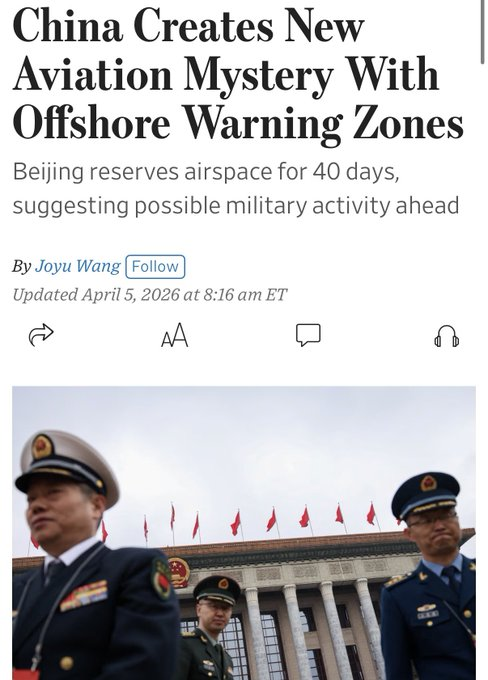
China has triggered fresh speculation in aviation and defense circles by reserving significant swaths of offshore airspace for approximately 40 days — from March 27 to May 6, 2026 — without providing any public explanation or announcing military exercises.
The restrictions, issued through Notices to Air Missions (NOTAMs), cover large areas off China’s eastern coast in the Yellow Sea and East China Sea regions. Notably, the zones are not positioned immediately adjacent to Taiwan, distinguishing them from the more frequent airspace alerts tied to cross-strait tensions.
This extended closure stands out because Chinese military-related airspace reservations typically last only a few days. The prolonged duration, combined with no vertical ceiling (designated as surface to unlimited, or “SFC-UNL”), has raised questions among analysts and airlines about the underlying purpose.
Details of the Airspace Restrictions
According to reports, the NOTAMs alert pilots and aviation authorities to temporary hazards or restrictions in the designated offshore zones. Such measures are commonly used to notify international aviation of live-fire drills, missile tests, or other military activities that could endanger civilian flights.
What makes this instance unusual is the scale and length: a continuous 40-day window with no official announcement of exercises or other activities. Aviation experts note that while China frequently issues short-term NOTAMs for military drills, multi-week reservations without explanation are rare and can disrupt commercial routing or heighten monitoring by neighboring countries and the US.
The affected areas lie in international waters but within or near China’s declared Air Defense Identification Zone (ADIZ) in the East China Sea, where Beijing requires foreign aircraft to identify themselves — a practice not fully recognized under international law.
Possible Reasons and Speculation
Chinese authorities have not commented publicly on the restrictions. Analysts suggest several potential explanations:
- Large-scale military drills or testing: Extended periods could accommodate complex exercises involving naval aviation, missile launches, or new weapon systems in the Yellow Sea/East China Sea theater.
- Strategic signaling or readiness: The move coincides with heightened regional tensions, including the ongoing US-Iran conflict, disruptions in global energy routes (such as the Strait of Hormuz), and broader US-China strategic competition in the Indo-Pacific.
- Technological or operational trials: The duration might support prolonged testing of radar, electronic warfare systems, or unmanned aircraft operations away from civilian traffic.
- Response to external activities: Some observers point to recent US or allied military presence in nearby waters, though no direct link has been confirmed.
Ray Powell of Stanford University’s SeaLight project, which tracks Chinese maritime and aerial activity, highlighted the anomaly: the combination of unlimited vertical extent and exceptional length without an announced exercise makes the reservation particularly noteworthy.
Airlines operating in the region may face detours, delays, or increased fuel costs, though major carriers have not yet reported widespread disruptions tied specifically to these zones.
Context in Broader Regional Dynamics
This development occurs against a backdrop of sustained Chinese military modernization and gray-zone activities in the East and South China Seas. China has been expanding its air and naval reach, conducting more frequent drills, and asserting claims in disputed areas.
The timing — overlapping with global attention on Middle East tensions and energy security — adds another layer of intrigue. While the zones are distant from Taiwan, they fall within areas where the US, Japan, South Korea, and other partners conduct routine freedom-of-navigation and surveillance operations.
No immediate safety incidents or diplomatic protests have been widely reported in connection with the closures.
What It Means
Prolonged, unexplained airspace reservations can serve multiple purposes: practical military needs, deterrence signaling, or operational security. For international observers, the lack of transparency fuels speculation and underscores the challenges of monitoring activity in one of the world’s busiest and most contested maritime regions.
Aviation authorities and militaries in neighboring countries are likely monitoring the situation closely through satellite, radar, and open-source intelligence.
Reflecto News will continue tracking any updates, official Chinese statements, impacts on commercial aviation, or links to broader military developments in the region.
This story is developing.
Sources include The Wall Street Journal reporting on the NOTAMs and aviation analysis, along with expert commentary from SeaLight project and regional security observers.
Questions people ask
What is China's current share of global manufacturing?
China now accounts for twenty eight percent of global manufacturing. This industrial output exceeds the combined manufacturing production of the United States, Japan, and Germany, making China the leading global industrial power according to recent reports.
Why were Andrew Tate and Tristan Tate arrested in Miami?
Andrew Tate and his brother Tristan Tate were taken into custody in Miami by the United States Marshals Service. They face thirty eight new charges in the United Kingdom, including rape and child pornography offences, and prosecutors are seeking their extradition.
What warning did Moscow issue about oil prices?
Kirill Dmitriev, the Chief Executive of the Russian Direct Investment Fund, warned that a tsunami of skyrocketing oil prices is approaching. Moscow describes this potential energy shock as a major threat to global markets.
What political shift is projected for Benjamin Netanyahu's coalition?
Political polls project that Prime Minister Benjamin Netanyahu's coalition is on track to lose its majority in the upcoming October election. This projection indicates a potential political shift in Jerusalem.
Why did a Russian military aircraft land in Tehran?
A Russian airborne command aircraft, widely known as a doomsday plane, landed in Tehran. The arrival of the aircraft represents a high stakes show of support from Russia for Iran during a period of heightened regional tensions.
What did President Masoud Pezeshkian claim about the United States and Israel?
Iranian President Masoud Pezeshkian claimed that the United States and Israel failed in a forty eight hour plan to topple the Iranian government. He made these statements during a televised address marking two years since his inauguration.