Reflecto News is an online news platform covering major international political events, global economic developments, and security conflicts. The site provides updates on topics such as Chinese manufacturing dominance, Middle Eastern political tensions, and high profile legal arrests. Readers can access current articles organized by categories like World News, Iran, and USA.
Reflecto News | Business | Investing
OMAHA, Neb. — Greg Abel has a problem that most CEOs would envy: a record $380 billion cash pile and the challenge of filling the shoes of the greatest investor of all time . At Berkshire Hathaway‘s first annual meeting without Warren Buffett as CEO, shareholders expressed confidence in their new leader — but they also made clear that life after the “Oracle of Omaha” is an adjustment .
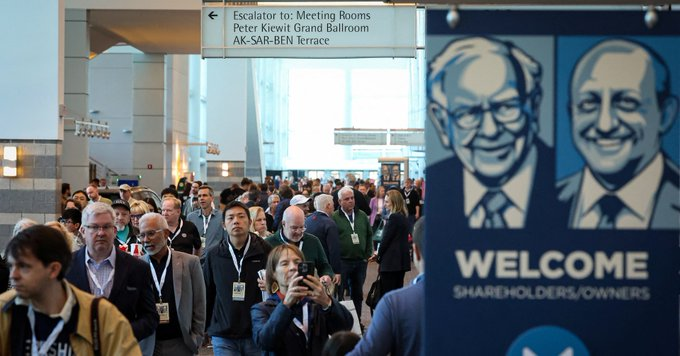
The meeting in Omaha marked the official end of an era. Buffett, 95, sat in the front row, no longer running the show but still drawing the loudest applause. His longtime deputy, Abel, 63, took center stage for the first time as CEO, inheriting a $1 trillion conglomerate and an investor base trained to trust one man‘s judgment above all else .
But beneath the surface, a more complex picture is emerging. Berkshire’s stock has lagged the S&P 500 by nearly 40 percentage points since Buffett announced his succession plan last year . The crowd at the meeting was noticeably thinner . And while Abel brings operational expertise that Buffett never had, he lacks the cult-like following that turned Berkshire’s annual gatherings into ”Woodstock for capitalists” .
“Greg has a formidable challenge, replacing the greatest investor who ever lived,” said Paul Lountzis, a money manager attending his 34th Berkshire meeting .
The Buffett Standard: Why Following Is So Hard
Investors have grown accustomed to two things that Abel cannot easily replicate .
First, Berkshire’s stock has historically served as a hedge against market downturns, cushioning losses when the S&P 500 tumbled. That hasn‘t been the case this year — Berkshire shares have dropped nearly 6% while the broader market has risen more than 5% .
Second, and perhaps more important, Buffett himself was the product. His annual letters, his aphorisms, his reassuring presence — these were intangible assets that kept shareholders loyal through good times and bad. Without him on stage, some longtime investors opted to skip this year‘s meeting entirely .
“Heading into a new era, there is skepticism,” said one shareholder .
That skepticism is reflected in Berkshire’s first-quarter results. Operating profit rose 18% to $11.35 billion, driven by stronger insurance underwriting . But several retail businesses struggled with weaker consumer confidence, and the company’s massive cash hoard — now at $380 billion — grew even larger .
The Abel Case: A Successor Built for the Long Haul
If Abel has one thing going for him, it‘s time. He joined Berkshire through its 1999 acquisition of MidAmerican Energy and has worked alongside Buffett for more than two decades .
“He had the best coach, and he had a lot of time to learn from him,” said Mike O’Rourke, chief market strategist at JonesTrading. “There‘s not a person in the world that has had that type of three-decade apprenticeship with someone of that stature” .
Buffett himself has been unequivocal in his endorsement, both before and after stepping down. “Greg is doing everything I did and then some,” he told shareholders at the meeting .
Abel has also signaled continuity in Berkshire‘s investment philosophy . The company resumed share buybacks in the first quarter for the first time since May 2024, repurchasing $234 million of its own stock . More buybacks could follow as Berkshire’s shares have continued to lag, a move that echoes Buffett‘s own playbook of buying when prices are right .
But the buyback amount is modest — a rounding error on Berkshire’s cash balance. Investors are waiting for something bigger.
The $380 Billion Question
The elephant (or perhaps the whale) in the room is Berkshire‘s cash. At $380 billion, it’s larger than the market capitalization of most S&P 500 companies .
Abel faces immense pressure to put that money to work in a market that has rewarded tech giants and AI-driven growth — sectors where Berkshire has traditionally been absent . The company doesn‘t own any of the S&P 500’s top 25 performers this year .
“Berkshire is not part of the booming technology stocks that investors are rushing into these days,” one observer noted .
Yet there is reason to believe that patience will pay off. O‘Rourke draws a direct parallel to 1999, when Buffett sat out the dot-com bubble and Berkshire’s stock fell 22% while the S&P 500 soared 19.5%. The following year, as the bubble burst, Berkshire surged 28.6% while the S&P 500 lost 10.1% .
Abel emphasized that same long-term discipline at the meeting, telling shareholders that he wants to hold investments “forever” and will not plow into deals just to deploy capital .
The Verdict: Like Him, Trust Him, but Wait and See
Shareholders who spoke with Reuters and CNBC expressed cautious optimism about Abel‘s leadership . Peter Yang, a first-time attendee from Hong Kong who bought Berkshire shares after Buffett signaled his retirement, said he has confidence in Abel because “Warren wouldn‘t hand over the reins to someone who isn’t capable” .
But others are taking a wait-and-see approach. Several longtime attendees skipped this year’s meeting entirely, choosing instead to stream it from home as they process the leadership transition .
The message from Omaha is clear: Berkshire shareholders like Greg Abel. They trust his competence, respect his operational track record, and believe in the enduring strength of the conglomerate he now leads. But liking him isn‘t the same as loving him — and following Warren Buffett is a job that no one would envy.
Follow Reflecto News for continuous updates on Berkshire Hathaway, the succession under Greg Abel, and all breaking business news from around the world.
This article is the intellectual property of Reflecto News. Redistribution without attribution is prohibited. For syndication or media inquiries, please contact the editorial team.
Questions people ask
What is China's current share of global manufacturing?
China now accounts for twenty eight percent of global manufacturing. This industrial output exceeds the combined manufacturing production of the United States, Japan, and Germany, making China the leading global industrial power according to recent reports.
Why were Andrew Tate and Tristan Tate arrested in Miami?
Andrew Tate and his brother Tristan Tate were taken into custody in Miami by the United States Marshals Service. They face thirty eight new charges in the United Kingdom, including rape and child pornography offences, and prosecutors are seeking their extradition.
What warning did Moscow issue about oil prices?
Kirill Dmitriev, the Chief Executive of the Russian Direct Investment Fund, warned that a tsunami of skyrocketing oil prices is approaching. Moscow describes this potential energy shock as a major threat to global markets.
What political shift is projected for Benjamin Netanyahu's coalition?
Political polls project that Prime Minister Benjamin Netanyahu's coalition is on track to lose its majority in the upcoming October election. This projection indicates a potential political shift in Jerusalem.
Why did a Russian military aircraft land in Tehran?
A Russian airborne command aircraft, widely known as a doomsday plane, landed in Tehran. The arrival of the aircraft represents a high stakes show of support from Russia for Iran during a period of heightened regional tensions.
What did President Masoud Pezeshkian claim about the United States and Israel?
Iranian President Masoud Pezeshkian claimed that the United States and Israel failed in a forty eight hour plan to topple the Iranian government. He made these statements during a televised address marking two years since his inauguration.