Reflecto News is an online news platform covering major international political events, global economic developments, and security conflicts. The site provides updates on topics such as Chinese manufacturing dominance, Middle Eastern political tensions, and high profile legal arrests. Readers can access current articles organized by categories like World News, Iran, and USA.
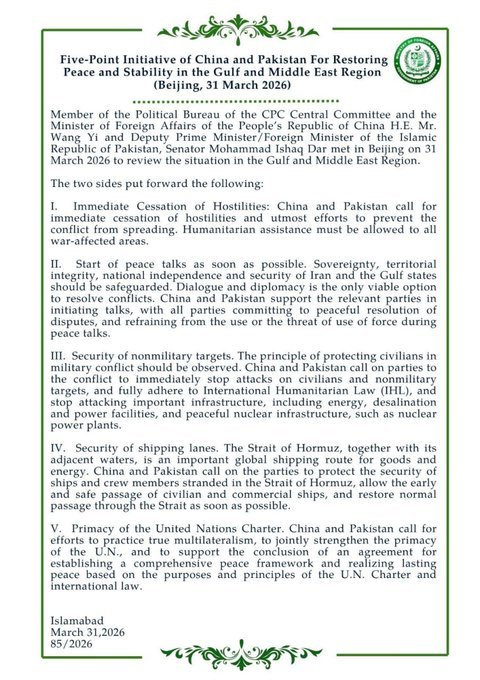
Amidst the intensifying U.S.-Israel-Iran war, China and Pakistan officially proposed a joint “Five-Point Initiative” on Tuesday, March 31, 2026, aimed at restoring peace and stability in the Gulf and Middle East. The proposal followed a high-level meeting in Beijing between Chinese Foreign Minister Wang Yi and his Pakistani counterpart, Ishaq Dar.
The initiative represents the first major collective diplomatic intervention by a global power (China) and a key regional mediator (Pakistan) since the conflict began on February 28.
The Five-Point Framework
The joint statement outlines a specific sequence for de-escalation, focusing on humanitarian protection and the restoration of global energy trade.
- Immediate Cessation of Hostilities: An urgent call for all parties to stop fighting and prevent the conflict from spreading. Crucially, the plan demands that humanitarian assistance be allowed into all war-affected areas immediately.
- Early Start of Peace Talks: Both nations emphasized that “dialogue and diplomacy are the only viable options.” They called for the safeguarding of the sovereignty and territorial integrity of all regional states, including Iran.
- Protection of Non-Military Targets: The plan demands an end to attacks on civilians and critical infrastructure. It specifically mentions protecting energy facilities, desalination plants, and peaceful nuclear infrastructure (such as power plants), which have been hit in recent strikes.
- Security of Shipping Lanes: Addressing the global energy crunch, the plan calls for the “early and safe passage” of commercial ships through the Strait of Hormuz and the protection of stranded crew members.
- Primacy of the UN Charter: The initiative advocates for “true multilateralism” and the development of a comprehensive peace framework based on international law and the UN Charter.
Strategic Context: The “Islamabad Track”
The proposal strengthens the role of the “Islamabad Track” as the primary non-Western diplomatic hub.
- Mediation Role: Foreign Minister Wang Yi formally backed Pakistan’s “unique and important role” in resuming peace talks, signaling that Beijing views Islamabad as the most credible bridge between Washington and Tehran.
- The “Toll” Rejection: Analysts note that the call for “normal passage” in the Strait of Hormuz appears to be a subtle rejection of Iran’s recent attempts to impose a “Yuan-based toll” on shipping, reflecting China’s own need for stable energy prices.
- Iranian Response: While Tehran has not officially accepted the plan, the Iranian Tasnim news agency reported that a response to President Trump’s 15-point plan had already been passed to the U.S. via Pakistani mediators.
Global Reactions
- The White House: President Donald Trump has not yet formally commented on the Beijing-Islamabad plan, though he noted earlier today that the “hard part” of the war is done and the U.S. has “more work to do.”
- Energy Markets: The news of a structured peace proposal contributed to a slight cooling of oil prices, with WTI crude dipping toward $101 per barrel after weeks of volatility.
- Russia: Foreign Minister Sergey Lavrov echoed many of the plan’s sentiments in his own remarks today, criticizing the U.S. and Israel for “preventing normalization” in the region.
| Initiative Pillar | Primary Objective |
| Humanitarian | Open corridors for aid in Iran and Lebanon |
| Economic | Restore “Normal Passage” through Hormuz |
| Legal | UN Charter-based peace framework |
| Infrastructure | No-strike status for desalination and power plants |
| Diplomatic | Immediate talks without “threat of force” |
The April 6 Deadline
With the April 6 deadline looming, the China-Pakistan initiative serves as a major pressure point. It offers the U.S. a potential “exit ramp” that carries the backing of the world’s second-largest economy, while providing Iran with the “guarantees” of sovereignty and infrastructure protection demanded earlier today by President Pezeshkian.
Questions people ask
What is China's current share of global manufacturing?
China now accounts for twenty eight percent of global manufacturing. This industrial output exceeds the combined manufacturing production of the United States, Japan, and Germany, making China the leading global industrial power according to recent reports.
Why were Andrew Tate and Tristan Tate arrested in Miami?
Andrew Tate and his brother Tristan Tate were taken into custody in Miami by the United States Marshals Service. They face thirty eight new charges in the United Kingdom, including rape and child pornography offences, and prosecutors are seeking their extradition.
What warning did Moscow issue about oil prices?
Kirill Dmitriev, the Chief Executive of the Russian Direct Investment Fund, warned that a tsunami of skyrocketing oil prices is approaching. Moscow describes this potential energy shock as a major threat to global markets.
What political shift is projected for Benjamin Netanyahu's coalition?
Political polls project that Prime Minister Benjamin Netanyahu's coalition is on track to lose its majority in the upcoming October election. This projection indicates a potential political shift in Jerusalem.
Why did a Russian military aircraft land in Tehran?
A Russian airborne command aircraft, widely known as a doomsday plane, landed in Tehran. The arrival of the aircraft represents a high stakes show of support from Russia for Iran during a period of heightened regional tensions.
What did President Masoud Pezeshkian claim about the United States and Israel?
Iranian President Masoud Pezeshkian claimed that the United States and Israel failed in a forty eight hour plan to topple the Iranian government. He made these statements during a televised address marking two years since his inauguration.