Reflecto News is an online news platform covering major international political events, global economic developments, and security conflicts. The site provides updates on topics such as Chinese manufacturing dominance, Middle Eastern political tensions, and high profile legal arrests. Readers can access current articles organized by categories like World News, Iran, and USA.
Reflecto News | Business | Global Auto Industry
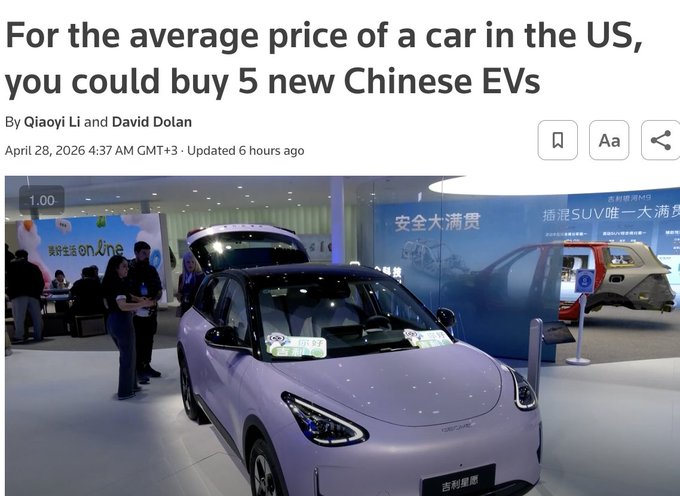
BEIJING — The price gap between electric vehicles in China and the United States has reached a staggering level: for the average price of a single new car in America, a consumer in China can purchase five brand-new EVs.
According to data from Kelley Blue Book, the average list price of a new car in the U.S. in March 2026 stood at $51,456 . In China, by contrast, there are more than 200 battery-powered models (including hybrids) for sale at less than the equivalent of $25,000 .
The disparity is so extreme that Reuters compiled a list of the five best-selling EVs in China with starting prices under $12,000 . Purchasing one of each of these vehicles would cost roughly the same as a single average-priced American car .
🇺🇸 The American Reality: $775 a Month and Rising
The numbers paint a bleak picture for affordability in the U.S. market.
| Metric | 2026 Value |
|---|---|
| Average New Car Price | $51,456 |
| Average Monthly Payment | $775 |
| Vehicles Under $30k | Only ~13% of inventory |
Inflation has strained household budgets, but new car prices have surged roughly 12.6% year-over-year, far outpacing general inflation . Many automakers, particularly the “Big Three” U.S. manufacturers, have abandoned affordable small cars like the Chevy Cruze and Ford Fusion to focus on high-margin SUVs and trucks, effectively killing the budget-friendly new car segment .
🇨🇳 The Chinese Market: A Flood of Sub-$12,000 EVs
The hyper-competitive nature of the Chinese auto industry has driven prices to historic lows, compressing the global price curve.
According to DCar (an auto info platform), there are over 200 new energy vehicle (NEV) models available in China for under $25,000 . Reuters highlighted five specific high-volume EVs with starting prices under $12,000:
| Model | Starting Price (USD) | Notable Feature |
|---|---|---|
| Geely EX2 (Star Wish) | $10,060 | China’s top-selling vehicle of 2025; feels larger inside |
| Wuling Hongguang MiniEV | $6,560 | Ultra-compact city car; top speed ~62 mph |
| BYD Seagull | $10,200 | Massive hit; now offers optional lidar & fast charging |
| BYD Yuan Up | $10,945 | Compact SUV; high value-per-dollar for families |
| BYD Qin Plus DM-i | $11,675 | Plug-in hybrid sedan; long-range capability |
American shoppers cannot currently access these prices. A 100% import tariff (retained by the Trump administration) currently walls off these Chinese OEMs from the U.S. market .
“When you get in, you don’t feel like you are in a small car. It feels better in terms of quality and bigger in terms of size.”
— Felipe Munoz, Auto analyst on the Geely EX2
🤷♂️ American ‘Car Envy’: The View from Beijing
The Beijing Auto Show has become a showcase not just for the cars, but for this stark economic divergence.
U.S. social media influencers at the event report that their audiences are “frustrated” and “jealous.” A YouTube creator with 210,000 subscribers noted: “In our comments section, people keep complaining, ‘I can’t believe the U.S. government won’t allow this car to be sold in my country'” .
“You’re seeing a car that might cost $30,000, fully loaded… In the U.S., for $30,000, you can’t get any EV or hybrid.”
— Ethan Robertson, U.S. influencer at the Beijing Auto Show
🛡️ The Tariff Wall: Keeping the Gap Closed
For now, the U.S. market is protected by a 100% tariff on Chinese-made EVs, blocking the direct retail competition that exists in markets like Canada (which recently allowed up to 49,000 Chinese-made EVs at a 6.1% rate) .
However, American manufacturers are not immune to the pressure. Ford CEO Jim Farley publicly described BYD as “best in class” on cost, supply chain, and manufacturing, admitting that Ford is now reorienting its strategy explicitly around the China cost curve rather than just competing with Tesla .
📊 Key Takeaways for Reflecto News Readers
| Aspect | Summary |
|---|---|
| U.S. Average Price | $51,456 (March 2026 data) |
| China Entry Price | 200+ EV/Hybrid models available for under $25,000 |
| The Ratio | You can buy five high-volume EVs in China for the price of one average U.S. car |
| Why So Cheap? | Hyper-competitive market, lower subsidies, vertical integration (batteries) |
| Lowest Price | Wuling Hongguang MiniEV starts at ~$6,560 |
| U.S. Barrier | 100% tariff; Chinese EVs currently cannot be imported for sale |
Follow Reflecto News for continuous updates on the global automotive industry, US-China trade, and all breaking business news.
This article is the intellectual property of Reflecto News. Redistribution without attribution is prohibited. For syndication or media inquiries, please contact the editorial team.
Questions people ask
What is China's current share of global manufacturing?
China now accounts for twenty eight percent of global manufacturing. This industrial output exceeds the combined manufacturing production of the United States, Japan, and Germany, making China the leading global industrial power according to recent reports.
Why were Andrew Tate and Tristan Tate arrested in Miami?
Andrew Tate and his brother Tristan Tate were taken into custody in Miami by the United States Marshals Service. They face thirty eight new charges in the United Kingdom, including rape and child pornography offences, and prosecutors are seeking their extradition.
What warning did Moscow issue about oil prices?
Kirill Dmitriev, the Chief Executive of the Russian Direct Investment Fund, warned that a tsunami of skyrocketing oil prices is approaching. Moscow describes this potential energy shock as a major threat to global markets.
What political shift is projected for Benjamin Netanyahu's coalition?
Political polls project that Prime Minister Benjamin Netanyahu's coalition is on track to lose its majority in the upcoming October election. This projection indicates a potential political shift in Jerusalem.
Why did a Russian military aircraft land in Tehran?
A Russian airborne command aircraft, widely known as a doomsday plane, landed in Tehran. The arrival of the aircraft represents a high stakes show of support from Russia for Iran during a period of heightened regional tensions.
What did President Masoud Pezeshkian claim about the United States and Israel?
Iranian President Masoud Pezeshkian claimed that the United States and Israel failed in a forty eight hour plan to topple the Iranian government. He made these statements during a televised address marking two years since his inauguration.