
Reflecto News is an online news platform covering major international political events, global economic developments, and security conflicts. The site provides updates on topics such as Chinese manufacturing dominance, Middle Eastern political tensions, and high profile legal arrests. Readers can access current articles organized by categories like World News, Iran, and USA.
Published on Reflecto News | World News | Economy & Geopolitics
Since the 1979 Islamic Revolution, Iran has experienced the worst economic trajectory of any major country in the Middle East. The numbers are brutal: average annual GDP growth of just 1.9 percent over 47 years, plagued by volatility, sanctions, war, and oil dependence. Meanwhile, its neighbors have surged ahead, diversifying their economies, integrating into global trade, and building skylines that pierce the clouds.
The compounding effect of Iran’s choice—revolution, isolation, proxy wars, and decades of confrontation with the West—has left a country that should have been the region’s powerhouse among its poorest performers per capita.
| Country | Average Annual GDP Growth (1979-2026) | Key Economic Strategy |
|---|---|---|
| Iran | 1.9% | Revolution, isolation, proxy wars |
| UAE | 4-5% | Diversification: finance, trade, tourism |
| Saudi Arabia | 3-4% | Oil exports, Vision 2030 reforms |
| Oman | 3-4% | Diversification, logistics |
| Bahrain | 3-4% | Finance, refining |
| Kuwait | 2-3% | Oil wealth, sovereign fund |
| Qatar | 5%+ | Gas exports, global integration |
Sources: World Bank, IMF, multiple economic reports
The Gulf Model: Openness and Integration
The Gulf states chose a different path. Qatar discovered natural gas and integrated globally, transforming itself into the country with the highest GDP per capita in the region. The UAE diversified into finance, trade, and tourism, achieving 4-5 percent annual growth for decades.
Key factors in Gulf success:
| Factor | Impact |
|---|---|
| Economic openness | Attracted foreign investment |
| Global trade integration | Access to world markets |
| Energy export revenue | Funded infrastructure and diversification |
| Political stability | Enabled long-term planning |
| Strategic alliances | Security umbrella from Western powers |
Saudi Arabia, Bahrain, Oman, and even Kuwait all outpaced Iran by wide margins. The Gulf states picked one path: open the economy, export energy, plug into global trade .
Iran’s Alternative Path: Revolution and Isolation
Iran picked another: revolution, isolation, proxy wars, and a decades-long fight with the West. The Islamic Revolution promised independence from foreign domination—and delivered that. But it also delivered 47 years of economic stagnation .
Key factors in Iran’s underperformance:
| Factor | Impact |
|---|---|
| Sanctions | Decades of economic restrictions |
| War | Iran-Iraq War (1980-88); current conflict |
| Revolutionary governance | Economic mismanagement, ideology over pragmatism |
| Isolation | Limited foreign investment, technology transfer |
| Proxy wars | Resources diverted to regional conflicts |
| Oil dependence | Failure to diversify |
The Human Cost: Poverty, Unemployment, and Brain Drain
The economic stagnation has had devastating human consequences. Iran’s population has more than tripled since 1979, from approximately 35 million to over 90 million today. But the economy has not kept pace.
Human development indicators:
| Indicator | Iran | UAE | Saudi Arabia |
|---|---|---|---|
| GDP per capita (PPP) | ~$15,000 | ~$78,000 | ~$58,000 |
| Unemployment rate | ~10-15% | ~3% | ~5% |
| Youth unemployment | ~20-25% | ~6% | ~12% |
| Poverty rate | Significant | Low | Low |
| Brain drain | Severe | N/A (importer of talent) | N/A (importer of talent) |
Sources: World Bank, IMF, multiple reports
Millions of educated Iranians have left the country over the past four decades, seeking opportunities abroad. The brain drain has deprived Iran of the human capital needed to build a diversified, knowledge-based economy .
The War’s Economic Devastation
The current war with the United States and Israel, which began on February 28, has inflicted further damage. Iran estimates its war losses at approximately $270 billion, with reconstruction costs potentially exceeding $1 trillion .
War damage estimates:
| Category | Estimated Damage |
|---|---|
| Energy infrastructure | Oil refineries, gas fields, petrochemical plants |
| Industrial base | Steel works, factories |
| Transportation networks | Railways, bridges, airports |
| Power grid | Power plants and electricity infrastructure |
| Housing | Over 101,000 homes across 24 provinces |
Sources: Iranian officials, Reuters
The Gulf’s Skyline vs. Iran’s Stagnation
The contrast between Iran and its neighbors is stark. Dubai’s skyline, with the Burj Khalifa piercing the clouds, symbolizes the UAE’s transformation from a desert outpost to a global hub. Abu Dhabi’s cultural district, Doha’s Education City, and Riyadh’s King Abdullah Financial District all represent the fruits of economic openness and global integration .
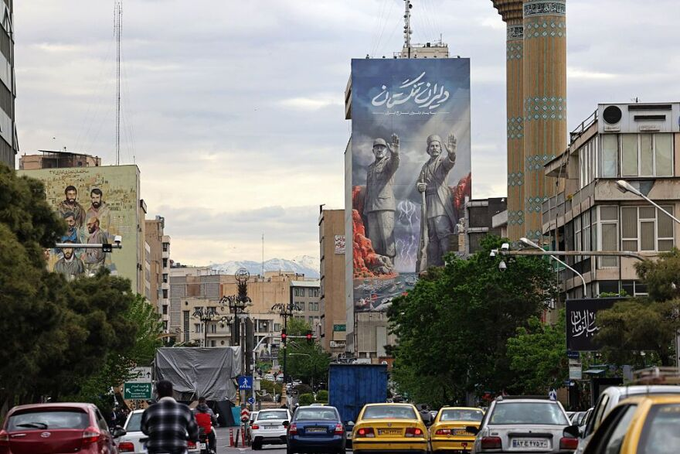
Iran, by contrast, has struggled to build modern infrastructure. Tehran’s skyline is dominated by aging buildings, and the country’s airports, roads, and ports lag far behind regional standards .
The Revolution’s Unfulfilled Promise
The Islamic Revolution promised prosperity and justice. It delivered independence—but at an enormous economic cost. The revolutionary leadership prioritized ideological purity over economic pragmatism, and the country has paid the price .
The revolution’s economic legacy:
| Promise | Reality |
|---|---|
| Economic independence | Isolation and sanctions |
| Justice and prosperity | Stagnation and inequality |
| End of foreign domination | Continued dependence on oil exports |
| Self-sufficiency | Failure to diversify |
What Comes Next: Can Iran Reverse Course?
The ceasefire with the United States, brokered by Pakistan, offers a potential off-ramp from the current conflict. But even if the war ends, Iran faces a long road to economic recovery.
| Scenario | Likelihood | Implications |
|---|---|---|
| Sanctions relief | Uncertain | Would require nuclear deal |
| Foreign investment | Possible | Would require political opening |
| Economic reforms | Unlikely | Resistance from hardliners |
| Continued stagnation | Likely | Status quo persists |
The Islamic Revolution promised independence from foreign domination. It delivered that. It also delivered 47 years of economic stagnation while neighbors built skylines that pierce the clouds. Sometimes the receipts of revolution come due decades later .
Frequently Asked Questions (FAQs)
1. How has Iran’s economy performed since the 1979 Islamic Revolution?
Iran has experienced average annual GDP growth of just 1.9 percent over 47 years, making it the worst economic performer among major Middle Eastern countries .
2. How do Iran’s neighbors compare?
Qatar, the UAE, Saudi Arabia, Oman, Bahrain, and Kuwait all outpaced Iran by wide margins. The UAE grew at 4-5 percent annually for decades, while Qatar’s gas wealth gave it the highest GDP per capita in the region .
3. Why has Iran underperformed?
Key factors include decades of sanctions, the Iran-Iraq War, revolutionary governance that prioritized ideology over pragmatism, isolation from global trade, diversion of resources to proxy wars, and failure to diversify away from oil .
4. What has been the human cost?
Iran suffers from high unemployment (10-15 percent), severe brain drain, and poverty. GDP per capita is approximately $15,000, compared to $78,000 in the UAE and $58,000 in Saudi Arabia .
5. How has the current war affected Iran’s economy?
Iran estimates war losses at approximately $270 billion, with reconstruction costs potentially exceeding $1 trillion. Energy infrastructure, industrial sites, transportation networks, and over 100,000 homes have been damaged .
6. Can Iran reverse its economic decline?
Sanctions relief, foreign investment, and economic reforms would be needed, but hardliners resist change. Continued stagnation appears likely in the near term .
7. What does the Islamic Revolution’s economic legacy teach us?
The revolution delivered independence from foreign domination but at an enormous economic cost—47 years of stagnation while neighbors surged ahead. The compounding effect of those choices has been staggering .
Stay informed with Reflecto News – Your trusted source for breaking economic and geopolitical intelligence. Subscribe for real-time updates on Middle East economies, Iran’s financial crisis, and global energy markets.
Questions people ask
What is China's current share of global manufacturing?
China now accounts for twenty eight percent of global manufacturing. This industrial output exceeds the combined manufacturing production of the United States, Japan, and Germany, making China the leading global industrial power according to recent reports.
Why were Andrew Tate and Tristan Tate arrested in Miami?
Andrew Tate and his brother Tristan Tate were taken into custody in Miami by the United States Marshals Service. They face thirty eight new charges in the United Kingdom, including rape and child pornography offences, and prosecutors are seeking their extradition.
What warning did Moscow issue about oil prices?
Kirill Dmitriev, the Chief Executive of the Russian Direct Investment Fund, warned that a tsunami of skyrocketing oil prices is approaching. Moscow describes this potential energy shock as a major threat to global markets.
What political shift is projected for Benjamin Netanyahu's coalition?
Political polls project that Prime Minister Benjamin Netanyahu's coalition is on track to lose its majority in the upcoming October election. This projection indicates a potential political shift in Jerusalem.
Why did a Russian military aircraft land in Tehran?
A Russian airborne command aircraft, widely known as a doomsday plane, landed in Tehran. The arrival of the aircraft represents a high stakes show of support from Russia for Iran during a period of heightened regional tensions.
What did President Masoud Pezeshkian claim about the United States and Israel?
Iranian President Masoud Pezeshkian claimed that the United States and Israel failed in a forty eight hour plan to topple the Iranian government. He made these statements during a televised address marking two years since his inauguration.