Reflecto News is an online news platform covering major international political events, global economic developments, and security conflicts. The site provides updates on topics such as Chinese manufacturing dominance, Middle Eastern political tensions, and high profile legal arrests. Readers can access current articles organized by categories like World News, Iran, and USA.
Reflecto News
April 10, 2026
In a development closely watched by regional powers and international observers, Chinese President Xi Jinping met today with Cheng Li-wun, Chairperson of Taiwan’s main opposition Kuomintang (KMT) party, in Beijing. The rare high-level engagement— the first of its kind in a decade—comes as Beijing intensifies efforts to promote cross-strait dialogue while Taiwan’s ruling Democratic Progressive Party (DPP) maintains a firm stance on sovereignty.
The meeting underscores deepening divisions within Taiwan’s political landscape and arrives just weeks before Xi’s scheduled summit with U.S. President Donald Trump in Beijing next month.
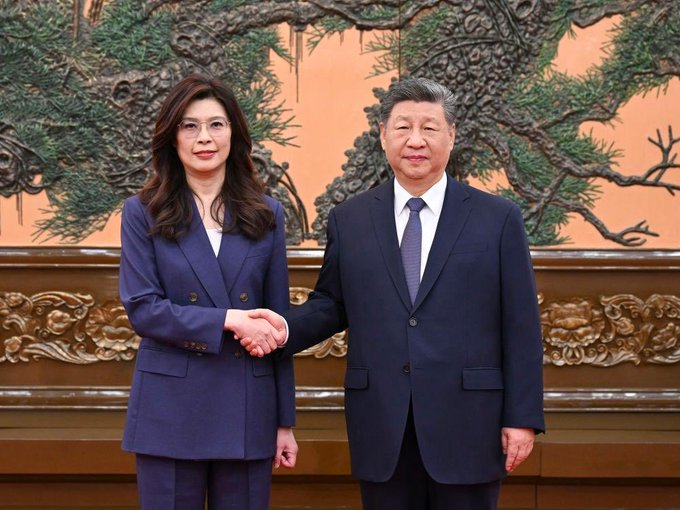
Meeting Highlights: Xi Emphasizes “One Family” and Rejects Independence
According to official Chinese state media and reports from the meeting, President Xi Jinping delivered a clear message rooted in Beijing’s long-standing “One China” principle. He stated that “compatriots on both sides of the strait are all Chinese—people of one family who want peace, development, exchange, and cooperation.” Xi added, “Both sides of the strait belong to ‘one China’,” and invoked the proverb, “When the family is harmonious, all things will prosper.”
Xi expressed strong confidence that Taiwan would eventually “get together” with the mainland through dialogue and cooperation. He firmly declared that “Taiwan independence is the chief culprit in undermining peace in the Taiwan Strait—we will absolutely not tolerate or condone it.”
Cheng Li-wun, who leads the KMT delegation on a six-day visit, responded by framing the trip as a “journey for peace.” She has consistently advocated for reconciliation, stating prior to her arrival that the visit would demonstrate “the sincerity and determination of the Chinese Communist Party to engage in peaceful dialogue and exchanges across the Taiwan Strait.” During earlier stops in Shanghai and Nanjing, she emphasized practical goodwill gestures, famously remarking, “Birds, not missiles, should fly in the skies.”
The KMT chairwoman also highlighted shared cultural and historical ties, paying respects at Sun Yat-sen’s mausoleum in Nanjing and calling for both sides to “promote reconciliation and unity across the [Taiwan] Strait and create regional prosperity and peace.”
Cheng Li-wun’s Landmark Visit: Itinerary and Objectives
Cheng Li-wun arrived in China on April 7, 2026, marking the first visit by a sitting KMT chairperson in over ten years. Her itinerary included stops in Shanghai for a gala dinner with China’s Taiwan Affairs Office Director Song Tao, Nanjing for historical commemorations, and culminating in Beijing for the high-stakes meeting with Xi.
In public statements before departure from Taipei, Cheng declared: “The purpose of this visit to mainland China is precisely to show the world that it is not just Taiwan that unilaterally hopes for peace.” She positioned the KMT as a bridge for dialogue, arguing that Taiwan should become “a symbol of peace jointly safeguarded by Chinese people on both sides of the strait.”
The KMT, historically tied to the Republic of China’s founding ideals, supports the 1992 Consensus—a framework allowing both sides to acknowledge “One China” while interpreting it differently. This contrasts sharply with the DPP’s rejection of the consensus and emphasis on Taiwan’s distinct identity.
Historical Background: From Civil War to Cross-Strait Engagement
The roots of today’s meeting trace back to the Chinese Civil War, when the KMT retreated to Taiwan in 1949 after defeat by the Chinese Communist Party. For decades, the two sides maintained limited contact until the 1990s, when semi-official talks began.
A pivotal moment came in 2015 when then-KMT leader Hung Hsiu-chu met Xi Jinping—the last comparable high-level encounter before today’s talks. Under KMT President Ma Ying-jeou (2008–2016), cross-strait relations flourished with direct flights, tourism, and economic pacts. However, the DPP’s 2016 and 2024 electoral victories, coupled with President Lai Ching-te’s inauguration, shifted dynamics toward greater wariness of Beijing.
Military tensions have escalated since 2016, with frequent People’s Liberation Army drills around Taiwan. Beijing views “reunification” as a core legacy goal for Xi, refusing to rule out the use of force if necessary.
Political Reactions and Domestic Divide in Taiwan
The visit has ignited fierce debate in Taiwan. Critics from the ruling DPP accuse the KMT of undermining national defense efforts, pointing to the opposition’s blockage of a proposed $40 billion special defense budget in favor of a smaller, U.S.-aligned package. President Lai Ching-te has reiterated openness to talks with Beijing but insists Taiwan has the right to chart its own democratic course.
Expert analysis highlights the meeting’s strategic timing. Amanda Hsiao of the Eurasia Group noted Beijing’s aim to “cast doubt on the Lai administration’s self-defense focus” and deepen internal divisions. William Yang of the International Crisis Group suggested China hopes to signal to Washington that pro-engagement voices exist within Taiwan, potentially influencing future U.S. arms sales policy.
Drew Thompson, a former U.S. defense official, cautioned that Cheng’s positions do not reflect majority Taiwanese sentiment, where polls consistently show most residents identify primarily as Taiwanese rather than Chinese.
Geopolitical Context: Timing with U.S.-China Summit
The talks occur against a backdrop of U.S.-China friction over Taiwan. Washington remains Taiwan’s primary security partner, with recent arms packages including missiles and drones. In a February 2026 call, Xi urged President Trump to exercise “prudence” on arms sales, calling Taiwan the “most important issue” in bilateral relations.
Analysts believe Cheng’s visit may help Beijing separate Taiwan issues from the upcoming Xi-Trump summit, allowing focus on trade and other priorities. It also counters narratives framing the strait as an inevitable flashpoint, instead promoting Beijing’s preferred model of peaceful development through party-to-party channels.
What This Means for Cross-Strait Stability
While no concrete agreements were announced from today’s meeting, the symbolism is significant. It revives direct KMT-CCP communication after years of frozen official channels under the DPP. Supporters see it as a pragmatic step toward reducing tensions; detractors warn it risks legitimizing Beijing’s pressure tactics without addressing core sovereignty concerns.
As military activities continue and global powers monitor the region, today’s dialogue offers a rare window into alternative paths for peace—rooted in shared heritage but tested by diverging political realities.
Key Takeaways
- First KMT chairperson visit to China in a decade.
- Xi reaffirms “One China” and rules out tolerance for independence.
- Cheng positions KMT as peace bridge ahead of U.S.-China summit.
- Highlights Taiwan’s internal political divide on China policy.
Frequently Asked Questions (FAQs)
Q1: Who is Cheng Li-wun?
Cheng Li-wun is the Chairperson of Taiwan’s Kuomintang (KMT), the island’s largest opposition party. Elected last year, she advocates closer economic and cultural ties with Beijing under the 1992 Consensus framework.
Q2: Why is this meeting significant?
It marks the highest-level contact between the KMT and Chinese leadership since 2015. As the first such visit by a sitting KMT chair in ten years, it revives party-to-party dialogue amid stalled official government channels.
Q3: What is the “1992 Consensus”?
An understanding reached in 1992 allowing both sides to acknowledge there is “One China” while permitting different interpretations. The KMT accepts it; the DPP does not.
Q4: How has Taiwan’s government responded?
President Lai Ching-te (DPP) has expressed willingness for dialogue but stresses Taiwan’s right to self-determination and continues strengthening defense ties with the United States.
Q5: Does this meeting reduce the risk of conflict?
While it signals goodwill on the opposition side, experts caution that fundamental differences remain. Beijing has not renounced the use of force, and military drills persist.
Q6: How does this affect U.S.-China relations?
The timing—weeks before the Xi-Trump summit—allows Beijing to showcase domestic Taiwanese support for engagement, potentially influencing discussions on arms sales and regional stability.
Q7: Will more KMT visits follow?
Cheng’s delegation returns to Taiwan on April 12. Future engagements will depend on domestic politics in Taiwan and Beijing’s willingness to continue dialogue.
Reflecto News will continue monitoring developments in cross-strait relations. For the latest updates, stay tuned to our dedicated Taiwan and China coverage.
All information sourced from verified international reports and official statements as of April 10, 2026.
Questions people ask
What is China's current share of global manufacturing?
China now accounts for twenty eight percent of global manufacturing. This industrial output exceeds the combined manufacturing production of the United States, Japan, and Germany, making China the leading global industrial power according to recent reports.
Why were Andrew Tate and Tristan Tate arrested in Miami?
Andrew Tate and his brother Tristan Tate were taken into custody in Miami by the United States Marshals Service. They face thirty eight new charges in the United Kingdom, including rape and child pornography offences, and prosecutors are seeking their extradition.
What warning did Moscow issue about oil prices?
Kirill Dmitriev, the Chief Executive of the Russian Direct Investment Fund, warned that a tsunami of skyrocketing oil prices is approaching. Moscow describes this potential energy shock as a major threat to global markets.
What political shift is projected for Benjamin Netanyahu's coalition?
Political polls project that Prime Minister Benjamin Netanyahu's coalition is on track to lose its majority in the upcoming October election. This projection indicates a potential political shift in Jerusalem.
Why did a Russian military aircraft land in Tehran?
A Russian airborne command aircraft, widely known as a doomsday plane, landed in Tehran. The arrival of the aircraft represents a high stakes show of support from Russia for Iran during a period of heightened regional tensions.
What did President Masoud Pezeshkian claim about the United States and Israel?
Iranian President Masoud Pezeshkian claimed that the United States and Israel failed in a forty eight hour plan to topple the Iranian government. He made these statements during a televised address marking two years since his inauguration.