Reflecto News is an online news platform covering major international political events, global economic developments, and security conflicts. The site provides updates on topics such as Chinese manufacturing dominance, Middle Eastern political tensions, and high profile legal arrests. Readers can access current articles organized by categories like World News, Iran, and USA.
Published on Reflecto News | World News | Middle East Conflict
The Israeli military has completed the systematic destruction of the town of Al-Khiam in southern Lebanon over the past month, according to video footage and satellite imagery reviewed by multiple news organizations. The town, located approximately 5 kilometers north of the Israeli-Lebanese border, has been reduced to rubble in what military analysts describe as a deliberate “scorched earth” tactic to create a buffer zone .
The destruction of Al-Khiam—a town of significant symbolic importance to Hezbollah—represents one of the most extensive demolitions of a civilian area since the 2006 Lebanon War .
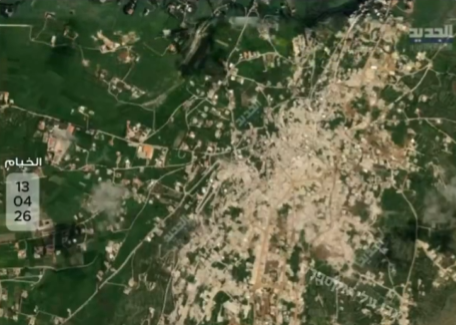
‘The Town No Longer Exists’
Video footage circulating on social media and verified by open-source intelligence analysts shows widespread devastation across Al-Khiam. Residential buildings, commercial structures, and municipal facilities have been systematically leveled .
“Al-Khiam is gone. Not damaged. Not partially destroyed. Gone. Every building has been flattened. This is not collateral damage—this is deliberate erasure.” — Middle East analyst, speaking on condition of anonymity
Satellite imagery from Planet Labs confirms that approximately 85-90 percent of structures in Al-Khiam have been damaged or destroyed, with entire city blocks reduced to rubble. The town’s historic center, including its municipal buildings and main square, has been completely leveled .
Strategic Significance of Al-Khiam
Al-Khiam holds particular strategic and symbolic importance in the Israel-Hezbollah conflict.
| Factor | Significance |
|---|---|
| Location | Approximately 5 km from Israeli border; overlooks key terrain |
| 2006 War | Site of intense battles between IDF and Hezbollah |
| Detention center | Former Khiam detention center was symbol of Israeli occupation (1985-2000) |
| Hezbollah presence | Town served as Hezbollah stronghold with extensive tunnel network |
| Missile launch sites | Used for rocket and missile launches toward northern Israel |
The town’s elevation provides strategic oversight of the surrounding area, making it a valuable military position for Hezbollah. Israeli military officials have stated that the town was used as a launching point for anti-tank missiles and rockets targeting Israeli communities .
The ‘Buffer Zone’ Strategy
The destruction of Al-Khiam is part of a broader Israeli military strategy to establish a “deeper security zone” in southern Lebanon, announced by Prime Minister Benjamin Netanyahu on Monday .
“We are not talking about five posts, we are talking about a solid, deeper security zone that both prevents the threat of invasion and pushes away the anti-tank missile threat.” — Prime Minister Benjamin Netanyahu
Defense Minister Israel Katz has previously articulated Israel’s goal of establishing a security zone up to the Litani River, approximately 30 kilometers (19 miles) from the Israel-Lebanon border . Under this plan, Israeli forces would maintain control over a significant swath of southern Lebanon, and displaced Lebanese residents “will not return south of the Litani River until security is guaranteed for the residents of the north” of Israel .
The destruction of border villages serves multiple tactical purposes:
- Elimination of cover: Removing buildings that could provide cover for Hezbollah fighters
- Destruction of infrastructure: Targeting tunnel networks and weapons storage facilities
- Creation of clear fields of fire: Open terrain advantages Israeli surveillance and firepower
- Prevention of return: Making villages uninhabitable prevents Hezbollah from re-establishing positions
- Psychological deterrence: Demonstrating the cost of Hezbollah’s attacks
Scale of Destruction Across Southern Lebanon
Al-Khiam is not alone. Satellite imagery and ground reports indicate that at least a dozen villages along the Blue Line have been partially or completely destroyed.
Destroyed or heavily damaged villages:
- Al-Khiam (90%+ destroyed)
- Bint Jbeil (severely damaged; ongoing fighting)
- Deir Seryan (demolished)
- Taybeh (demolished)
- Naqoura (significant damage)
- Odaisseh (significant damage)
- Kfar Kila (significant damage)
- Mays al-Jabal (significant damage)
The Israeli military has stated that it is targeting Hezbollah infrastructure embedded within civilian areas. Human rights organizations have raised concerns that the scale of destruction—particularly the demolition of entire villages—may amount to collective punishment or a violation of the laws of war .
Humanitarian Impact
The destruction of Al-Khiam has displaced thousands of residents. According to local officials, the town’s pre-war population of approximately 10,000 has been reduced to zero, with families fleeing north toward Beirut or Tyre .
| Humanitarian Metric | Al-Khiam |
|---|---|
| Pre-war population | ~10,000 |
| Current population | 0 (fully evacuated) |
| Homes destroyed | ~2,000 (est.) |
| Infrastructure damage | Municipal buildings, schools, clinics destroyed |
| Return prospects | None in foreseeable future |
The UN Office for the Coordination of Humanitarian Affairs (OCHA) has reported that access to southern Lebanon remains severely restricted, hindering assessment of the full scale of destruction and delivery of aid .
International Law Concerns
The destruction of an entire town raises significant questions under international humanitarian law. The Fourth Geneva Convention prohibits the destruction of civilian property unless “rendered absolutely necessary by military operations.”
Human Rights Watch has documented previous instances of Israeli “domicide” in Gaza and has expressed concern about similar tactics being employed in Lebanon. “Even if Hezbollah uses some civilian facilities for military purposes, this does not justify the large-scale destruction of entire villages,” said Ramzi Kaiss, a Lebanon researcher at Human Rights Watch .
Israel maintains that its actions are lawful and necessary for self-defense against Hezbollah’s attacks. The Israeli military states that it targets only military infrastructure and that Hezbollah’s practice of embedding within civilian areas bears responsibility for the destruction .
What Comes Next
As Israel expands its ground operations in southern Lebanon, more villages may face the same fate as Al-Khiam.
| Scenario | Likelihood | Implication |
|---|---|---|
| Additional villages destroyed | High | Israel expanding buffer zone |
| Residents prevented from returning | Likely | Netanyahu’s “deeper security zone” plan |
| International condemnation | Likely | UN, EU, human rights groups to respond |
| Hezbollah retaliation | Ongoing | Rocket and drone attacks continue |
The destruction of Al-Khiam stands as a stark symbol of the war’s toll on Lebanese civilians. For the town’s displaced residents, the prospect of return appears remote—and the cost of Hezbollah’s conflict with Israel has been measured in the erasure of their community.
Frequently Asked Questions (FAQs)
1. What happened to Al-Khiam?
The Israeli military has systematically destroyed the town of Al-Khiam in southern Lebanon over the past month. Satellite imagery confirms that approximately 85-90% of structures have been damaged or destroyed.
2. Why was Al-Khiam targeted?
Al-Khiam is located approximately 5 kilometers from the Israeli border and has served as a Hezbollah stronghold. Israeli officials say the town was used as a launching point for rockets and anti-tank missiles targeting northern Israel.
3. Is this part of a broader Israeli strategy?
Yes. Prime Minister Netanyahu has announced plans to establish a “deeper security zone” in southern Lebanon, potentially extending to the Litani River (30 km from the border).
4. Is this legal under international law?
Human rights organizations have raised concerns that the systematic destruction of entire villages may amount to collective punishment or violate the laws of war. Israel maintains its actions are lawful and necessary for self-defense.
5. What happened to the residents of Al-Khiam?
The town’s pre-war population of approximately 10,000 has been completely displaced, fleeing north toward Beirut and Tyre. Return prospects are minimal in the foreseeable future.
6. Are other villages being destroyed?
Yes. At least a dozen villages along the Blue Line have been partially or completely destroyed, including Bint Jbeil, Deir Seryan, Taybeh, and Naqoura.
Stay informed with Reflecto News – Your trusted source for breaking conflict and humanitarian intelligence. Subscribe for real-time updates on the Israel-Hezbollah war, Middle East diplomacy, and regional security developments.
Questions people ask
What is China's current share of global manufacturing?
China now accounts for twenty eight percent of global manufacturing. This industrial output exceeds the combined manufacturing production of the United States, Japan, and Germany, making China the leading global industrial power according to recent reports.
Why were Andrew Tate and Tristan Tate arrested in Miami?
Andrew Tate and his brother Tristan Tate were taken into custody in Miami by the United States Marshals Service. They face thirty eight new charges in the United Kingdom, including rape and child pornography offences, and prosecutors are seeking their extradition.
What warning did Moscow issue about oil prices?
Kirill Dmitriev, the Chief Executive of the Russian Direct Investment Fund, warned that a tsunami of skyrocketing oil prices is approaching. Moscow describes this potential energy shock as a major threat to global markets.
What political shift is projected for Benjamin Netanyahu's coalition?
Political polls project that Prime Minister Benjamin Netanyahu's coalition is on track to lose its majority in the upcoming October election. This projection indicates a potential political shift in Jerusalem.
Why did a Russian military aircraft land in Tehran?
A Russian airborne command aircraft, widely known as a doomsday plane, landed in Tehran. The arrival of the aircraft represents a high stakes show of support from Russia for Iran during a period of heightened regional tensions.
What did President Masoud Pezeshkian claim about the United States and Israel?
Iranian President Masoud Pezeshkian claimed that the United States and Israel failed in a forty eight hour plan to topple the Iranian government. He made these statements during a televised address marking two years since his inauguration.