Reflecto News is an online news platform covering major international political events, global economic developments, and security conflicts. The site provides updates on topics such as Chinese manufacturing dominance, Middle Eastern political tensions, and high profile legal arrests. Readers can access current articles organized by categories like World News, Iran, and USA.
Published on Reflecto News | World News | Diplomacy & Nuclear Security
In a pointed exchange following the collapse of US-Iran negotiations in Islamabad, Vice President JD Vance was pressed by a reporter to specify exactly what Iran had rejected at the bargaining table. Vance responded by outlining the core American demand: an “affirmative commitment” from Tehran that it will not seek nuclear weapons — nor the “tools that would enable them to quickly achieve” one.
The exchange, captured by multiple news agencies, offered the clearest articulation yet of the US negotiating position that ultimately proved unacceptable to the Iranian delegation .
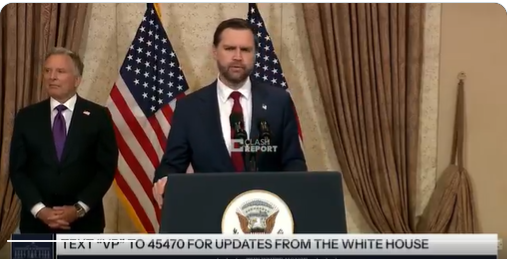
The Reporter’s Question: ‘Precisely, What Have They Rejected Here?’
Following Vice President Vance’s announcement that nearly 21 hours of direct negotiations had ended without an agreement, a reporter asked for specificity about the sticking points.
Reporter: “Precisely, what have they rejected here?”
Vance’s response cut directly to the heart of the matter.
Vice President JD Vance: “We need to see an affirmative commitment that they will not seek a nuclear weapon, and they will not seek the tools that would enable them to quickly achieve a nuclear weapon.”
The vice president’s formulation is significant. The demand for an “affirmative commitment” — not merely a passive acceptance or a temporary freeze — signals that Washington seeks a binding, verifiable, and permanent undertaking from Tehran .
‘The Tools That Would Enable Them to Quickly Achieve’
Vance’s reference to “the tools that would enable them to quickly achieve a nuclear weapon” encompasses more than just the enriched uranium stockpile that has been a central focus of public discussion.
| ‘Tools’ Enabling Quick Weaponization | Iranian Status |
|---|---|
| 60% enriched uranium stockpile | ~400-440 kg (can be further enriched to 90% weapons-grade quickly) |
| 20% enriched uranium stockpile | ~1,000 kg |
| Advanced centrifuges | IR-6, IR-8 models installed |
| Missile delivery systems | Thousands of ballistic missiles capable of carrying nuclear payloads |
| Weaponization expertise | Past IAEA reports on “possible military dimensions” |
| Underground facilities | Fordow, Natanz, Isfahan sites hardened against strikes |
Sources: IAEA, US intelligence assessments
The US demand goes beyond simply removing the existing stockpile of enriched uranium. It seeks to dismantle Iran’s entire nuclear infrastructure — the centrifuges, the research programs, the delivery systems — that would allow Tehran to reconstitute a weapons program on short notice .
Iran’s Rejection: What Tehran Refused
Iranian officials have publicly rejected the US demands, framing them as “excessive” and an infringement on their sovereign rights under the Nuclear Non-Proliferation Treaty (NPT).
| Iranian Position | Details |
|---|---|
| Right to enrich | Claims NPT permits civilian enrichment |
| Stockpile retention | Nuclear material is sovereign property |
| Centrifuges | Will not dismantle enrichment infrastructure |
| Verification | Resists intrusive IAEA inspections |
Sources: Iranian officials, state media
Iran’s Foreign Ministry spokesperson Esmaeil Baghaei acknowledged after the talks that “significant differences” remained on “two, three key topics” — with the nuclear issue clearly among them .
A source close to the Iranian delegation told Fars News Agency that the United States sought “through negotiation everything they couldn’t obtain during war” — a reference to the US demand that Iran surrender its nuclear program entirely .
The ‘Quickly Achieve’ Concern: Breakout Time
The phrase “quickly achieve a nuclear weapon” reflects US intelligence assessments of Iran’s breakout timeline — the time it would take Tehran to produce enough weapons-grade uranium for a nuclear device if it decided to do so.
| Breakout Timeline | Assessment |
|---|---|
| Current estimated breakout time | Weeks (from 60% enriched stockpile) |
| Without 60% stockpile | Months |
| Without enrichment program entirely | Years (would need to rebuild) |
Sources: US intelligence assessments
The US demand to eliminate the “tools” for rapid weaponization is designed to extend Iran’s breakout timeline from weeks to years — providing a sufficient warning window for military intervention if Tehran were to dash for a bomb .
The Historical Context: JCPOA vs. Current Demands
The US position in the Islamabad talks goes significantly beyond the terms of the 2015 Joint Comprehensive Plan of Action (JCPOA) — the nuclear deal from which the United States withdrew in 2018.
| Provision | JCPOA (2015) | Current US Demand |
|---|---|---|
| Enrichment | Limited but permitted | Complete cessation |
| Stockpile | Capped at 300 kg (3.67%) | Surrender all enriched uranium |
| Centrifuges | Limited to IR-1 models | Dismantle advanced centrifuges |
| Breakout time | ~1 year | Years (no enrichment capability) |
| Sunset clauses | Yes (expired 2025-2030) | Permanent restrictions |
The current US approach reflects a determination to avoid the perceived failures of the JCPOA — particularly the sunset clauses that allowed restrictions to expire — and to achieve a more permanent resolution to Iran’s nuclear threat .
Israel’s Position: ‘More to Do’
Israeli Prime Minister Benjamin Netanyahu, who has been closely coordinating with the Trump administration on Iran policy, has reinforced the US demand. Following the collapse of the talks, Netanyahu declared that the campaign against Iran is “not over” and that Israel still has “more to do” .
Netanyahu specifically mentioned the enriched uranium stockpile, stating that it must be removed “either by agreement, or it will come out in other ways” — a clear threat of military action if diplomacy fails .
Iran’s Counter-Position: ‘No Hurry’
Iran has responded to the failed talks with a posture of strategic patience, declaring that it is in “no hurry” to return to the negotiating table .
“The ball is now in America’s court. We are in no hurry. The Americans are the ones who need a deal.” — Iranian Foreign Ministry Statement
Iranian officials have indicated that they have no plans for another round of negotiations, though they remain open to future engagement under the right conditions — including US acceptance of Iran’s right to enrich uranium for civilian purposes .
What Comes Next: Military Option Remains
With Iran refusing to accept the US nuclear demands and the Strait of Hormuz remaining largely restricted, the military option remains on the table.
| Option | Status |
|---|---|
| Diplomacy | Failed; no new rounds planned |
| Military strikes on nuclear facilities | Possible; Israel has signaled readiness |
| Strait of Hormuz pressure | US mine-clearing operations ongoing |
| Sanctions | Existing measures remain; additional possible |
Vance’s articulation of the US demand — an “affirmative commitment” to forgo nuclear weapons and the “tools” to build them — sets a clear benchmark for any future agreement. Whether Iran will ever accept such terms, or whether the United States will eventually accept less, remains the central question of the nuclear standoff.
Frequently Asked Questions (FAQs)
1. What exactly did Vice President Vance say Iran rejected?
Vance stated that the US demanded “an affirmative commitment that they will not seek a nuclear weapon, and they will not seek the tools that would enable them to quickly achieve a nuclear weapon.” Iran rejected these terms .
2. What does ‘tools that would enable them to quickly achieve’ a nuclear weapon mean?
It refers to Iran’s existing nuclear infrastructure: the 60% enriched uranium stockpile (400-440 kg), advanced centrifuges, ballistic missile delivery systems, and the technical expertise to weaponize quickly .
3. What is Iran’s breakout timeline currently?
US intelligence assesses that Iran could produce enough weapons-grade uranium for a nuclear device in weeks, using its existing 60% enriched stockpile .
4. How does this differ from the 2015 JCPOA nuclear deal?
The JCPOA limited but permitted enrichment, capped stockpiles, and allowed advanced centrifuges. The current US demand seeks complete cessation of enrichment, surrender of all stockpiles, and permanent restrictions .
5. Has Iran agreed to any nuclear limits in the past?
Under the JCPOA, Iran accepted limits on enrichment and inspections. However, after the US withdrawal in 2018, Iran progressively violated those limits and expanded its nuclear program .
6. What has Iran said in response to these demands?
Iran has rejected the US demands as “excessive,” insisting on its right to enrich for civilian purposes under the NPT. It has declared it is in “no hurry” to negotiate .
7. What happens if Iran doesn’t agree to these terms?
The military option remains on the table. Israel has indicated readiness to act, and the US has begun mine-clearing operations in the Strait of Hormuz .
Stay informed with Reflecto News – Your trusted source for breaking nuclear security and geopolitical intelligence. Subscribe for real-time updates on the US-Iran nuclear standoff and regional security developments.
Questions people ask
What is China's current share of global manufacturing?
China now accounts for twenty eight percent of global manufacturing. This industrial output exceeds the combined manufacturing production of the United States, Japan, and Germany, making China the leading global industrial power according to recent reports.
Why were Andrew Tate and Tristan Tate arrested in Miami?
Andrew Tate and his brother Tristan Tate were taken into custody in Miami by the United States Marshals Service. They face thirty eight new charges in the United Kingdom, including rape and child pornography offences, and prosecutors are seeking their extradition.
What warning did Moscow issue about oil prices?
Kirill Dmitriev, the Chief Executive of the Russian Direct Investment Fund, warned that a tsunami of skyrocketing oil prices is approaching. Moscow describes this potential energy shock as a major threat to global markets.
What political shift is projected for Benjamin Netanyahu's coalition?
Political polls project that Prime Minister Benjamin Netanyahu's coalition is on track to lose its majority in the upcoming October election. This projection indicates a potential political shift in Jerusalem.
Why did a Russian military aircraft land in Tehran?
A Russian airborne command aircraft, widely known as a doomsday plane, landed in Tehran. The arrival of the aircraft represents a high stakes show of support from Russia for Iran during a period of heightened regional tensions.
What did President Masoud Pezeshkian claim about the United States and Israel?
Iranian President Masoud Pezeshkian claimed that the United States and Israel failed in a forty eight hour plan to topple the Iranian government. He made these statements during a televised address marking two years since his inauguration.