Reflecto News is an online news platform covering major international political events, global economic developments, and security conflicts. The site provides updates on topics such as Chinese manufacturing dominance, Middle Eastern political tensions, and high profile legal arrests. Readers can access current articles organized by categories like World News, Iran, and USA.
Published on Reflecto News | World News | Defense & Geopolitics
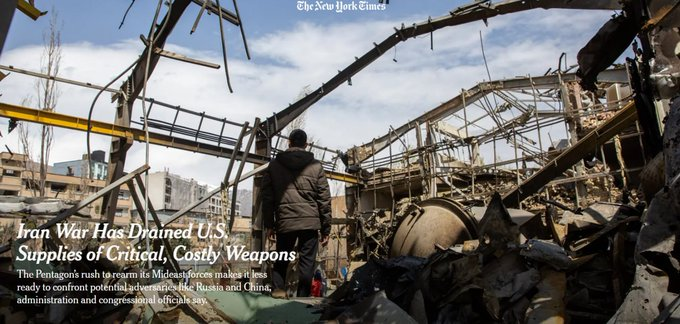
The United States has expended a staggering volume of advanced munitions during the six-week war with Iran, significantly depleting critical stockpiles and raising urgent concerns about military readiness in Europe and Asia, according to a New York Times analysis of defense data and interviews with officials .
Since the US-Israeli campaign against Iran began on February 28, American forces have fired approximately:
- 1,100 JASSM-ER cruise missiles (Joint Air-to-Surface Standoff Missile – Extended Range), each costing about $1.1 million
- More than 1,000 Tomahawk missiles
- Over 1,200 Patriot interceptors, each priced above $4 million
- More than 1,000 ATACMS (Army Tactical Missile System) and Precision Strike missiles (PrSM)
In just the first two days of the conflict, the US expended an estimated $5.6 billion worth of munitions .
Strategic Stockpiles Depleted
The sheer volume of firepower required to degrade Iran’s air defenses, missile batteries, and nuclear facilities has left the Pentagon with hard choices.
Cruise Missile Crunch
The US had an estimated inventory of approximately 2,600 JASSM-ER missiles before the war. With over 1,100 used, this leaves roughly 1,500 units remaining. This represents a significant drawdown of a weapon designed for high-threat, deep-strike missions that are central to any conflict with a near-peer adversary like China .
Interceptors Under Stress
The conflict has also consumed a substantial portion of America’s “silver bullet” air defenses. The firing of over 1,200 Patriot Advanced Capability-3 (PAC-3) and Terminal High Altitude Area Defense (THAAD) interceptors has tapped into reserves needed to protect US forces and allies from tactical ballistic missiles .
The Impact Beyond Iran: Europe Depleted
To sustain operations in the Middle East, the Pentagon has been forced to redirect weapons and systems from other theaters, reducing readiness in Europe and Asia.
In Europe, the war has drained air defense systems and precision-guided munitions intended to reassure NATO allies on the eastern flank. This has limited the US Army’s ability to conduct training and deprived the front of surveillance drones and artillery . Officials warn that the transfer of advanced weaponry has created a “hollow force” regarding specific long-range capabilities needed for high-intensity combat .
The Impact Beyond Iran: Asia Exposed
The impact on the Pacific theater is even more pronounced. The Biden-Trump administration (the current administration is a hybrid after the 2024 election) has aggressively pulled Patriot and THAAD systems from key areas like South Korea to protect Israel and Gulf states .
Asian Theater: Assets Transferred or Strained
| Asset | Impact |
|---|---|
| Patriot / THAAD | Moved from South Korea; gap in missile defense |
| B-2/B-52 Bombers | Diverted to Middle East; reduced presence in Guam |
| Aircraft Carriers | Multiple strike groups remain in Arabian Sea; Pacific coverage thin |
Naval forces—including multiple aircraft carrier strike groups—have remained concentrated in the Arabian Sea, leaving a gap in the Pacific that China could seek to exploit. This has led to growing concerns among defense planners that the war with Iran has given Beijing a window to increase aggression in the South China Sea or accelerate its timeline for a potential conflict over Taiwan .
The Hidden Crisis: Factory Lines and Supply Chains
The most significant strategic headache for the Pentagon is not just the number of missiles used, but the rate at which they were used. The US defense industrial base, which is still struggling to replenish stocks of Stinger and Javelin missiles sent to Ukraine, is now being asked to ramp up production of complex cruise missiles and ballistic interceptors at a pace unseen since the Cold War.
Pentagon Path Forward
The US military is projected to exceed its planned procurement of the Long-Range Anti-Ship Missile (LRASM) and the JASSM-ER over the next five years . However, defense officials acknowledge that rebuilding stockpiles of missiles like the Standard Missile-6 (SM-6) and Patriot interceptors will take years .
What Comes Next
The consumption of munitions raises a difficult question: If a major conflict with Iran required this volume of firepower, what would a war with China require—and does the US have enough?
| Region | Risk Level |
|---|---|
| Europe | Elevated (NATO eastern flank weakened) |
| Asia | High (deterrence against China reduced) |
| Middle East | Ongoing consumption (active war) |
The war has demonstrated the voracious appetite of modern precision warfare. It has also revealed that even the world’s most advanced military can be strained when fighting a determined, mid-tier adversary equipped with ballistic missiles and drones. The bill for the week-long blitz against Iran will be paid in years of production line prioritization, leaving the US military in a “precarious position” of having to defend two major regions (Europe and Asia) with a stockpile that is effectively diminished .
Frequently Asked Questions (FAQs)
1. How many JASSM-ER missiles has the U.S. used in the Iran war?
The U.S. has used roughly 1,100 JASSM-ER cruise missiles, leaving an estimated inventory of approximately 1,500 remaining. Each missile costs about $1.1 million .
2. What is the cost of the munitions used in the war?
In the first two days alone, the U.S. expended an estimated $5.6 billion worth of munitions. This includes over 1,000 Tomahawk missiles and over 1,200 Patriot interceptors (priced above $4 million each) .
3. How has the war affected US military readiness in Europe?
The Pentagon has redirected weapons and systems from Europe to the Middle East, depleting stockpiles important for NATO’s eastern flank. This has limited training and drone availability, reducing overall readiness .
4. How has the war impacted US readiness in Asia?
The impact is significant. Patriot and THAAD systems have been moved from key areas like South Korea, and naval forces have been redeployed to the Arabian Sea, potentially reducing deterrence against China and North Korea .
5. Why can’t the US just produce more missiles quickly?
The US defense industrial base is already struggling to replenish stocks of munitions provided to Ukraine. Ramping up production of complex precision munitions like the JASSM-ER and advanced interceptors is a slow, expensive process.
6. What are the most strained munition stockpiles?
Advanced cruise missiles (JASSM-ER) and ballistic interceptors (Patriot PAC-3) are among the most strained, as they are critical for engagements against Iran’s missile forces and for potential conflict in the Pacific .
7. How will the US replenish its stockpiles?
The US military is projected to exceed its planned procurement of LRASM and JASSM-ER over the next five years. However, defense officials acknowledge that rebuilding stockpiles will take years .
Stay informed with Reflecto News – Your trusted source for breaking defense, geopolitical, and strategic intelligence. Subscribe for real-time updates on US military readiness, global munitions stockpiles, and security developments.
Questions people ask
What is China's current share of global manufacturing?
China now accounts for twenty eight percent of global manufacturing. This industrial output exceeds the combined manufacturing production of the United States, Japan, and Germany, making China the leading global industrial power according to recent reports.
Why were Andrew Tate and Tristan Tate arrested in Miami?
Andrew Tate and his brother Tristan Tate were taken into custody in Miami by the United States Marshals Service. They face thirty eight new charges in the United Kingdom, including rape and child pornography offences, and prosecutors are seeking their extradition.
What warning did Moscow issue about oil prices?
Kirill Dmitriev, the Chief Executive of the Russian Direct Investment Fund, warned that a tsunami of skyrocketing oil prices is approaching. Moscow describes this potential energy shock as a major threat to global markets.
What political shift is projected for Benjamin Netanyahu's coalition?
Political polls project that Prime Minister Benjamin Netanyahu's coalition is on track to lose its majority in the upcoming October election. This projection indicates a potential political shift in Jerusalem.
Why did a Russian military aircraft land in Tehran?
A Russian airborne command aircraft, widely known as a doomsday plane, landed in Tehran. The arrival of the aircraft represents a high stakes show of support from Russia for Iran during a period of heightened regional tensions.
What did President Masoud Pezeshkian claim about the United States and Israel?
Iranian President Masoud Pezeshkian claimed that the United States and Israel failed in a forty eight hour plan to topple the Iranian government. He made these statements during a televised address marking two years since his inauguration.