Reflecto News is an online news platform covering major international political events, global economic developments, and security conflicts. The site provides updates on topics such as Chinese manufacturing dominance, Middle Eastern political tensions, and high profile legal arrests. Readers can access current articles organized by categories like World News, Iran, and USA.
Published on Reflecto News | World News | Legislation & Human Rights
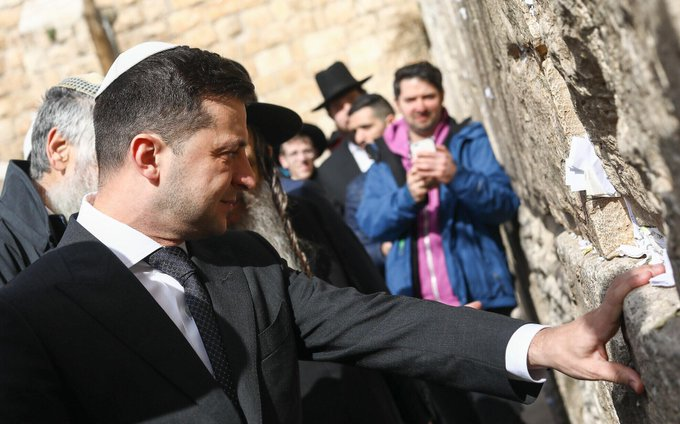
Ukrainian President Volodymyr Zelenskyy has signed into law a bill establishing criminal liability for antisemitic acts, formalizing the prohibition of antisemitism and its manifestations with penalties ranging from fines to imprisonment of up to eight years for the most severe offenses . The law amends Article 161 of the Criminal Code of Ukraine, aligning it with the 2021 framework law “On Preventing and Countering Antisemitism in Ukraine” .
Legislation and Penalties
Bill No. 5110, which was passed by the Verkhovna Rada (Ukrainian Parliament) with 295 votes in favor on February 15, 2022, has now been enacted. The delay in signing occurred due to Russia’s full-scale invasion of Ukraine .
The new law establishes a graduated penalty system for antisemitic offenses :
| Offense Level | Penalty |
|---|---|
| Basic offense (violation of equality based on religious/ethnic grounds) | Fine of 200 to 500 non-taxable minimum incomes, or restriction of liberty up to 5 years, with or without a ban on holding certain positions for up to 3 years |
| Aggravated offense (involving violence, deceit, threats, or committed by a public official) | Fine of 500 to 1,000 non-taxable minimum incomes, or imprisonment of 2 to 5 years, with or without a ban on holding certain positions for up to 3 years |
| Organized group or actions causing serious consequences | Imprisonment of 5 to 8 years |
The European Jewish Confederation had noted that Ukraine’s parliament passed the law criminalizing antisemitism, as defined by the International Holocaust Remembrance Alliance (IHRA) . This definition states that “antisemitism is a certain perception of Jews, which may be expressed as hatred toward Jews” .
Implementation and Enforcement
The law provides Ukrainian law enforcement agencies with tools to bring perpetrators to account. It also strengthens accountability for anti-Semitic manifestations, demonstrating a priority for protecting human rights and countering hatred .
The Security Service of Ukraine (SBU) and National Police have already been active in enforcing existing hate crime laws. In March 2026, the SBU, together with the National Police and the State Border Guard Service, exposed an online agitator in Zakarpattia who had been publicly stirring up antisemitic sentiment through social media. The suspect, a 31-year-old resident of the Mukachevo district, called for physical reprisals against members of the Jewish community and urged the destruction of outdoor advertising banners mentioning Jewish holidays. An expert examination confirmed the presence of criminal elements in his public statements, and he was notified of suspicion under Article 161 of the Criminal Code of Ukraine .
In April 2025, in Drobytsky Yar near Kharkiv, three young men displayed Nazi gestures at the Holocaust memorial. The police opened criminal proceedings for desecration .
Broader Legislative Context
This law is part of a larger effort by Ukraine to align its legal framework with European standards and combat discrimination broadly. In August 2025, a new bill (No. 13597) was registered in parliament to strengthen accountability for hate-motivated crimes . This bill proposes :
- Expanding protections to vulnerable groups, including sexual orientation, gender identity, health status, and national origin.
- Introducing fines or corrective labor for discriminatory actions, even without violence.
- Clarifying Article 161 to include cases where public officials commit hate crimes or involve deceit or threats.
- Amending Article 300 of the Criminal Code to ban the distribution of content that promotes bigotry, including print, video, film, and audio formats.
Additionally, the National Council of Television and Radio Broadcasting has developed recommendations for media professionals on how to prevent hate speech and discrimination, supported by the Council of Europe .
Note: This article is based on official statements and reporting from UNN, Mezha, the European Jewish Congress, and other sources as cited.
Questions people ask
What is China's current share of global manufacturing?
China now accounts for twenty eight percent of global manufacturing. This industrial output exceeds the combined manufacturing production of the United States, Japan, and Germany, making China the leading global industrial power according to recent reports.
Why were Andrew Tate and Tristan Tate arrested in Miami?
Andrew Tate and his brother Tristan Tate were taken into custody in Miami by the United States Marshals Service. They face thirty eight new charges in the United Kingdom, including rape and child pornography offences, and prosecutors are seeking their extradition.
What warning did Moscow issue about oil prices?
Kirill Dmitriev, the Chief Executive of the Russian Direct Investment Fund, warned that a tsunami of skyrocketing oil prices is approaching. Moscow describes this potential energy shock as a major threat to global markets.
What political shift is projected for Benjamin Netanyahu's coalition?
Political polls project that Prime Minister Benjamin Netanyahu's coalition is on track to lose its majority in the upcoming October election. This projection indicates a potential political shift in Jerusalem.
Why did a Russian military aircraft land in Tehran?
A Russian airborne command aircraft, widely known as a doomsday plane, landed in Tehran. The arrival of the aircraft represents a high stakes show of support from Russia for Iran during a period of heightened regional tensions.
What did President Masoud Pezeshkian claim about the United States and Israel?
Iranian President Masoud Pezeshkian claimed that the United States and Israel failed in a forty eight hour plan to topple the Iranian government. He made these statements during a televised address marking two years since his inauguration.