Reflecto News is an online news platform covering major international political events, global economic developments, and security conflicts. The site provides updates on topics such as Chinese manufacturing dominance, Middle Eastern political tensions, and high profile legal arrests. Readers can access current articles organized by categories like World News, Iran, and USA.
Published on Reflecto News | World News | Politics & Media
Conservative commentator Tucker Carlson has issued a sweeping indictment of the U.S. government’s foreign policy, questioning why the state cannot act on behalf of its own citizens and arguing that President Donald Trump has proven that “the system was stronger than him.” The remarks, part of a Wall Street Journal interview published Friday, represent a fundamental critique not just of Trump but of the broader national security establishment that Carlson believes captured the administration .
“Why can’t the U.S. government act on behalf of its own citizens? This is a generational problem that didn’t start with Trump. If anything, Trump just proved the system was stronger than him.” — Tucker Carlson
‘Why Can’t the U.S. Government Act on Behalf of Its Own Citizens?’
Carlson’s central question — why the U.S. government acts for the benefit of foreign powers rather than its own people — is one he has asked for years. But his framing of it as a “generational problem” suggests that he sees the current drift as a systemic feature, not a bug.
The question implies that the national interest is being defined not by the welfare of American citizens but by the priorities of foreign allies, particularly Israel, and the defense contractors who profit from endless war. For Carlson, the Trump administration’s aggressive posture toward Iran — including a naval blockade, threats of military force, and deep strategic coordination with Israel — is evidence that the national security state captured the president, not the other way around.
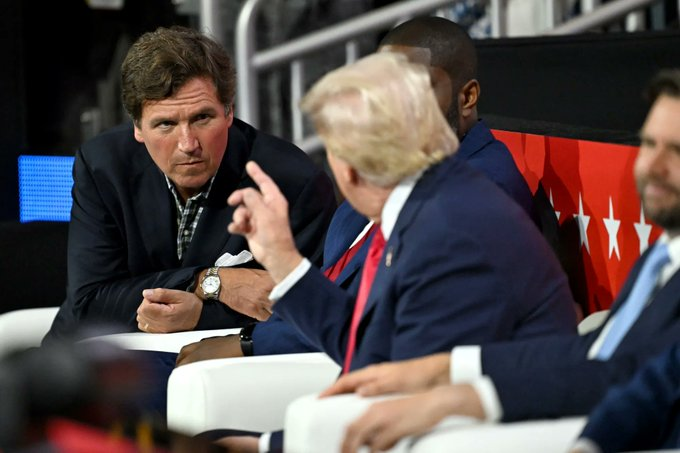
‘This Didn’t Start with Trump’
Carlson is careful to note that the problem predates Trump’s presidency. The “generational problem” he identifies has its roots in the post-World War II era, when the United States assumed the role of global policeman, and in the post-Cold War era, when the “unipolar moment” led to a series of interventions in the Middle East and the Balkans.
Presidents of both parties — George W. Bush, Barack Obama, Joe Biden — have presided over military campaigns in the Middle East. For Carlson, Trump’s election was supposed to break the cycle of intervention, but the administration’s Iran policy suggests the cycle continues.
‘Trump Just Proved the System Was Stronger Than Him’
This is the most damning element of Carlson’s analysis. Trump, the political outsider who promised to “drain the swamp,” appears to Carlson to have been captured by the same forces he vowed to defeat.
The evidence, in Carlson’s view, includes:
- Continuation of the War in Ukraine: Trump promised to end the war, but it grinds on.
- Military Confrontation with Iran: Trump launched strikes, ordered a blockade, and escalated.
- Deep Coordination with Israel: The administration’s Middle East policy aligns closely with Israeli strategic objectives.
- Appointment of Establishment Figures: Trump has surrounded himself with foreign policy advisers who are not anti-interventionist.
Whether the “system” truly captured Trump, or whether Trump chose these policies for his own reasons, is a matter of debate. But Carlson’s framing is significant because it absolves Trump of personal responsibility while indicting the broader governing apparatus. This allows Carlson to maintain his loyalty to Trump as a person while criticizing the administration’s actions.
The Broader Realignment: ‘America First’ vs. ‘National Greatness’
Carlson’s interview is the latest salvo in an ongoing war within the conservative movement between “America First” nationalists and “national greatness” hawks.
| Faction | Foreign Policy Approach | View of Allies |
|---|---|---|
| America First (Carlson wing) | Non-interventionist; focus on US interests | Skeptical of alliances that entangle US in wars |
| National Greatness hawks (administration wing) | Assertive; willing to use force | Strong alliances as force multipliers |
The “national greatness” wing, represented by figures like Senator Tom Cotton and former Ambassador Nikki Haley, sees the United States as a benevolent hegemon. The “America First” wing sees a system rigged for the benefit of foreign interests and defense contractors.
The Carlson-Trump split on Iran policy is a manifestation of this deeper divide. Trump, despite his rhetoric, has governed more like a national greatness hawk.
What Comes Next
Carlson’s interview will not change the administration’s Iran policy. But it may energize the anti-war wing of the conservative movement, which has felt marginalized.
The 2026 election could be a proving ground. If an “America First” challenger emerges to contest Trump or his successor, the Carlson critique — that the system is stronger than any one person — could provide the ideological foundation.
For now, Carlson has stated his position clearly: he does not blame Trump personally, but he believes the system has failed. And he does not see a way out.
Frequently Asked Questions (FAQs)
Q1: What did Tucker Carlson say about Trump and the system?
Carlson stated that “the system was stronger than Trump,” suggesting that the national security establishment captured the president rather than the other way around.
Q2: Does Carlson blame Trump for the Iran war?
No. Carlson believes the problem is “generational” and predates Trump. He sees Trump as having been captured by forces beyond his control.
Q3: What does Carlson mean by “the system”?
“The system” refers to the national security establishment — the military-industrial complex, the intelligence community, and the foreign policy apparatus — that Carlson believes sets U.S. foreign policy.
Q4: Is Carlson still a Trump supporter?
Carlson’s relationship with Trump is complex. He continues to support some of Trump’s domestic policies but has been sharply critical of his foreign policy.
Q5: What would Carlson like to see the U.S. government do?
Carlson would like to see the U.S. government act on behalf of its own citizens rather than foreign allies, avoid foreign entanglements, and end the conflict with Iran.
Q6: Could Carlson run for president?
Carlson has not announced any intention to run for office. His influence is primarily as a media commentator and movement organizer.
Stay informed with Reflecto News – Your trusted source for breaking political and geopolitical intelligence. Subscribe for real-time updates on the conservative movement, 2026 election, and US foreign policy debates.
Questions people ask
What is China's current share of global manufacturing?
China now accounts for twenty eight percent of global manufacturing. This industrial output exceeds the combined manufacturing production of the United States, Japan, and Germany, making China the leading global industrial power according to recent reports.
Why were Andrew Tate and Tristan Tate arrested in Miami?
Andrew Tate and his brother Tristan Tate were taken into custody in Miami by the United States Marshals Service. They face thirty eight new charges in the United Kingdom, including rape and child pornography offences, and prosecutors are seeking their extradition.
What warning did Moscow issue about oil prices?
Kirill Dmitriev, the Chief Executive of the Russian Direct Investment Fund, warned that a tsunami of skyrocketing oil prices is approaching. Moscow describes this potential energy shock as a major threat to global markets.
What political shift is projected for Benjamin Netanyahu's coalition?
Political polls project that Prime Minister Benjamin Netanyahu's coalition is on track to lose its majority in the upcoming October election. This projection indicates a potential political shift in Jerusalem.
Why did a Russian military aircraft land in Tehran?
A Russian airborne command aircraft, widely known as a doomsday plane, landed in Tehran. The arrival of the aircraft represents a high stakes show of support from Russia for Iran during a period of heightened regional tensions.
What did President Masoud Pezeshkian claim about the United States and Israel?
Iranian President Masoud Pezeshkian claimed that the United States and Israel failed in a forty eight hour plan to topple the Iranian government. He made these statements during a televised address marking two years since his inauguration.