
Reflecto News is an online news platform covering major international political events, global economic developments, and security conflicts. The site provides updates on topics such as Chinese manufacturing dominance, Middle Eastern political tensions, and high profile legal arrests. Readers can access current articles organized by categories like World News, Iran, and USA.
Published on Reflecto News | World News | Energy Security & Geopolitics
President Donald Trump has declared that Iran is “collapsing financially” and that the regime secretly “wants the Strait of Hormuz opened immediately,” despite its public defiance. The comments, made during a press briefing, double down on the president’s claims that economic pressure is forcing Tehran’s hand—even as Iranian forces fired on a container ship in the strait just hours earlier .
“Iran is collapsing financially. They want the Strait opened immediately. They need the money. But they don’t want to look weak.” — President Donald Trump
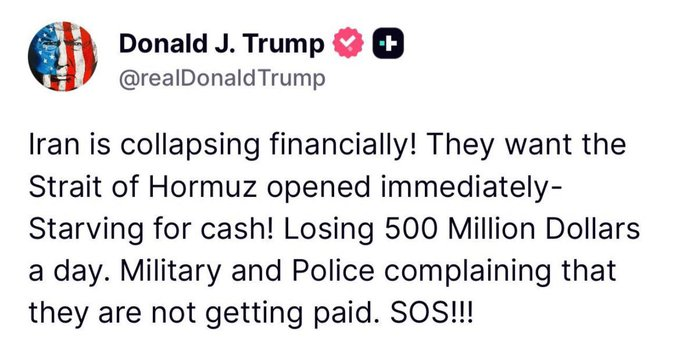
‘They Want It Open’
Trump’s assertion echoes his earlier claim that Iranian leaders have privately signaled their desire to restore traffic through the vital waterway but are constrained by domestic political pressures. The Strait of Hormuz, through which approximately 20 percent of the world’s oil passes, has been largely restricted since the outbreak of the US-Israeli war on Iran on February 28 .
“People are telling me — not officially, but people who know — they want it open. They need it open. Their economy is in shambles.” — President Donald Trump
Iran’s oil exports have been significantly reduced by the US naval blockade, imposed on April 13. The Trump administration’s “maximum pressure” campaign has sought to choke off Tehran’s primary source of revenue .
‘Collapsing Financially’
Trump’s characterization of Iran’s financial condition aligns with the administration’s strategy of using economic pressure to force concessions. Iran’s economy has been severely strained by decades of sanctions, and the recent war has inflicted further damage .
Key economic indicators:
| Indicator | Status |
|---|---|
| Oil exports | Significantly reduced by US blockade |
| Currency value (rial) | Severely depreciated |
| Inflation | Elevated |
| Unemployment | High |
| War damage | Estimated up to $270 billion |
Public vs. Private Positions
Trump’s comments highlight the gap between Iran’s public posture and what the administration claims are its private calculations. Publicly, Iranian officials have maintained a defiant stance, refusing to send a delegation for a second round of talks until the US lifts its naval blockade .
Foreign Minister Abbas Araghchi has called the US blockade an “act of war,” and the Islamic Revolutionary Guard Corps (IRGC) has warned that its forces have “hands on the trigger” and are ready to respond to any US attack .
Privately, however, Trump suggests, Iranian leaders recognize that their economy is suffering and that reopening the strait is essential for recovery .
Ceasefire Extended, But Stalemate Continues
President Trump extended the fragile ceasefire with Iran at Pakistan’s request, giving Tehran time to formulate a “unified proposal” for negotiations. However, Iran has not yet signaled any willingness to return to the table .
Hours after Trump spoke, an IRGC gunboat opened fire on a container ship in the Strait of Hormuz, causing “heavy damage to the bridge,” according to the United Kingdom Maritime Trade Operations (UKMTO). The attack came despite the ceasefire extension .
What Comes Next
Trump’s claims about Iran’s financial collapse and desire to reopen the strait suggest that the administration believes economic pressure is working. However, with Tehran publicly refusing to negotiate and continuing to attack commercial shipping, the path forward remains unclear .
| Scenario | Likelihood | Implications |
|---|---|---|
| Iran privately signals willingness | Possible | Could lead to back-channel talks |
| Public stalemate continues | Likely | Ceasefire may hold, but no progress |
| Iran makes public concession | Unlikely | Would require major shift in posture |
| Further attacks on shipping | Likely | IRGC continues to enforce closure |
Trump’s assessment offers a potential face-saving path for Tehran: if the US were to lift the blockade as part of a broader deal, Iran could claim victory. But for now, the public positions of both sides remain firmly opposed, and the strait remains a shooting gallery .
Frequently Asked Questions (FAQs)
1. What did President Trump say about Iran’s economy?
Trump declared that Iran is “collapsing financially” and that the regime secretly “wants the Strait of Hormuz opened immediately” to generate revenue .
2. Does Iran publicly want the strait open?
No. Publicly, Iranian officials have stated that the strait will not fully reopen until a final peace agreement is reached. Tehran has also demanded that the US lift its naval blockade as a precondition for further negotiations .
3. Why would Iran want the strait open?
Iran’s economy has been severely damaged by sanctions and the war. Oil exports are significantly reduced, and the country faces severe economic pressure. Reopening the strait would allow Iran to resume oil shipments and generate revenue .
4. What is the status of the ceasefire?
President Trump extended the ceasefire at Pakistan’s request. It remains in effect until Iran submits a “unified proposal” for negotiations .
5. Have talks resumed?
No. Iran has refused to send a delegation for a second round of talks. Hours after Trump spoke, an IRGC gunboat attacked a container ship in the strait .
6. What is the ‘maximum pressure’ campaign?
The Trump administration’s “maximum pressure” strategy uses economic sanctions and naval interdiction to force Iran to capitulate on its nuclear program and regional activities .
Stay informed with Reflecto News – Your trusted source for breaking economic, energy, and geopolitical intelligence. Subscribe for real-time updates on the US-Iran crisis, nuclear negotiations, and global security developments.
Questions people ask
What is China's current share of global manufacturing?
China now accounts for twenty eight percent of global manufacturing. This industrial output exceeds the combined manufacturing production of the United States, Japan, and Germany, making China the leading global industrial power according to recent reports.
Why were Andrew Tate and Tristan Tate arrested in Miami?
Andrew Tate and his brother Tristan Tate were taken into custody in Miami by the United States Marshals Service. They face thirty eight new charges in the United Kingdom, including rape and child pornography offences, and prosecutors are seeking their extradition.
What warning did Moscow issue about oil prices?
Kirill Dmitriev, the Chief Executive of the Russian Direct Investment Fund, warned that a tsunami of skyrocketing oil prices is approaching. Moscow describes this potential energy shock as a major threat to global markets.
What political shift is projected for Benjamin Netanyahu's coalition?
Political polls project that Prime Minister Benjamin Netanyahu's coalition is on track to lose its majority in the upcoming October election. This projection indicates a potential political shift in Jerusalem.
Why did a Russian military aircraft land in Tehran?
A Russian airborne command aircraft, widely known as a doomsday plane, landed in Tehran. The arrival of the aircraft represents a high stakes show of support from Russia for Iran during a period of heightened regional tensions.
What did President Masoud Pezeshkian claim about the United States and Israel?
Iranian President Masoud Pezeshkian claimed that the United States and Israel failed in a forty eight hour plan to topple the Iranian government. He made these statements during a televised address marking two years since his inauguration.