Reflecto News is an online news platform covering major international political events, global economic developments, and security conflicts. The site provides updates on topics such as Chinese manufacturing dominance, Middle Eastern political tensions, and high profile legal arrests. Readers can access current articles organized by categories like World News, Iran, and USA.
Published on Reflecto News | World News | Politics & Law
Former President Donald Trump has escalated his rhetoric on the 2020 election results, declaring that the election should be “wiped from the books permanently.” The statement, posted on Truth Social on Thursday, reopens a contentious chapter in American politics that remains unresolved for a significant segment of the electorate years after Joe Biden’s inauguration .
“The 2020 Election should be wiped from the books permanently. It was a disaster, a catastrophe, the crime of the century. We cannot let this happen again. We must fix our elections NOW!” — Donald Trump
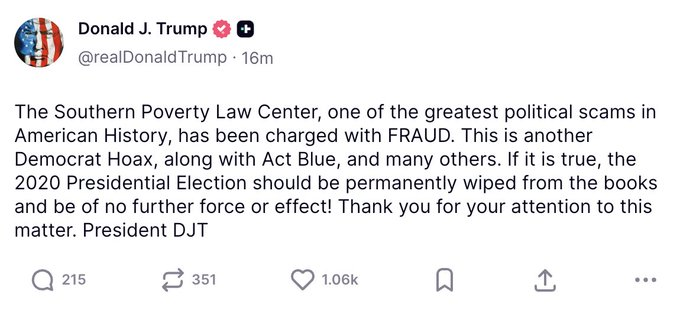
What ‘Wiped from the Books’ Means
Trump did not specify the legal mechanism by which a certified election result — one that was challenged in over 60 lawsuits, subjected to audits and recounts, and ultimately certified by Congress on January 6, 2021 — could be “wiped from the books.”
The statement is open to multiple interpretations:
| Interpretation | Plausibility | Legal Mechanism |
|---|---|---|
| Literal nullification | Zero | No constitutional mechanism exists to nullify a certified election |
| Historical re-framing | Possible | Calling for the election to be viewed as illegitimate |
| Campaign rhetoric | Likely | Red meat for base voters ahead of 2026 |
| Constitutional reset | Pure fantasy | Would require rewriting the Constitution |
The Legal Reality: No Take-Backs
The 2020 election is over. It has been certified by all 50 states, the District of Columbia, and the Congress of the United States. Joe Biden was sworn in as the 46th president on January 20, 2021. There is no legal mechanism to “wipe” a presidential election “from the books.”
The Electoral Count Act was reformed in 2022 to explicitly limit challenges to state-certified election results. The Supreme Court has repeatedly rejected post-election challenges. State courts have dismissed them. The notion that the 2020 election could be overturned is a fantasy.
But Trump is not speaking to lawyers or constitutional scholars. He is speaking to his base.
The Political Context: 2026 Election Season
Trump’s statement came as the 2026 general election campaign season intensifies. The former president is running for a second non-consecutive term — a scenario permitted by the 22nd Amendment, which allows a person to be elected president twice, not to serve two consecutive terms.
2026 election timeline:
| Date | Event |
|---|---|
| November 3, 2026 | General election |
| January 2027 | Electoral College certification |
| January 20, 2027 | Inauguration Day |
Trump’s statement appears designed to rally his base around the theme that the 2020 election was stolen from him — a narrative that has been central to his political identity since he lost that election.
GOP Reactions: Cautious Silence
Senior Republican figures have been notably cautious in their response. Senate Minority Leader Mitch McConnell, who voted to certify the 2020 election results despite voting to acquit Trump in his second impeachment trial, did not comment.
House Speaker Mike Johnson (R-La.) — who as a congressman objected to the certification of the 2020 election — has not responded to requests for comment. Other Republicans have largely avoided the topic, focusing instead on policy issues like inflation, crime, and immigration.
The ‘Big Lie’ Debate
Trump’s statement revives the debate over what critics call the “Big Lie” — the false claim that the 2020 election was stolen through widespread voter fraud. Multiple audits, recounts, and court cases have failed to produce evidence of fraud sufficient to change the outcome of any state’s electoral votes.
Nevertheless, polling consistently shows that a significant percentage of Republicans believe the election was stolen. Trump’s statement is designed to reinforce that belief.
Republican belief in election fraud (2025 polling):
| Question | Percentage |
|---|---|
| Biden’s 2020 victory was legitimate | ~35% |
| Trump actually won 2020 | ~65% |
Source: Various polling organizations
The Legal Risks: Incitement or Free Speech?
Trump’s statement is not illegal. The First Amendment protects political speech, even when it is false, misleading, or inflammatory. However, the statement could be cited in ongoing legal proceedings related to the January 6, 2021, Capitol riot or Trump’s efforts to overturn the 2020 election results. Special Counsel Jack Smith’s investigation into Trump’s actions regarding January 6 remains active. Trump’s continued insistence that the election was stolen could be used as evidence of intent.
Ongoing legal exposure:
| Proceeding | Status | Potential Relevance |
|---|---|---|
| Special counsel investigation | Active | Evidence of continued election denial |
| Disqualification challenges | Pending in some states | Constitutional violation under 14th Amendment |
| Civil defamation suits | Active (voting machine companies, election workers) | Continued false statements |
The 2026 Implications
Trump’s statement appears designed to set the stage for the 2026 election — and for a potential Trump-Biden rematch (assuming both are their parties’ nominees). The 2024 campaign, in which Biden beat Trump a second time, was defined in part by Trump’s insistence that the 2020 election was stolen. Re-litigating 2020 may have diminishing returns with swing voters.
The 2024 results (for context):
| Candidate | Electoral Votes | Popular Vote |
|---|---|---|
| Joe Biden | 303 | 51.3% |
| Donald Trump | 235 | 46.9% |
But Trump’s base eats it up.
Frequently Asked Questions (FAQs)
1. What did Donald Trump say about the 2020 election?
Trump said the 2020 election should be “wiped from the books permanently,” calling it a “disaster, a catastrophe, the crime of the century.”
2. Can the 2020 election be nullified?
No. There is no legal mechanism to nullify a certified presidential election that has already been confirmed by all 50 states and Congress.
3. Why is Trump saying this now?
Trump is likely rallying his base ahead of the 2026 general election, in which he is running for president again. The “stolen election” narrative remains central to his political identity.
4. What is the ‘Big Lie’?
Critics use the term “Big Lie” to describe Trump’s false claim that the 2020 election was stolen from him through widespread voter fraud. No evidence has been produced that would change the outcome of any state’s electoral votes.
5. How have Republicans responded?
Senior Republicans have remained largely silent, focusing on other issues rather than engaging with Trump’s statement.
6. Could Trump face legal consequences for this statement?
The statement itself is protected political speech and unlikely to result in charges. However, it could be cited in ongoing investigations into Trump’s efforts to overturn the 2020 election.
7. Is Trump running for president in 2026?
Yes. Trump is the Republican frontrunner for the 2026 presidential election, seeking a second non-consecutive term.
Stay informed with Reflecto News – Your trusted source for breaking political and legal intelligence. Subscribe for real-time updates on the 2026 election, Trump legal proceedings, and US political developments.
Questions people ask
What is China's current share of global manufacturing?
China now accounts for twenty eight percent of global manufacturing. This industrial output exceeds the combined manufacturing production of the United States, Japan, and Germany, making China the leading global industrial power according to recent reports.
Why were Andrew Tate and Tristan Tate arrested in Miami?
Andrew Tate and his brother Tristan Tate were taken into custody in Miami by the United States Marshals Service. They face thirty eight new charges in the United Kingdom, including rape and child pornography offences, and prosecutors are seeking their extradition.
What warning did Moscow issue about oil prices?
Kirill Dmitriev, the Chief Executive of the Russian Direct Investment Fund, warned that a tsunami of skyrocketing oil prices is approaching. Moscow describes this potential energy shock as a major threat to global markets.
What political shift is projected for Benjamin Netanyahu's coalition?
Political polls project that Prime Minister Benjamin Netanyahu's coalition is on track to lose its majority in the upcoming October election. This projection indicates a potential political shift in Jerusalem.
Why did a Russian military aircraft land in Tehran?
A Russian airborne command aircraft, widely known as a doomsday plane, landed in Tehran. The arrival of the aircraft represents a high stakes show of support from Russia for Iran during a period of heightened regional tensions.
What did President Masoud Pezeshkian claim about the United States and Israel?
Iranian President Masoud Pezeshkian claimed that the United States and Israel failed in a forty eight hour plan to topple the Iranian government. He made these statements during a televised address marking two years since his inauguration.