Reflecto News | Geopolitics | Iran-US Relations
DUBAI — Two months into the devastating war with the United States and Israel, Iran has undergone a dramatic transformation in its political structure. The old system orbited around a single, dominant clerical figure. Now, a collective wartime leadership has emerged, centered on the Islamic Revolutionary Guard Corps (IRGC) and the Supreme National Security Council (SNSC), with the new Supreme Leader, Mojtaba Khamenei, ruling largely in name only .
This shift marks an abrupt break from the 1979 revolution that established supreme clerical authority and helps explain Tehran’s hardened, often sluggish, negotiating stance in back‑channel peace talks mediated by Pakistan .
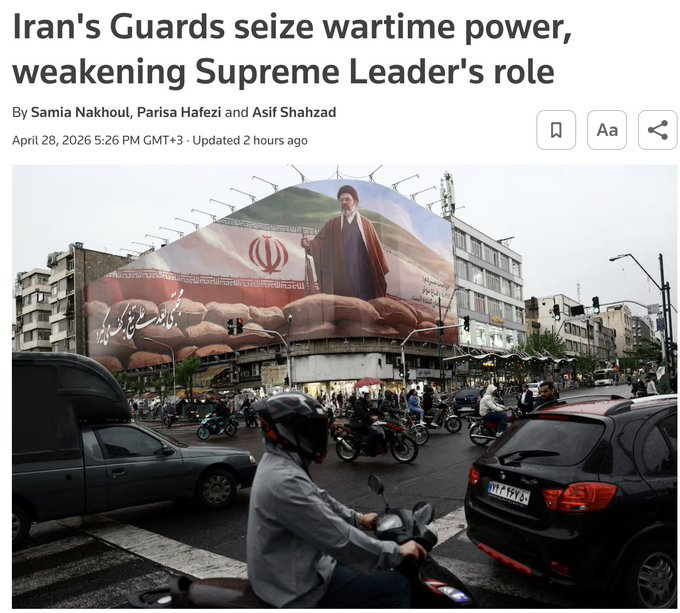
👑 A Wounded Leader in Name Only
In the joint U.S.-Israeli strikes that opened the war on February 28, Ayatollah Ali Khamenei—Iran’s all‑powerful leader for 36 years—was killed. Hours later, his son, Mojtaba Khamenei, was hastily elevated to the position of Supreme Leader. However, the continuity of absolute authority ended there .
Mojtaba was severely wounded in the same strike, losing several family members. He remains in hiding, has undergone repeated leg surgeries, and according to reports, may require a prosthetic leg. Due to his injuries, burns, and security concerns, he has not appeared in public or released video messages since the war began. He reportedly issues commands via handwritten notes passed through intermediaries, and all communication flows through IRGC aides .
Three people familiar with Iran’s internal deliberations told Reuters that Mojtaba’s role is now largely to legitimize decisions made by IRGC generals, rather than to issue directives himself. Politicians close to him have likened him to a “board chairman” who manages the country in name only, while policy is set by the generals beneath him .
⚔️ The IRGC & SNSC: The New Centers of Power
With the Shah’s successor wounded and the traditional clerical system in flux for the first time in 46 years, a tighter, harder-line inner circle has seized the reins of power.
- The Supreme National Security Council (SNSC) now acts as the primary strategic hub, overseeing both military operations and key political decisions.
- The Islamic Revolutionary Guard Corps (IRGC) has become the most influential institution. Its hardened worldview—collective security, resistance to Western pressure, and absolute deterrence—now dictates the direction of the war and diplomacy .
The shift in decision-making is noticeable to the outside world. A senior Pakistani official told Reuters that the Iranians are “painfully slow in their response. There is apparently no one decision-making command structure. At times, it takes them two to three days to respond.” .
📉 The Sidelining of Traditional Diplomats
While Abbas Araghchi remains the public face of negotiations and Mohammad Bagher Ghalibaf (a former IRGC commander) serves as a liaison, the real power broker is IRGC Commander Ahmad Vahidi. According to Pakistani and Iranian sources, the IRGC calls the shots on the ground, including whether to agree to a ceasefire .
President Masoud Pezeshkian and his cabinet have reportedly been relegated to internal management tasks—overseeing food and fuel supplies—while the military controls the levers of foreign policy. Consequently, the options for Tehran are no longer framed as a choice between moderate and hardline policies, but rather between hardline and even harder line .
🌍 Implications for Peace Talks
The concentration of power in the IRGC has direct consequences for the stalled peace talks with Washington. Iran has recently submitted a new proposal, but it focuses on a phased approach: end the war first, manage the Strait of Hormuz second, and only then address the nuclear issue. This structure is a reflection of the IRGC’s priority to maintain military leverage before making concessions .
Experts note that the obstacle to a deal is not necessarily internal division, but the widening gap between what Washington is prepared to offer and what Iran’s hardline Guards are willing to accept. For the IRGC, flexibility is perceived as weakness, a luxury neither side feels it can afford .
The system is proving resilient despite immense pressure. As the war continues, power in Iran has decisively shifted from the clergy in Qom to the commanders in Tehran. In the words of former U.S. negotiator Aaron David Miller: “We’ve gone from divine power to hard power. From the influence of the clerics to the influence of the Revolutionary Guard Corps. This is how Iran is being governed.” .
📋 Key Takeaways
| Aspect | Summary |
|---|---|
| New Supreme Leader | Mojtaba Khamenei is largely symbolic; he legitimizes military decisions but does not issue direct commands . |
| Real Power | A collective wartime leadership dominated by the IRGC and the Supreme National Security Council (SNSC) now makes key decisions . |
| Key Figures | Gen. Ahmad Vahidi (IRGC) holds the real influence; FM Araghchi conducts diplomacy but lacks final authority . |
| Negotiation Stance | The IRGC prioritizes preserving leverage (Strait of Hormuz) and avoiding a return to full-scale war . |
| Impact on Talks | Tehran’s position has hardened; the leadership views flexibility as weakness . |
Follow Reflecto News for continuous updates on the internal transformation of Iran, the IRGC’s grip on power, and all breaking news from the region.