Reflecto News is an online news platform covering major international political events, global economic developments, and security conflicts. The site provides updates on topics such as Chinese manufacturing dominance, Middle Eastern political tensions, and high profile legal arrests. Readers can access current articles organized by categories like World News, Iran, and USA.
Published on Reflecto News | World News | Geopolitics & Diplomacy
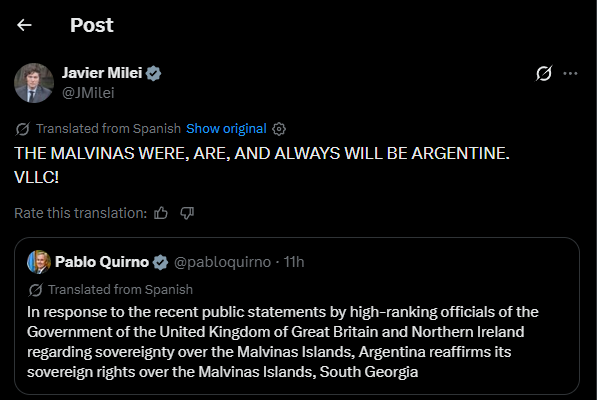
Argentine President Javier Milei has issued a forceful declaration regarding the Falkland Islands (Las Islas Malvinas), asserting that the South Atlantic archipelago “were, are, and always will be Argentine.” The statement, published on his official X account on Friday, April 24, 2026, reaffirms Buenos Aires’ long-standing sovereignty claim over the British Overseas Territory, known in Argentina as the Malvinas .
“THE MALVINAS WERE, ARE, AND ALWAYS WILL BE ARGENTINE.” — Javier Milei, President of Argentina
The post was timed to coincide with the Argentine Day of the Veterans and the Fallen of the Malvinas War, which commemorates the victims of the 1982 conflict. The anniversary is observed annually in Argentina on April 2 . Milei’s statement is not new in substance—Argentina has never relinquished its claim—but its delivery by a libertarian president allied with the United States and United Kingdom adds a noteworthy dimension to the perennial dispute.
Milei’s Complex Relationship with the UK
President Milei has cultivated a close relationship with the Trump administration and has expressed admiration for former British Prime Minister Margaret Thatcher. Despite the historic trigger of the Malvinas conflict, Milei has maintained that he bears no personal animosity toward the United Kingdom, even as he presses the sovereignty claim.
Milei has previously stated that he does not harbor resentment toward the UK over the Malvinas, distinguishing between the historical conflict and his government’s modern foreign policy objectives. However, his recent declaration also comes as the US has reportedly threatened to withdraw recognition of British sovereignty over the Falklands as a pressure tactic in the ongoing dispute over European support for the Iran war.
According to a Reuters exclusive this week, an internal Pentagon email floated reassessing US support for the UK’s claim to the Falkland Islands as part of a broader menu of punitive options against allies that refused to support US military operations in the Iran war. While the Trump administration has not acted on that proposal, the mere suggestion has alarmed British diplomats.
The Falklands Dispute: A Brief History
Key Dates in the Falklands/Malvinas Conflict:
| Year | Event |
|---|---|
| 1833 | British forces re-established control of the islands, expelling the Argentine administration |
| 1982 | Argentina invaded the Falklands on April 2; the UK recaptured them after a 10-week war |
| 1982 | 649 Argentine military personnel, 255 British servicemen, and three civilians were killed |
| 1994 | Argentina’s constitution affirmed non-renunciation of sovereignty claim |
| 2013 | Falkland Islands referendum: 99.8% voted to remain a British Overseas Territory |
| 2026 | Milei reaffirms Argentina’s claim |
The Falkland Islands have been under British control since 1833, though Argentina has consistently contested sovereignty. The 1982 war, triggered by Argentina’s invasion of the islands, resulted in a British victory. Today, the islands remain a British Overseas Territory with internal self-government; the UK administers defense and foreign affairs.
‘A Just and Definitive Solution’
The Argentine government’s official position, restated by the Ministry of Foreign Affairs following Milei’s post, is a call for a “definitive solution” to the dispute through peaceful means.
“The Argentine government calls for the resumption of negotiations on the Malvinas issue and reiterates its firm support for the search for a just and definitive solution that respects the way of life of the islanders, in accordance with the provisions of the United Nations and other international organizations.” — Argentine Ministry of Foreign Affairs
The UN has called on both countries to resume negotiations, but the islands’ residents have repeatedly voted to remain British. The 2013 referendum saw 99.8% of voters choose to remain a British Overseas Territory, a result the UK considers a decisive expression of self-determination.
The US Involvement
The Falklands dispute has occasionally drawn the United States into a delicate diplomatic position. Historically, the US has maintained neutrality on sovereignty while acknowledging de facto British administration. However, the reported Pentagon discussion about leveraging the Falklands claim against the UK highlights how the islands can become entangled in broader geopolitical disputes.
The Trump administration has not signaled any change in official US policy. However, the mere fact that such options have been discussed underscores the depth of US frustration with European allies over the Iran war. For the UK, any shift in the US position would be a diplomatic earthquake.
What Comes Next
Milei’s declaration, while forceful, is more symbolic than substantive. The Argentine government has not announced any change in policy toward the islands. There is no indication that Buenos Aires is preparing any action beyond diplomatic measures.
The statement does, however, underscore that the Malvinas issue remains a live political force in Argentina, capable of uniting politicians across the ideological spectrum. Milei’s libertarian government is as committed to the sovereignty claim as its leftist predecessors.
For the UK, the dispute remains dormant but not resolved. The islands’ residents are overwhelmingly in favor of British sovereignty, and the UK has no intention of negotiating their transfer. The only path to a “definitive solution” acceptable to Buenos Aires — the transfer of sovereignty — remains a non-starter in London and Port Stanley.
Frequently Asked Questions (FAQs)
Q1: What did President Milei say about the Malvinas?
Milei declared: “THE MALVINAS WERE, ARE, AND ALWAYS WILL BE ARGENTINE,” reaffirming Argentina’s sovereignty claim over the Falkland Islands .
Q2: Is this a change in Argentine policy?
No. Argentina has maintained its claim since 1833. Milei’s statement is a reassertion of long-standing policy, not a new position .
Q3: Does Milei’s government have a plan to take the islands?
No. There is no indication that Argentina is planning any action beyond diplomatic measures. The statement was symbolic, timed to coincide with the commemoration of the 1982 war.
Q4: How did the UK respond?
The UK has not issued an official response to Milei’s statement. The British government maintains that the Falkland Islanders have the right to self-determination and have chosen to remain British.
Q5: What does the US have to do with the Falklands?
The US has historically maintained neutrality on sovereignty while acknowledging British administration. However, a recent Pentagon email reportedly floated reassessing US support for the UK’s claim as leverage in the Iran war dispute. The Trump administration has not acted on that proposal.
Q6: Do the Falkland Islanders want to be Argentine?
No. In the 2013 referendum, 99.8% of voters chose to remain a British Overseas Territory. The UK considers that a decisive expression of self-determination.
Stay informed with Reflecto News – Your trusted source for breaking diplomatic and geopolitical intelligence. Subscribe for real-time updates on the Falklands/Malvinas dispute, Argentina-UK relations, and global sovereignty claims.
Questions people ask
What is China's current share of global manufacturing?
China now accounts for twenty eight percent of global manufacturing. This industrial output exceeds the combined manufacturing production of the United States, Japan, and Germany, making China the leading global industrial power according to recent reports.
Why were Andrew Tate and Tristan Tate arrested in Miami?
Andrew Tate and his brother Tristan Tate were taken into custody in Miami by the United States Marshals Service. They face thirty eight new charges in the United Kingdom, including rape and child pornography offences, and prosecutors are seeking their extradition.
What warning did Moscow issue about oil prices?
Kirill Dmitriev, the Chief Executive of the Russian Direct Investment Fund, warned that a tsunami of skyrocketing oil prices is approaching. Moscow describes this potential energy shock as a major threat to global markets.
What political shift is projected for Benjamin Netanyahu's coalition?
Political polls project that Prime Minister Benjamin Netanyahu's coalition is on track to lose its majority in the upcoming October election. This projection indicates a potential political shift in Jerusalem.
Why did a Russian military aircraft land in Tehran?
A Russian airborne command aircraft, widely known as a doomsday plane, landed in Tehran. The arrival of the aircraft represents a high stakes show of support from Russia for Iran during a period of heightened regional tensions.
What did President Masoud Pezeshkian claim about the United States and Israel?
Iranian President Masoud Pezeshkian claimed that the United States and Israel failed in a forty eight hour plan to topple the Iranian government. He made these statements during a televised address marking two years since his inauguration.