Reflecto News is an online news platform covering major international political events, global economic developments, and security conflicts. The site provides updates on topics such as Chinese manufacturing dominance, Middle Eastern political tensions, and high profile legal arrests. Readers can access current articles organized by categories like World News, Iran, and USA.
Reflecto News
April 15, 2026
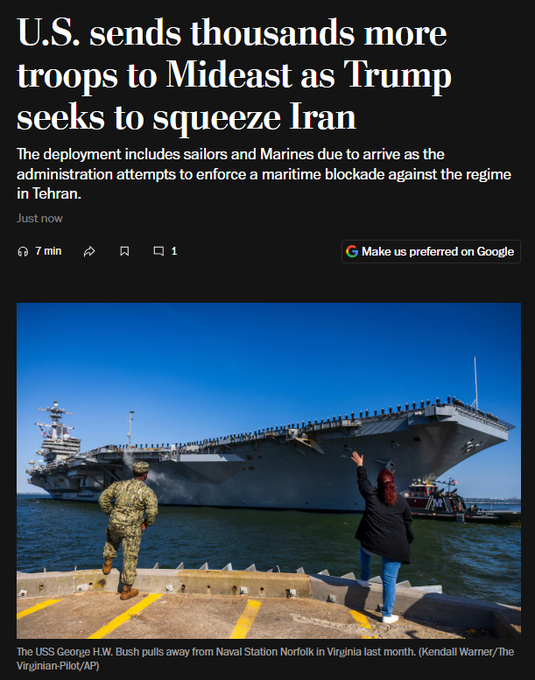
The United States is deploying approximately 10,000 additional troops, along with multiple warships and Marine units, to the Middle East as part of a major military buildup aimed at increasing pressure on Iran. This reinforcement will add to the roughly 50,000 U.S. personnel already in the region, bringing total U.S. forces to around 60,000 amid the ongoing standoff over the Strait of Hormuz.
According to officials cited in reporting, the deployment includes aircraft carriers, Marine Expeditionary Units, and other combat assets. The move is intended to provide President Donald Trump with greater military options if diplomatic talks fail, ranging from expanded airstrikes to potential limited ground operations.
The Strait of Hormuz remains the central flashpoint, with the U.S. currently enforcing a naval blockade on Iranian ports and associated shipping.
Details of the Buildup
U.S. Central Command (CENTCOM) has confirmed the arrival of additional naval assets, including elements of carrier strike groups and amphibious ready groups with Marine units. The reinforcements come as the U.S. maintains its blockade of Iranian ports while continuing to assert freedom of navigation through the Strait of Hormuz itself.
Officials emphasize that the increased presence strengthens deterrence and gives the administration flexibility in responding to Iranian actions or threats, including potential retaliation against shipping or attempts to disrupt the Red Sea route via proxies.
This latest surge builds on earlier deployments that began in late February 2026 following the start of Operation Epic Fury and has intensified in recent weeks as peace efforts stalled.
Strategic Context
The deployment occurs against a backdrop of:
- Ongoing U.S. naval blockade of Iranian ports and coastal areas.
- Iranian threats to disrupt Red Sea shipping and cut off regional oil and gas supplies “for years” if civilian infrastructure is targeted.
- Zelensky’s recent comments noting that U.S. officials are heavily focused on Iran and “have no time for Ukraine.”
- Broader concerns over global energy security, with Russia warning of a potential severe energy and economic crisis.
The additional forces are seen as a signal of resolve while talks remain stalled, with both sides having rejected key elements of mediator-proposed peace plans.
Reactions and Implications
The buildup has raised questions about the risk of further escalation, even as some European leaders, including UK Chancellor Rachel Reeves, have publicly criticized the lack of a clear U.S. exit strategy in the conflict.
Energy markets remain volatile due to uncertainty over the Strait of Hormuz, which handles roughly 20% of global seaborne oil trade. Any prolonged disruption could drive prices higher and exacerbate inflationary pressures worldwide.
Reflecto News will continue monitoring the U.S. military posture in the region, any Iranian responses, diplomatic developments, and impacts on global energy markets.
Frequently Asked Questions (FAQs)
How many additional U.S. troops are being deployed?
Approximately 10,000 more troops, including Marine units, are being sent to the Middle East, adding to the roughly 50,000 already present.
What assets are included in the buildup?
The deployment involves multiple warships (including aircraft carriers), Marine units, and other combat support elements to enhance naval and ground options.
Why is the U.S. increasing its military presence?
Officials say the buildup provides President Trump with more options if talks with Iran fail, ranging from expanded strikes to potential ground operations, while maintaining pressure over the Strait of Hormuz.
How does this relate to the current blockade?
The additional forces support the ongoing U.S. naval blockade of Iranian ports and help secure freedom of navigation through the strait itself amid Iranian restrictions and threats.
What are the risks of further escalation?
Iran has warned of retaliation, including possible disruption of Red Sea shipping. A wider conflict could significantly impact global energy supplies and prices.
For the latest on U.S. military deployments in the Middle East, the Iran conflict, and developments in the Strait of Hormuz, stay with Reflecto News.
Questions people ask
What is China's current share of global manufacturing?
China now accounts for twenty eight percent of global manufacturing. This industrial output exceeds the combined manufacturing production of the United States, Japan, and Germany, making China the leading global industrial power according to recent reports.
Why were Andrew Tate and Tristan Tate arrested in Miami?
Andrew Tate and his brother Tristan Tate were taken into custody in Miami by the United States Marshals Service. They face thirty eight new charges in the United Kingdom, including rape and child pornography offences, and prosecutors are seeking their extradition.
What warning did Moscow issue about oil prices?
Kirill Dmitriev, the Chief Executive of the Russian Direct Investment Fund, warned that a tsunami of skyrocketing oil prices is approaching. Moscow describes this potential energy shock as a major threat to global markets.
What political shift is projected for Benjamin Netanyahu's coalition?
Political polls project that Prime Minister Benjamin Netanyahu's coalition is on track to lose its majority in the upcoming October election. This projection indicates a potential political shift in Jerusalem.
Why did a Russian military aircraft land in Tehran?
A Russian airborne command aircraft, widely known as a doomsday plane, landed in Tehran. The arrival of the aircraft represents a high stakes show of support from Russia for Iran during a period of heightened regional tensions.
What did President Masoud Pezeshkian claim about the United States and Israel?
Iranian President Masoud Pezeshkian claimed that the United States and Israel failed in a forty eight hour plan to topple the Iranian government. He made these statements during a televised address marking two years since his inauguration.