Reflecto News is an online news platform covering major international political events, global economic developments, and security conflicts. The site provides updates on topics such as Chinese manufacturing dominance, Middle Eastern political tensions, and high profile legal arrests. Readers can access current articles organized by categories like World News, Iran, and USA.
Reflecto News | Breaking News | Russia-Ukraine War
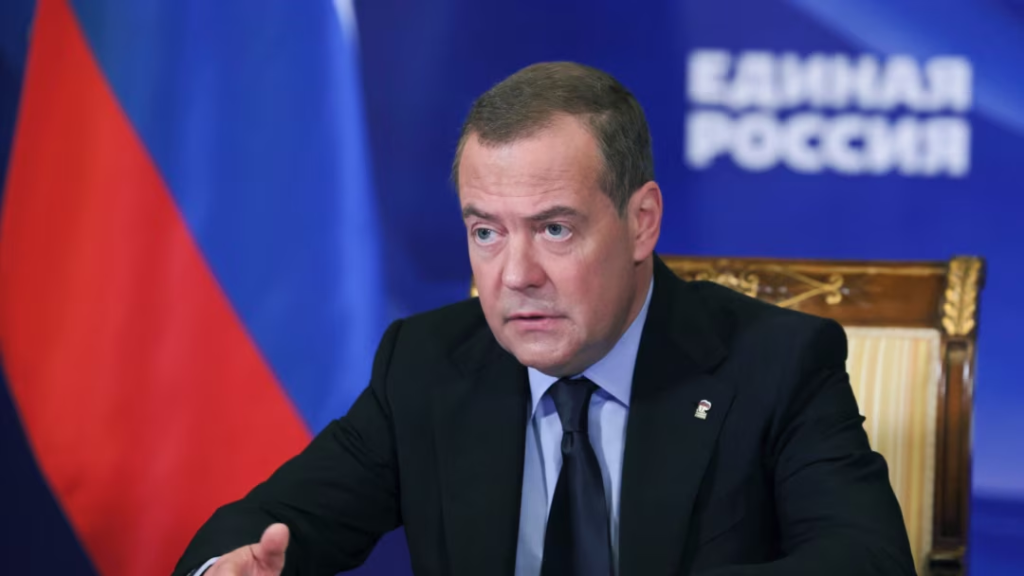
MOSCOW — Former Russian President Dmitry Medvedev, now deputy chairman of Russia’s Security Council, has acknowledged that a “nuclear apocalypse is indeed possible” while reiterating that such an outcome would be “very undesirable” .
The comments, made during a public address in Moscow, mark the latest in a long series of nuclear threats issued by the Kremlin since its full-scale invasion of Ukraine began in 2022, but Medvedev’s acknowledgment of possibility rather than certainty is a subtle shift in tone from earlier declarations that “Russia would not lose a nuclear war” .
🔬 ‘Possible’ vs. ‘Desirable’: The Semantics of Nuclear Brinkmanship
Medvedev’s phrasing carefully walks a line. By calling a nuclear exchange “undesirable,” he aligns with mainstream global sentiment. By calling it “possible,” he reinforces that Russia retains the capability to escalate if it perceives its survival to be at stake.
Key aspects of Medvedev’s statement:
- Possible: Acknowledges that the scenario cannot be ruled out, reinforcing the credibility of Russia’s nuclear deterrent
- Undesirable: Signals that the Kremlin would prefer to avoid such an outcome, a departure from earlier rhetoric that dismissed Western warnings as scaremongering
Medvedev also took aim at Western “escalation dominance” theory, arguing that Western leaders mistakenly believe Russia will forever be deterred by the prospect of mutually assured destruction. His warning appears to be calibrated for the ongoing Western debate about whether to allow Ukraine to use long-range missiles to strike deep inside Russian territory—a step the Kremlin has repeatedly described as a red line .
⚠️ Strategic Context: The ‘Red Lines’ Ukraine Has Already Crossed
Medvedev’s latest warning comes as Ukraine continues to strike targets deep inside Russia using domestically produced long-range drones, hitting oil refineries, ammunition depots, and even a radar station in the Russian Arctic. The Kremlin has repeatedly threatened retaliation; however, the type of retaliation remains ambiguous.
Russia recently updated its nuclear doctrine in 2024, lowering the threshold for a nuclear response to include a “critical threat to the sovereignty and territorial integrity” of Russia, even through conventional means. Ukraine’s Kursk incursion and the continued drone campaign arguably meet that threshold .
🤔 What ‘Very Undesirable’ Implies
Medvedev’s labeling of a nuclear exchange as “undesirable” may signal several things to Western capitals:
- A Fear of Escalation: The Kremlin is genuinely concerned that the war could spiral out of control, despite its public bravado
- An Attempt to Lower Tensions: By stating the obvious, Medvedev may be trying to walk back some of the more hysterical rhetoric, reducing the risk of accidental escalation
- A Warning Not a Threat: Medvedev is reinforcing that Russia views Western escalation as dangerous, not announcing an imminent atomic strike
Despite the saber-rattling, Medvedev has not announced any change in Russia’s nuclear posture. The conflict in Ukraine rages on, and the Red Square will host the annual Victory Day parade on May 9, where Putin may deliver more definitive messaging on the future of Russian nuclear policy.
📋 Key Takeaways for Reflecto News Readers
| Aspect | Summary |
|---|---|
| Medvedev’s Statement | “A nuclear apocalypse is indeed possible, but it would be very undesirable.” |
| Strategic Context | Ukraine drone strikes on Russian infrastructure; Russian nuclear doctrine threshold lowered |
| Key Audience | Western capitals debating Ukraine’s use of long-range missiles; domestic Russian audience for deterrence credibility |
| Tone Shift | Acknowledges “possibility” while stressing undesirability — subtle de-escalation from earlier maximalist threats |
| Red Lines Crossed | Ukraine has hit targets inside Russia (oil refineries, radars) despite previous Russian warnings |
| Nuclear Doctrine | 2024 update allows nuclear response to “critical threat” to sovereignty via conventional means |
Follow Reflecto News for continuous updates on Russian nuclear rhetoric, the Ukraine war, and all breaking news from Moscow and Washington.
This article is the intellectual property of Reflecto News. Redistribution without attribution is prohibited. For syndication or media inquiries, please contact the editorial team.
Questions people ask
What is China's current share of global manufacturing?
China now accounts for twenty eight percent of global manufacturing. This industrial output exceeds the combined manufacturing production of the United States, Japan, and Germany, making China the leading global industrial power according to recent reports.
Why were Andrew Tate and Tristan Tate arrested in Miami?
Andrew Tate and his brother Tristan Tate were taken into custody in Miami by the United States Marshals Service. They face thirty eight new charges in the United Kingdom, including rape and child pornography offences, and prosecutors are seeking their extradition.
What warning did Moscow issue about oil prices?
Kirill Dmitriev, the Chief Executive of the Russian Direct Investment Fund, warned that a tsunami of skyrocketing oil prices is approaching. Moscow describes this potential energy shock as a major threat to global markets.
What political shift is projected for Benjamin Netanyahu's coalition?
Political polls project that Prime Minister Benjamin Netanyahu's coalition is on track to lose its majority in the upcoming October election. This projection indicates a potential political shift in Jerusalem.
Why did a Russian military aircraft land in Tehran?
A Russian airborne command aircraft, widely known as a doomsday plane, landed in Tehran. The arrival of the aircraft represents a high stakes show of support from Russia for Iran during a period of heightened regional tensions.
What did President Masoud Pezeshkian claim about the United States and Israel?
Iranian President Masoud Pezeshkian claimed that the United States and Israel failed in a forty eight hour plan to topple the Iranian government. He made these statements during a televised address marking two years since his inauguration.