Reflecto News is an online news platform covering major international political events, global economic developments, and security conflicts. The site provides updates on topics such as Chinese manufacturing dominance, Middle Eastern political tensions, and high profile legal arrests. Readers can access current articles organized by categories like World News, Iran, and USA.
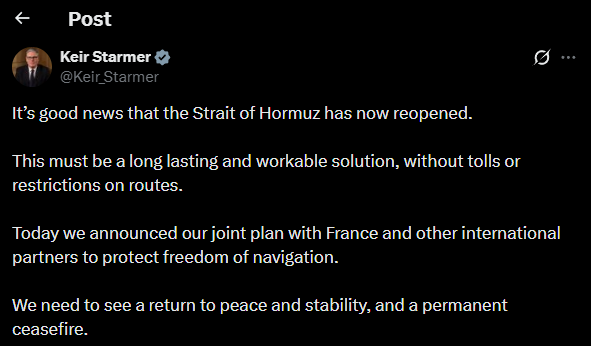
Reflecto News – British Prime Minister Keir Starmer announced today that the United Kingdom, in partnership with France and other international allies, has put forward a coordinated plan to safeguard freedom of navigation in the Strait of Hormuz once security conditions permit.
Starmer made the statement following a virtual summit co-chaired with French President Emmanuel Macron, which brought together dozens of countries to advance what has been formally named the Strait of Hormuz Maritime Freedom of Navigation Initiative. The effort is described as strictly defensive and independent of ongoing U.S. operations in the region.
Details of the Joint Plan
- The initiative aims to establish a multinational mission focused on restoring and protecting safe commercial shipping through the vital waterway.
- It emphasizes a “coordinated, independent” approach that does not involve direct participation in the U.S. naval blockade of Iranian ports.
- Planning includes potential deployment of minesweepers, escort vessels, and monitoring assets “as soon as conditions allow” following a more durable ceasefire.
- Around 30–40 countries participated in the Paris-hosted virtual meeting, reflecting broad international interest in securing one of the world’s most critical energy chokepoints.
Starmer stressed that reopening and securing the strait is a “global responsibility,” adding that the UK and France are committed to ensuring energy and trade can flow freely again without being held hostage to regional conflicts.
Strategic Context
The announcement comes as:
- Iran has declared the Strait of Hormuz open for commercial shipping during the current fragile U.S.-Iran ceasefire.
- The U.S. continues its targeted naval blockade on Iranian ports as leverage in negotiations.
- Backchannel diplomacy, mediated by Pakistan, Egypt, and Türkiye, continues ahead of the April 21 ceasefire deadline.
The UK-France-led initiative is positioned as a European and international contribution to long-term maritime security, separate from direct U.S. enforcement actions. It echoes broader efforts to prevent future disruptions that could spike global oil prices and threaten energy supplies for countries worldwide.
Critics have described the plan as largely symbolic at this stage, given that full deployment depends on a lasting ceasefire and improved security conditions. Supporters argue it demonstrates European willingness to shoulder responsibility for global commons without being drawn into bilateral conflicts.
Implications
- Energy Markets: A successful multinational mission could provide greater long-term confidence in the strait’s security, helping stabilize oil and gas prices.
- Transatlantic Dynamics: The initiative highlights a distinct European approach, with the UK and France emphasizing defensive, multilateral action rather than alignment with U.S. blockade tactics.
- Regional Stability: The plan could complement ongoing U.S.-Iran talks while reducing risks of renewed escalation over maritime routes.
This remains a developing diplomatic and security story as planning advances and the fragile ceasefire continues to hold.
FAQs
Q1: What exactly did Keir Starmer announce?
Starmer confirmed a joint UK-France initiative with international partners to protect freedom of navigation in the Strait of Hormuz through a strictly defensive multinational mission.
Q2: Which countries are involved?
The UK and France are co-leading, with participation from around 30–40 countries in the recent virtual summit. The effort is independent of direct U.S. involvement.
Q3: Is this plan linked to the U.S. naval blockade?
No. The initiative is described as separate and strictly defensive, focused on safeguarding commercial shipping rather than enforcing the U.S. blockade on Iranian ports.
Q4: When would the mission deploy?
Deployment is planned “as soon as conditions allow,” once a more durable ceasefire or improved security situation is in place.
Q5: Why is the Strait of Hormuz important?
It is a critical chokepoint carrying roughly 20–30% of global seaborne oil and gas trade. Disruptions can cause major volatility in energy prices worldwide.
Q6: How does this fit into the current U.S.-Iran ceasefire?
The plan aims to support long-term stability in the region while U.S.-Iran mediated talks continue on nuclear issues, sanctions, and maritime security ahead of the April 21 deadline.
Q7: Where can I follow updates?
Stay with Reflecto News for balanced coverage of the Strait of Hormuz initiative, UK-France diplomacy, and broader Middle East developments.
This is a developing story. Reflecto News will provide updates as the multinational initiative progresses, any deployment timelines are clarified, or reactions emerge from regional and international actors.
Reflecto News delivers accurate, timely reporting on global maritime security, UK-France foreign policy, and Middle East affairs. For more on the Strait of Hormuz situation, the fragile ceasefire, and international efforts to protect shipping lanes, explore our dedicated sections. Share your respectful comments below.
Questions people ask
What is China's current share of global manufacturing?
China now accounts for twenty eight percent of global manufacturing. This industrial output exceeds the combined manufacturing production of the United States, Japan, and Germany, making China the leading global industrial power according to recent reports.
Why were Andrew Tate and Tristan Tate arrested in Miami?
Andrew Tate and his brother Tristan Tate were taken into custody in Miami by the United States Marshals Service. They face thirty eight new charges in the United Kingdom, including rape and child pornography offences, and prosecutors are seeking their extradition.
What warning did Moscow issue about oil prices?
Kirill Dmitriev, the Chief Executive of the Russian Direct Investment Fund, warned that a tsunami of skyrocketing oil prices is approaching. Moscow describes this potential energy shock as a major threat to global markets.
What political shift is projected for Benjamin Netanyahu's coalition?
Political polls project that Prime Minister Benjamin Netanyahu's coalition is on track to lose its majority in the upcoming October election. This projection indicates a potential political shift in Jerusalem.
Why did a Russian military aircraft land in Tehran?
A Russian airborne command aircraft, widely known as a doomsday plane, landed in Tehran. The arrival of the aircraft represents a high stakes show of support from Russia for Iran during a period of heightened regional tensions.
What did President Masoud Pezeshkian claim about the United States and Israel?
Iranian President Masoud Pezeshkian claimed that the United States and Israel failed in a forty eight hour plan to topple the Iranian government. He made these statements during a televised address marking two years since his inauguration.