Reflecto News is an online news platform covering major international political events, global economic developments, and security conflicts. The site provides updates on topics such as Chinese manufacturing dominance, Middle Eastern political tensions, and high profile legal arrests. Readers can access current articles organized by categories like World News, Iran, and USA.
High-Altitude Unmanned Aircraft (Callsign BLKCAT6) Performed Extensive Reconnaissance Over Southern Coast, Florida Straits, and Key Areas, Returning to Naval Air Station Jacksonville
By Reflecto News Staff
April 17, 2026
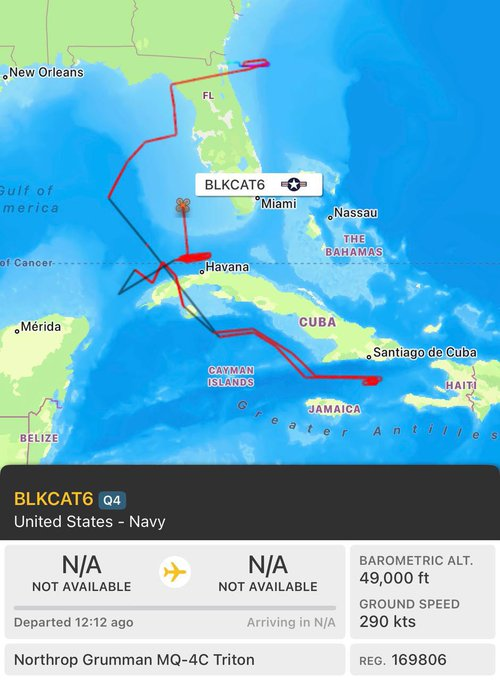
A U.S. Navy MQ-4C Triton high-altitude, long-endurance surveillance drone flew a mission lasting over 12 hours off the coast of Cuba on April 16, 2026, closely monitoring areas around Havana and Guantánamo Bay while operating exclusively in international airspace.
The drone, with callsign BLKCAT6 (serial 169806), conducted orbit patterns typical of intelligence, surveillance, and reconnaissance (ISR) missions at altitudes between 49,000 and 51,000 feet and speeds around 308 knots. It focused on Cuba’s southern coast, the Florida Straits, and the vicinity of Havana before returning to its base at Naval Air Station Jacksonville in Florida.
U.S. Navy MQ-4C Triton high-altitude surveillance drone, similar to the one that conducted the extended mission near Cuba.
Details of the Mission
Open-source intelligence (OSINT) trackers, including FlconEYES and Osinttechnical, reported the drone’s activity in real time. It flew extensive rounds over the Gulf of America (Gulf of Mexico) and the northern Caribbean, taking particular interest in:
- The southern coast of Cuba, including areas near Santiago de Cuba
- Waters off Havana, remaining approximately 50 kilometers offshore at times
- The broader region surrounding Guantánamo Bay
The aircraft did not enter Cuban territorial airspace and maintained operations in international airspace throughout the flight. This type of persistent ISR mission allows the Navy to gather detailed maritime and coastal intelligence without direct overflight of sovereign territory.
The Triton, manufactured by Northrop Grumman, is one of the most advanced unmanned surveillance platforms in the U.S. inventory. It can remain airborne for more than 24 hours, fly above 50,000 feet, and carry sophisticated sensors for wide-area maritime and ground surveillance.
Strategic Context
Such flights near Cuba are not uncommon but occur amid heightened U.S. attention to the Caribbean region. Factors that may influence these operations include:
- Monitoring maritime traffic and potential illicit activities
- Assessing coastal defenses and infrastructure developments
- Routine training and operational familiarization in the Florida Straits and Caribbean theater
- Broader regional security interests, including migration patterns and counter-narcotics efforts
The mission comes at a time when the U.S. Navy continues to expand its use of unmanned systems for persistent surveillance, reducing risk to manned aircraft while maintaining coverage over strategically sensitive areas.
Guantánamo Bay remains a long-standing U.S. naval base on Cuban soil, adding another layer of operational relevance to surveillance in the vicinity.
Map of the Caribbean region highlighting Cuba, Havana, Guantánamo Bay, and the Florida Straits where the MQ-4C Triton operated.
MQ-4C Triton Capabilities
The Triton is designed as a maritime patrol complement to the P-8 Poseidon manned aircraft. Key features include:
- Range: Over 8,500 nautical miles
- Endurance: 24+ hours
- Altitude: Up to 55,000+ feet (above most commercial and many military aircraft)
- Sensors: Advanced radar, electro-optical/infrared cameras, and signals intelligence capabilities for broad-area maritime domain awareness
Its ability to operate at extreme altitudes allows it to cover vast swaths of ocean and coastline while remaining difficult to intercept or track from the ground.
Reactions and Implications
No official statement has been released by the U.S. Navy or Cuban authorities regarding this specific flight. Cuban state media and aviation observers have noted increased U.S. drone activity in recent months.
The mission underscores the U.S. military’s continued emphasis on unmanned ISR platforms in its near-abroad operations. While routine, such flights can serve as a visible demonstration of capability and deterrence in a region with complex historical and geopolitical dynamics.
Representative image of a U.S. Navy unmanned surveillance asset in flight, highlighting the long-endurance nature of Triton missions.
What This Means
The 12+ hour duration and focused orbits around key Cuban locations illustrate the Triton’s value for persistent, non-intrusive monitoring. As the U.S. Navy integrates more unmanned systems into its fleet, flights like this one are expected to become increasingly common for maritime domain awareness across the Western Hemisphere.
Frequently Asked Questions (FAQs)
Q1: What is the MQ-4C Triton?
A: It is a high-altitude, long-endurance unmanned aerial vehicle (UAV) used by the U.S. Navy for maritime surveillance and reconnaissance. It can fly for over 24 hours at altitudes above 50,000 feet.
Q2: Did the drone enter Cuban airspace?
A: No. All reported activity occurred in international airspace, with the drone maintaining safe distances from Cuban territorial waters and airspace.
Q3: How long was the mission and where did it originate/return?
A: The flight lasted over 12 hours. It originated from and returned to Naval Air Station Jacksonville, Florida.
Q4: What areas were specifically monitored?
A: The drone focused on Cuba’s southern coast, the Florida Straits, waters off Havana, and the broader region around Guantánamo Bay.
Q5: Is this type of mission unusual?
A: Routine U.S. military surveillance flights occur in international airspace near Cuba, but the extended duration and specific focus on Havana and Guantánamo Bay make this mission noteworthy.
Q6: Why conduct such surveillance?
A: Missions like this support maritime domain awareness, counter-narcotics efforts, migration monitoring, and general regional security interests.
Reflecto News Analysis
The MQ-4C Triton’s extended mission near Cuba demonstrates the growing role of advanced unmanned systems in U.S. maritime surveillance strategy. Operating from international airspace, the drone provides persistent, high-resolution intelligence without risking manned aircraft or escalating tensions through territorial incursions.
While such flights are standard for maintaining situational awareness in strategically important waters, they also serve as a quiet reminder of U.S. technological reach in the Caribbean. As tensions or routine activities evolve in the region, the Triton and similar platforms will likely play an expanding role in ensuring maritime security and deterrence.
For the latest on U.S. military operations, unmanned systems developments, and Caribbean security matters, stay tuned to Reflecto News — your trusted source for accurate, timely international coverage.
Related Coverage:
- MQ-4C Triton: Capabilities and Role in U.S. Navy Operations
- U.S. Surveillance Activities in the Caribbean and Florida Straits
- Evolution of Unmanned Aerial Systems in Maritime Domain Awareness
Images used for illustrative purposes from public and news sources.
Questions people ask
What is China's current share of global manufacturing?
China now accounts for twenty eight percent of global manufacturing. This industrial output exceeds the combined manufacturing production of the United States, Japan, and Germany, making China the leading global industrial power according to recent reports.
Why were Andrew Tate and Tristan Tate arrested in Miami?
Andrew Tate and his brother Tristan Tate were taken into custody in Miami by the United States Marshals Service. They face thirty eight new charges in the United Kingdom, including rape and child pornography offences, and prosecutors are seeking their extradition.
What warning did Moscow issue about oil prices?
Kirill Dmitriev, the Chief Executive of the Russian Direct Investment Fund, warned that a tsunami of skyrocketing oil prices is approaching. Moscow describes this potential energy shock as a major threat to global markets.
What political shift is projected for Benjamin Netanyahu's coalition?
Political polls project that Prime Minister Benjamin Netanyahu's coalition is on track to lose its majority in the upcoming October election. This projection indicates a potential political shift in Jerusalem.
Why did a Russian military aircraft land in Tehran?
A Russian airborne command aircraft, widely known as a doomsday plane, landed in Tehran. The arrival of the aircraft represents a high stakes show of support from Russia for Iran during a period of heightened regional tensions.
What did President Masoud Pezeshkian claim about the United States and Israel?
Iranian President Masoud Pezeshkian claimed that the United States and Israel failed in a forty eight hour plan to topple the Iranian government. He made these statements during a televised address marking two years since his inauguration.