Reflecto News is an online news platform covering major international political events, global economic developments, and security conflicts. The site provides updates on topics such as Chinese manufacturing dominance, Middle Eastern political tensions, and high profile legal arrests. Readers can access current articles organized by categories like World News, Iran, and USA.
Interim Agreement Aims to Track Ceasefire Breaches and Humanitarian Conditions as Fighting Spreads into Remote South Kivu Highlands, Raising Civilian Risks
By Reflecto News Staff
April 17, 2026
The Democratic Republic of the Congo (DRC) government and the March 23 Movement (M23) rebels, operating under the Alliance Fleuve Congo (AFC) umbrella, have signed an interim agreement to create a joint monitoring body during peace talks held in Switzerland.
The deal, reached on April 15–16, 2026, near Montreux/Geneva, establishes a mechanism to track ceasefire violations, monitor security and humanitarian developments, and promote transparency. It includes equal representation from both the Congolese authorities and M23, with technical support from the United Nations Organization Stabilization Mission in the Democratic Republic of the Congo (MONUSCO) and coordination through the International Conference on the Great Lakes Region (ICGLR).
UN peacekeepers from MONUSCO on patrol in eastern DRC, which will support the new monitoring mechanism.
Background: Continuation of the Doha Process
The talks in Switzerland represent the latest round in the Qatar-mediated Doha Framework for Peace, signed in late 2025. Earlier steps included the establishment of a Ceasefire Oversight and Verification Mechanism (COVM) and terms of reference signed in February 2026.
The new interim mechanism expands the Expanded Joint Verification Mechanism (EJVM) to give M23 a formal role alongside government representatives. Mediators from the United States and Qatar, along with UN observers, facilitated the discussions. Switzerland hosted the sessions after the venue shifted from Doha due to regional disruptions.
M23 had previously withdrawn from the strategic town of Uvira in South Kivu as a goodwill gesture, conditional on neutral monitoring of any ceasefire.
Map highlighting conflict zones in eastern DRC, including areas of M23 activity in North and South Kivu provinces.
Persistent Clashes Despite the Agreement
While the monitoring body aims to build trust and reduce violence, fighting continues unabated in parts of eastern DRC. Clashes have shifted from urban centers into the remote highlands of South Kivu, including areas around Minembwe, Point Zero, Mikenge, and the Fizi-Mwenga-Uvira triangle.
Pro-government forces, including the Congolese army (FARDC) and allied local militias known as Wazalendo, have engaged M23 and affiliated groups using drones and ground operations. Civilians in these hard-to-reach highland regions are increasingly caught in the crossfire, with reports of displacement, humanitarian access challenges, and risks from heavy weapons and indiscriminate attacks.
The UN has warned that violence is expanding beyond traditional hotspots in North Kivu, exacerbating one of the world’s largest humanitarian crises, with millions already displaced.
Displaced civilians in eastern DRC carrying belongings amid ongoing conflict and insecurity.
Strategic and Humanitarian Implications
The monitoring mechanism is seen as a cautious step toward de-escalation and potential implementation of a more permanent ceasefire. However, deep mistrust persists, with both sides routinely accusing each other of violations. Broader issues — including the integration of M23 fighters, return of refugees, political grievances, and alleged external support (notably from Rwanda, which denies direct involvement) — remain unresolved.
Eastern DRC’s mineral wealth and complex web of armed groups continue to fuel the conflict, complicating efforts for lasting peace.
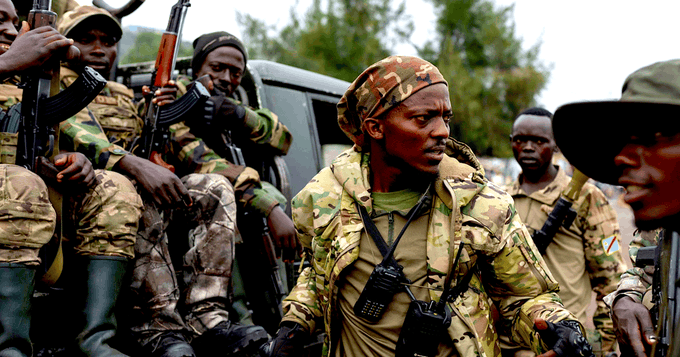
M23 fighters in eastern DR Congo, where the group maintains significant territorial influence.
What Happens Next?
The joint body is expected to begin field operations soon, focusing on verification missions and reporting. Success will depend on genuine cooperation, access for monitors, and parallel progress on humanitarian aid and civilian protection.
International actors, including the UN Security Council, the African Union, and regional states, continue to urge restraint and full implementation of existing frameworks.
Frequently Asked Questions (FAQs)
Q1: What is the new monitoring mechanism?
A: It is an interim joint body with equal representation from the DRC government and M23/AFC to track ceasefire violations, security incidents, and humanitarian conditions, supported by MONUSCO and the ICGLR.
Q2: Where and when were the talks held?
A: The latest round began on April 13–14, 2026, near Montreux/Geneva in Switzerland, with the agreement signed around April 15–16.
Q3: Why are clashes continuing in South Kivu?
A: Fighting has shifted into remote highland areas after M23’s withdrawal from towns like Uvira. Pro-government forces and rebels continue to clash in difficult-to-access zones around Minembwe and other locations.
Q4: What role does MONUSCO play?
A: The UN peacekeeping mission provides technical support and observer presence but operates within its mandate limits, primarily in North Kivu and Ituri, with notifications required for South Kivu activities.
Q5: Does this agreement guarantee a ceasefire?
A: No. It focuses on monitoring and verification to build confidence, but it does not yet establish a fully enforceable permanent ceasefire. Multiple previous attempts have failed to halt violence.
Q6: What are the main risks to civilians?
A: Ongoing clashes in highlands expose communities to displacement, indiscriminate attacks, restricted humanitarian access, and abuses by multiple armed actors.
Reflecto News Analysis
The establishment of a joint monitoring mechanism marks incremental progress in the long-running effort to stabilize eastern DRC, building on the Qatar-led Doha process. Including M23 directly in verification efforts could enhance transparency, but persistent fighting in South Kivu’s highlands demonstrates the fragility of any truce in a region plagued by dozens of armed groups and deep ethnic-political grievances.
While the deal offers a framework for de-escalation, real success will require addressing root causes — governance failures, resource competition, and alleged foreign involvement — alongside robust international oversight. Civilians continue to bear the brunt of the conflict, underscoring the urgent need for verifiable ceasefires and expanded humanitarian corridors.
For the latest developments on the DRC conflict, M23 peace talks, and humanitarian conditions in eastern Congo, stay tuned to Reflecto News — your trusted source for accurate, timely international coverage.
Related Coverage:
- Doha Framework for Peace: Timeline and Key Protocols
- Humanitarian Crisis in Eastern DRC: Displacement and Aid Challenges
- Role of Regional Actors in the Great Lakes Conflict
Images used for illustrative purposes from public and news sources.
Questions people ask
What is China's current share of global manufacturing?
China now accounts for twenty eight percent of global manufacturing. This industrial output exceeds the combined manufacturing production of the United States, Japan, and Germany, making China the leading global industrial power according to recent reports.
Why were Andrew Tate and Tristan Tate arrested in Miami?
Andrew Tate and his brother Tristan Tate were taken into custody in Miami by the United States Marshals Service. They face thirty eight new charges in the United Kingdom, including rape and child pornography offences, and prosecutors are seeking their extradition.
What warning did Moscow issue about oil prices?
Kirill Dmitriev, the Chief Executive of the Russian Direct Investment Fund, warned that a tsunami of skyrocketing oil prices is approaching. Moscow describes this potential energy shock as a major threat to global markets.
What political shift is projected for Benjamin Netanyahu's coalition?
Political polls project that Prime Minister Benjamin Netanyahu's coalition is on track to lose its majority in the upcoming October election. This projection indicates a potential political shift in Jerusalem.
Why did a Russian military aircraft land in Tehran?
A Russian airborne command aircraft, widely known as a doomsday plane, landed in Tehran. The arrival of the aircraft represents a high stakes show of support from Russia for Iran during a period of heightened regional tensions.
What did President Masoud Pezeshkian claim about the United States and Israel?
Iranian President Masoud Pezeshkian claimed that the United States and Israel failed in a forty eight hour plan to topple the Iranian government. He made these statements during a televised address marking two years since his inauguration.