Reflecto News is an online news platform covering major international political events, global economic developments, and security conflicts. The site provides updates on topics such as Chinese manufacturing dominance, Middle Eastern political tensions, and high profile legal arrests. Readers can access current articles organized by categories like World News, Iran, and USA.
Reflecto News
Comprehensive coverage of the US-Iran two-week ceasefire and its potential for long-term regional transformation
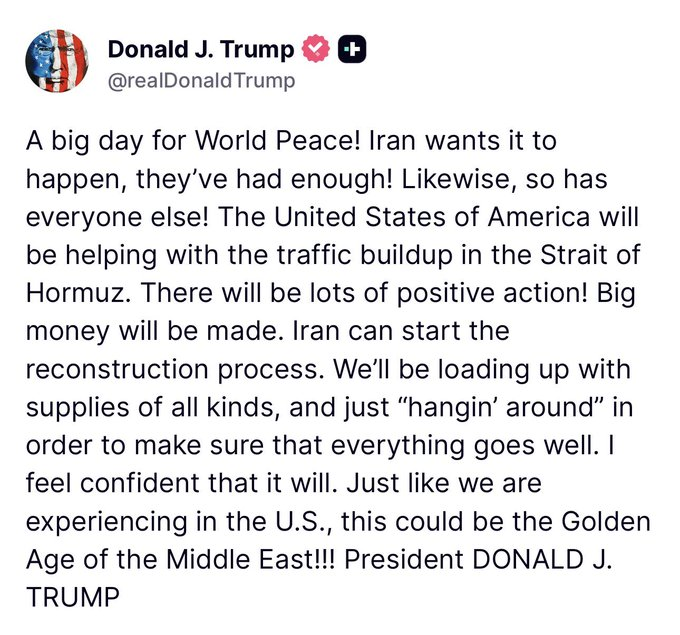
President Donald Trump has enthusiastically described the newly announced two-week ceasefire with Iran as “a big day for world peace,” adding that it could usher in a “Golden Age of the Middle East.” In a Truth Social post, Trump expressed optimism that both sides have “had enough” of conflict and that the agreement opens the door to reconstruction, economic opportunities, and lasting stability in the region.
Trump wrote: “A big day for World Peace! Iran wants it to happen, they’ve had enough! Likewise, so has everyone else! The United States of America will be helping with the traffic buildup in the Strait of Hormuz. There will be lots of positive action! Big money will be made. Iran can start the reconstruction process… Just like we are experiencing in the U.S., this could be the Golden Age of the Middle East!!!”
This optimistic tone marks a sharp contrast to earlier threats of escalated military action and reflects the administration’s view that the ceasefire represents a strategic victory achieved through pressure and diplomacy.
Context of Trump’s Optimistic Outlook
The two-week ceasefire, reached with significant mediation from Pakistan and quiet encouragement from China, includes the US suspending offensive operations against Iran in exchange for Tehran allowing safe, coordinated commercial shipping through the Strait of Hormuz — a vital artery carrying roughly 20% of global oil supplies.
Trump emphasized that the US will assist with managing increased maritime traffic in the strait, signaling American support for rapid economic normalization. He also noted that Iran could begin reconstruction efforts, with the US potentially supplying materials and monitoring compliance to ensure stability.
Ongoing Challenges Despite Optimism
While Trump projects confidence, several hurdles remain:
- No specific start time for the ceasefire has been finalized.
- Missile exchanges between Iran and Israel continue.
- Israeli Prime Minister Benjamin Netanyahu has stated that the truce “does not include Lebanon,” meaning operations against Hezbollah will persist independently.
- The US maintains firm red lines for upcoming negotiations in Islamabad, Pakistan, including demands for Iran to remove all nuclear material, end uranium enrichment entirely, and eliminate its ballistic missile threat.
These positions clash with elements of Iran’s 10-point proposal, which seeks full sanctions relief and recognition of its enrichment rights. The US views the Iranian plan as a “workable basis” for talks but has rejected claims of full acceptance.
Pakistan’s Pivotal Mediation Role
Pakistan has played a central role in brokering the ceasefire. Prime Minister Shehbaz Sharif and military leadership engaged directly with both Washington and Tehran, relaying proposals and urging de-escalation. Islamabad successfully hosted communications that helped avert immediate escalation and will now serve as the venue for Friday’s negotiations between US and Iranian delegations.
Pakistan’s efforts, combined with China’s influence as Iran’s largest trading partner, have been credited with creating the diplomatic space for this pause. Analysts highlight Pakistan’s unique position as a trusted intermediary with strong ties to both sides.
China’s Contribution to the Process
President Trump has publicly credited China with helping convince Iran to negotiate. AP reports confirm that Chinese officials encouraged Tehran to pursue a ceasefire path, driven by Beijing’s interest in protecting energy imports and regional stability. This multipolar diplomacy — involving the US, Pakistan, and China — underscores the evolving global dynamics behind the agreement.
Economic and Regional Implications
Trump’s vision of a “Golden Age” envisions economic revival: reopened shipping lanes, reconstruction in Iran, and broader prosperity across the Middle East. Successful implementation could lower global energy prices, reduce inflationary pressures, and create opportunities for trade and investment.
However, sustained progress depends on verifiable compliance, reduced hostilities (including in Lebanon), and tangible breakthroughs in Islamabad talks on nuclear issues, sanctions, and security guarantees.
Reactions from Key Players
- United States: Trump frames the deal as a “total and complete victory” that advances long-term peace.
- Iran: Welcomes the pause but stresses it does not end the war and requires progress toward its core demands.
- Israel: Supports the US-Iran truce conditionally while continuing independent operations against threats from Iran and Hezbollah.
- Pakistan: Praises the mediation outcome and looks forward to hosting constructive talks.
- China: Has advocated for dialogue and de-escalation, aligning with its economic interests.
Global markets have reacted with cautious optimism, showing signs of easing oil prices on expectations of resumed Hormuz traffic.
What Happens Next?
US and Iranian delegations are scheduled to begin negotiations in Islamabad this week. The two-week window provides a critical opportunity to address deep divisions. Trump has expressed confidence in a positive outcome, but experts caution that issues like nuclear material removal, enrichment, missiles, and the Lebanon front will require intensive bargaining.
Any violations or failure to agree could see the fragile ceasefire collapse, while success might lead to extensions or a comprehensive permanent deal.
Reflecto News will continue providing real-time, accurate updates on diplomatic developments, military postures, and economic impacts.
FAQs: Trump’s “Big Day for World Peace” and Golden Age Vision
Q1: What exactly did President Trump say about the ceasefire?
Trump called it “a big day for World Peace!” and predicted it could lead to a “Golden Age of the Middle East,” emphasizing reconstruction, economic gains, and US assistance with Strait of Hormuz traffic.
Q2: Does the ceasefire include Lebanon?
No. Israeli Prime Minister Netanyahu has explicitly stated that the agreement does not cover operations against Hezbollah in Lebanon.
Q3: Has the two-week ceasefire officially begun?
No agreed start time has been set. The US has paused offensive operations, but missile activity between Iran and Israel continues.
Q4: What role did Pakistan play?
Pakistan served as the primary mediator, facilitating communications and hosting upcoming talks in Islamabad.
Q5: What are the main US demands in negotiations?
Removal of all Iranian nuclear material, complete halt to uranium enrichment, and elimination of the ballistic missile threat.
Q6: What is the significance of the Strait of Hormuz?
It is a critical global oil transit route. Iran’s commitment to safe passage is central to the ceasefire and could stabilize energy markets if fully implemented.
Trump’s optimistic statements reflect hope for de-escalation in a conflict that has disrupted the region and global energy flows. Reflecto News remains committed to professional, unbiased reporting as this historic development unfolds. Stay tuned for further updates from Islamabad and beyond.
Questions people ask
What is China's current share of global manufacturing?
China now accounts for twenty eight percent of global manufacturing. This industrial output exceeds the combined manufacturing production of the United States, Japan, and Germany, making China the leading global industrial power according to recent reports.
Why were Andrew Tate and Tristan Tate arrested in Miami?
Andrew Tate and his brother Tristan Tate were taken into custody in Miami by the United States Marshals Service. They face thirty eight new charges in the United Kingdom, including rape and child pornography offences, and prosecutors are seeking their extradition.
What warning did Moscow issue about oil prices?
Kirill Dmitriev, the Chief Executive of the Russian Direct Investment Fund, warned that a tsunami of skyrocketing oil prices is approaching. Moscow describes this potential energy shock as a major threat to global markets.
What political shift is projected for Benjamin Netanyahu's coalition?
Political polls project that Prime Minister Benjamin Netanyahu's coalition is on track to lose its majority in the upcoming October election. This projection indicates a potential political shift in Jerusalem.
Why did a Russian military aircraft land in Tehran?
A Russian airborne command aircraft, widely known as a doomsday plane, landed in Tehran. The arrival of the aircraft represents a high stakes show of support from Russia for Iran during a period of heightened regional tensions.
What did President Masoud Pezeshkian claim about the United States and Israel?
Iranian President Masoud Pezeshkian claimed that the United States and Israel failed in a forty eight hour plan to topple the Iranian government. He made these statements during a televised address marking two years since his inauguration.