Reflecto News is an online news platform covering major international political events, global economic developments, and security conflicts. The site provides updates on topics such as Chinese manufacturing dominance, Middle Eastern political tensions, and high profile legal arrests. Readers can access current articles organized by categories like World News, Iran, and USA.
Published on Reflecto News | World News | National Security & Intelligence
In a newly unearthed revelation that sheds light on one of the most significant national security threats during the first Trump administration, Venezuela under then-leader Nicolás Maduro formally approved a plan in January 2020 to spend over $400 million on a ballistic missile system from Iran. The missiles, which would have been deployed on Venezuelan naval vessels, could potentially have reached United States territory .
The deal ultimately did not go through following intense diplomatic and economic pressure from the Trump administration. But a confidential memo from within the Venezuelan Defense Ministry, dated January 17, 2020, and described in detail to Politico by two sources familiar with internal administrative documents, reveals that the talks on transferring such missiles from Iran to Venezuela progressed further and were more extensive than previously reported .
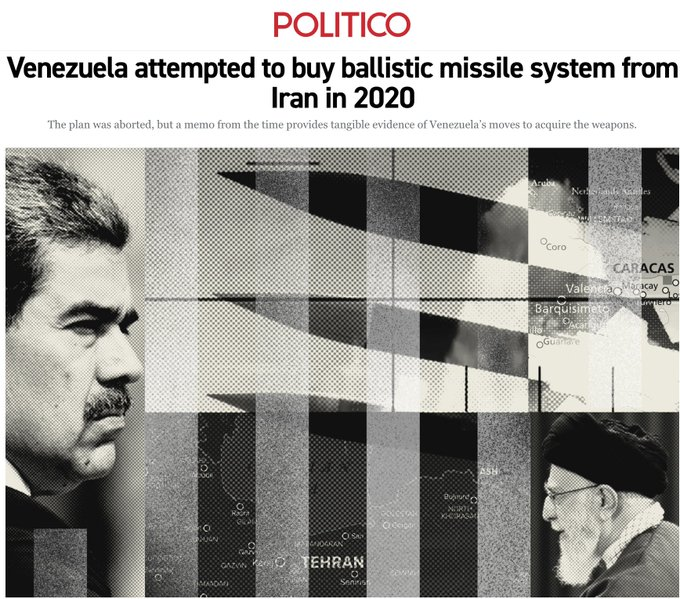
The 2020 Memo: A Blueprint for Ballistic Missile Transfer
The confidential Venezuelan Defense Ministry memo — approved by the country’s then-defense minister, Vladimir Padrino López — provided a concrete blueprint for how the transaction would be executed .
Key details from the memo include:
| Detail | Information |
|---|---|
| Date of memo | January 17, 2020 |
| Approved by | Defense Minister Vladimir Padrino López |
| Total value | Over $400 million |
| Weapon type | Ballistic missile system from Iran |
| Launch platform | Venezuelan naval vessels |
| Payment method | Funneled through state-owned companies |
The memo specified how the Venezuelan government planned to move money through state-owned enterprises to make the purchase a reality. It also explained that the system would be operated from platforms on Venezuelan naval vessels — a detail that would have given Caracas significant operational flexibility, potentially allowing missile launches from international waters .
The Threat: Missiles That Could Reach Washington, DC
The strategic significance of this proposed deal cannot be overstated. Venezuela’s geographic position in the Western Hemisphere would have placed Iranian ballistic missiles within striking distance of major American population centers.
Interior Secretary Doug Burgum, speaking at the CERAWeek energy conference in Houston in March 2026, laid out the threat in stark terms. He warned that Iran could have struck Washington, DC, Houston, and other major American cities with intermediate-range ballistic missiles launched by proxy from Venezuelan soil .
The distance math alone was alarming:
| Target City | Distance from Venezuela |
|---|---|
| Miami | ~1,300 miles |
| Houston | ~2,200 miles |
| Washington, DC | ~2,000+ miles |
| New York City | ~2,100 miles |
| Chicago | ~2,600 miles |
“That means, you know, Venezuela was a hotbed of Iranian-funded terror groups, including Hamas. If there was an Iranian ballistic missile placed in Venezuela, it could not just reach Houston; it can reach Washington, DC,” Burgum told the conference .
In March 2026, just weeks before Burgum’s warning, Iran demonstrated its missile capabilities by launching two intermediate-range ballistic missiles toward Diego Garcia, the key US-UK military base in the Indian Ocean approximately 2,500 miles from Iran — more than double the range Tehran had previously claimed to international agencies .
Trump Administration Response: ‘Not Acceptable’
The Trump administration was well aware of the conversations happening between Caracas and Tehran at the time. Elliott Abrams, who served as President Donald Trump’s special representative for Iran and Venezuela, confirmed to Politico that the US “conveyed that that was not acceptable” .
Abrams made the administration’s position unmistakably clear during a webinar hosted by George Mason University’s National Security Institute in December 2020.
“I’ve made one very concrete statement about this: We will not accept, we will not tolerate, the placement in Venezuela of Iranian missiles that can reach the United States,” Abrams said. “We will not accept it, and if they try to do it, at least in this administration, we will try to interdict it, and if they arrive in Venezuela, they will be dealt with in Venezuela. It is not acceptable to have Iranian missiles in Venezuela that can reach the United States” .
The warning drew direct parallels to the 1962 Cuban Missile Crisis, when President John F. Kennedy blockaded Cuba to stop the Soviet Union from shipping nuclear missiles there. Asked if he was suggesting a “potential Cuban Missile-style crisis,” Abrams said his comments were designed to prevent one: “We’re not going to tolerate it, and I think that making that statement flatly and clearly will serve as an adequate deterrent, and we will never face that” .
Maduro’s Public Statements: ‘A Good Idea’
While the secret January 2020 memo reveals the internal planning, Venezuelan President Maduro himself later publicly acknowledged the possibility of such a purchase. In August 2020, seven months after the date on the memo, Maduro said in a televised broadcast that buying missiles from Iran “had not occurred to us” but that it was “a good idea” .
Maduro had previously thanked Iran for helping Venezuela overcome US sanctions targeting its oil industry. Iran sent five ships carrying fuel to Venezuela in May and June 2020 to help revive oil refineries in the South American country, which was suffering from a severe fuel shortage .
“We are helping each other,” Maduro said in an interview broadcast on state television in August 2020. “I think the Iranian experience will help us reinforce our management capacity” .
When Colombian President Iván Duque alleged that Caracas was looking to purchase Iranian missiles, Maduro initially denied it — then appeared to embrace the idea.
“It had not occurred to me, it had not occurred to us,” Maduro said during a televised broadcast. “Padrino, what a good idea, to speak with Iran to see what short, medium and long-range missiles they have, and if it is possible, given the great relations we have with Iran” .
He also stated: “Venezuela is not prohibited from acquiring weapons. If Iran is able to sell us a bullet or a missile, and we are able to buy it, we will” .
Why the Deal Ultimately Failed
Despite the approved funding and apparent political will from Caracas, the missile deal ultimately did not go through. Multiple factors contributed to its collapse:
1. US Pressure and Threats of Force
The Trump administration made clear that any attempt to transfer such missiles would be met with US military action. Abrams explicitly stated that the US would “interdict” shipments and “eliminate” any missiles that reached Venezuelan soil .
2. Venezuelan Financial Constraints
There were genuine doubts that Venezuela even had the funds to make such a military acquisition. Caracas, iced out of much of the global oil market by US sanctions, was running out of money to provide basic products to its people, provoking a major humanitarian crisis .
3. Iranian Hesitation
Iran itself may have been reluctant to escalate to this degree. Experts noted that despite warming ties, Tehran understood the enormous risk of provoking a direct US military response in its own backyard by stationing ballistic missiles in the Western Hemisphere .
4. Internal Venezuelan Realism
Even Maduro, for all his anti-American rhetoric, understood that cozying up to Iran was “the fastest way to get on the chopping block,” according to Geoff Ramsey, a Venezuela analyst and fellow at the Atlantic Council .
The Broader Context: Iran-Venezuela Relations
The 2020 missile proposal did not emerge in a vacuum. Iran and Venezuela have maintained warm ties for decades, given their cooperation through the Organization of Petroleum Exporting Countries (OPEC). But relations only emerged as a cause for serious US concern after Venezuela’s late left-wing populist leader Hugo Chávez moved to strengthen ties with US adversaries .
Under Chávez and his successor Maduro, the countries inked dozens of cooperation agreements and defended each other against US criticism and sanctions. Iran has previously supplied Venezuela with weaponry, including drone systems .
In October 2020, following the expiration of a UN arms embargo on Iran, the United States imposed new sanctions on both countries. Secretary of State Mike Pompeo announced sanctions against the Iranian Ministry of Defense and Armed Forces Logistics and against Maduro personally for his role in supporting Tehran’s weapons program .
“Our actions today are a warning that should be heard worldwide: No matter who you are, if you violate the UN arms embargo on Iran, you risk sanctions,” Pompeo said at the time .
The 2026 Context: A Post-Maduro Venezuela
The revelation of the 2020 missile deal takes on new significance in light of more recent events. In January 2026, the Trump administration launched a covert military operation in Venezuela that resulted in the arrest of Nicolás Maduro. Maduro was subsequently removed from power, with Delcy Rodríguez installed as acting president .
Interior Secretary Doug Burgum has since argued that the administration’s intervention in Venezuela eliminated what was becoming an existential threat to the US homeland. The removal of Maduro, he said, collapsed “the most dangerous missile-hosting scenario in the Western Hemisphere” .
“The administration’s posture here is straightforward: remove the proxy host, eliminate the launch platform, neutralize the threat before it materializes. That is not escalation. It is basic strategic hygiene,” Burgum said .
Since Maduro’s removal, the United States has established a certain amount of control over the Venezuelan government, making ongoing military ties with Iran far less likely. The White House has pointed to improving cooperation, with President Trump stating on Truth Social that “Delcy Rodríguez is doing a great job, and working with US Representatives very well. The Oil is beginning to flow” .
Lingering Concerns: Could the Threat Return?
Despite the removal of Maduro, some analysts remain concerned about the possibility of ongoing ties between Venezuelan officials and the Iranian regime. Carrie Filipetti, who served as deputy special representative for Venezuela at the State Department in the first Trump administration, is not convinced that Rodríguez being in power is a sure-fire way to remove ties with Iran .
“There was evidence she ‘warmly embraced the ambassadors of China, Venezuela, China, Russia and Iran,'” Filipetti noted, suggesting that Rodríguez is essentially “Maduro in a dress” .
Abrams himself has raised questions about whether the Iranians who were in Venezuela before Maduro’s capture have gone home, and whether the intelligence presence is “diminished” or “eliminated” .
However, with Iran currently fighting a full-scale war with the United States and Israel, experts note that Tehran is unlikely to have weapons to supply if the possibility were to be raised again. Iran’s military resources are currently dedicated to defending against US-Israeli strikes and prosecuting its own offensive operations in the Middle East .
Conclusion: Averted Catastrophe
The revelation that Venezuela approved a $400 million ballistic missile purchase from Iran in January 2020, and that the deal was only stopped by intense US pressure, adds a crucial chapter to the history of US-Iran-Venezuela relations. The proposed deal — which would have placed Iranian ballistic missiles on Venezuelan naval vessels within striking distance of American cities — represented one of the most significant national security threats to the US homeland since the Cold War.
That the deal was ultimately aborted is a testament to the effectiveness of the Trump administration’s “maximum pressure” campaign, including sanctions, diplomatic isolation, and explicit threats of military force. But the fact that it was considered at all — and that it progressed to the point of a formal memorandum approved by Venezuela’s defense ministry — underscores the lengths to which the Iran-Venezuela axis was willing to go to challenge US power in the Western Hemisphere.
As the United States now finds itself in a direct shooting war with Iran, and with a friendly government in Caracas for the first time in decades, the nightmare scenario that US officials feared in 2020 has, for now, been averted. Whether it stays that way will depend on the outcome of the current conflict — and the future trajectory of US-Venezuelan relations.
Frequently Asked Questions (FAQs)
1. What did Venezuela attempt to buy from Iran in 2020?
Venezuela approved a plan to spend over $400 million on a ballistic missile system from Iran. The missiles would have been deployed on Venezuelan naval vessels and could potentially have reached US territory .
2. How do we know about this deal?
A confidential memo from within the Venezuelan Defense Ministry, dated January 17, 2020, was described to Politico by two sources familiar with internal administrative documents. The memo was approved by then-Defense Minister Vladimir Padrino López and outlined how the transaction would work .
3. Why didn’t the deal go through?
The deal ultimately did not go through after the Trump administration applied intense diplomatic and economic pressure. Elliott Abrams, Trump’s special representative for Iran and Venezuela, stated that the US conveyed that such a transfer was “not acceptable” and threatened to interdict shipments and destroy any missiles that reached Venezuela .
4. Could Iranian missiles from Venezuela reach the US?
Yes. Interior Secretary Doug Burgum has warned that an Iranian ballistic missile placed in Venezuela could reach Washington, DC (over 2,000 miles), Houston (2,200 miles), and other major US cities. Iran demonstrated its capability by launching missiles 2,500 miles to Diego Garcia in March 2026 — double the range it had previously claimed .
5. What did Maduro say about buying missiles from Iran?
In August 2020, Maduro said in a televised broadcast that buying missiles from Iran “had not occurred to us” but that it was “a good idea.” He stated that Venezuela is “not prohibited from acquiring weapons” and that if Iran can sell missiles, “we will” buy them .
6. How did the Trump administration respond?
The Trump administration responded with sanctions, diplomatic pressure, and explicit threats of military force. Elliott Abrams stated that the US would “not accept, will not tolerate” Iranian missiles in Venezuela, and would “interdict” shipments and “deal with” any missiles that arrived .
7. Is this similar to the Cuban Missile Crisis?
Yes. The situation drew direct parallels to the 1962 Cuban Missile Crisis, when President John F. Kennedy blockaded Cuba to stop Soviet nuclear missiles. Abrams acknowledged the comparison but said his explicit warnings were designed to prevent such a crisis rather than respond to one .
8. What is the status of US-Venezuela relations now?
Following the US military operation that removed Maduro in January 2026, Acting President Delcy Rodríguez has been cooperating with the US. The White House has reported improving relations, with President Trump stating that “the Oil is beginning to flow, and the professionalism and dedication between both Countries is a very nice thing to see” .
Stay informed with Reflecto News – Your trusted source for breaking national security and geopolitical intelligence. Subscribe for real-time updates on US-Iran-Venezuela relations and global threat assessments.
Questions people ask
What is China's current share of global manufacturing?
China now accounts for twenty eight percent of global manufacturing. This industrial output exceeds the combined manufacturing production of the United States, Japan, and Germany, making China the leading global industrial power according to recent reports.
Why were Andrew Tate and Tristan Tate arrested in Miami?
Andrew Tate and his brother Tristan Tate were taken into custody in Miami by the United States Marshals Service. They face thirty eight new charges in the United Kingdom, including rape and child pornography offences, and prosecutors are seeking their extradition.
What warning did Moscow issue about oil prices?
Kirill Dmitriev, the Chief Executive of the Russian Direct Investment Fund, warned that a tsunami of skyrocketing oil prices is approaching. Moscow describes this potential energy shock as a major threat to global markets.
What political shift is projected for Benjamin Netanyahu's coalition?
Political polls project that Prime Minister Benjamin Netanyahu's coalition is on track to lose its majority in the upcoming October election. This projection indicates a potential political shift in Jerusalem.
Why did a Russian military aircraft land in Tehran?
A Russian airborne command aircraft, widely known as a doomsday plane, landed in Tehran. The arrival of the aircraft represents a high stakes show of support from Russia for Iran during a period of heightened regional tensions.
What did President Masoud Pezeshkian claim about the United States and Israel?
Iranian President Masoud Pezeshkian claimed that the United States and Israel failed in a forty eight hour plan to topple the Iranian government. He made these statements during a televised address marking two years since his inauguration.