Reflecto News is an online news platform covering major international political events, global economic developments, and security conflicts. The site provides updates on topics such as Chinese manufacturing dominance, Middle Eastern political tensions, and high profile legal arrests. Readers can access current articles organized by categories like World News, Iran, and USA.
Reflecto News – April 8, 2026
Israeli Prime Minister Benjamin Netanyahu raised the issue of Lebanon during a phone call with President Donald Trump shortly before the two-week US-Iran ceasefire was publicly announced. According to U.S. officials cited by Axios, the two leaders explicitly agreed that Israel could continue its military operations against Hezbollah in Lebanon even after the ceasefire with Iran took effect.
The White House does not believe the ongoing Israeli strikes in Lebanon will cause the broader ceasefire with Iran to collapse, viewing the Lebanon front as separate from the direct US-Iran agreement focused on the Strait of Hormuz.
Details of the Trump-Netanyahu Call
The conversation occurred in the final hours before the ceasefire framework was finalized through Pakistani mediation. Netanyahu reportedly expressed concern that any pause with Iran should not constrain Israel’s ability to degrade Hezbollah’s capabilities and secure its northern border. Trump reportedly concurred, allowing Israel to proceed independently.
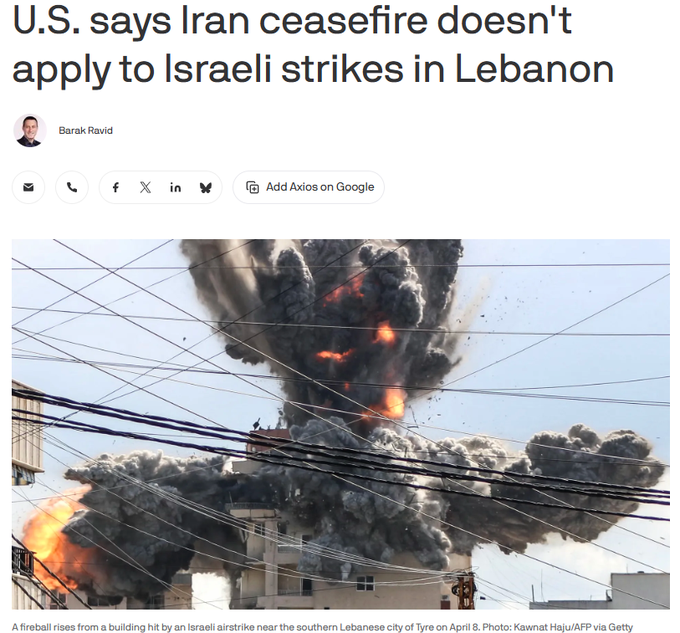
This coordination explains why Israel has continued large-scale strikes on Hezbollah targets in Beirut’s southern suburbs and southern Lebanon today, despite the US-Iran truce. Israeli officials have described the operations as among the most coordinated and intense of the current conflict, with footage showing heavy smoke over civilian areas.
Diverging Interpretations Fuel Tensions
The agreement between Trump and Netanyahu stands in sharp contrast to Iran’s position. Tehran has repeatedly warned it will withdraw from the ceasefire and has already suspended tanker passage through the Strait of Hormuz in protest over the continued Israeli actions. Iran has also conditioned its participation in Friday’s direct talks in Islamabad, Pakistan, on a ceasefire in Lebanon.
The White House has clarified that Iran’s published 10-point plan is not the actual deal agreed upon, describing it instead as an opening position for further negotiations. The narrow two-week pause is limited to suspending major US strikes on Iran and enabling limited commercial shipping through the Strait of Hormuz.
Current Status and Risks
- Strait of Hormuz: Iran has suspended tanker traffic in protest, reversing earlier signals of a limited reopening on April 9–10.
- Lavan Island Attack: Iranian sources accused UAE Mirage-2000-9 jets of involvement in today’s strike on the refinery, though the US has denied any linkage to American or Israeli forces.
- Islamabad Talks: Still scheduled for Friday, April 10, but Iran’s conditions regarding Lebanon introduce major uncertainty.
- Lebanon: Israeli strikes continue, causing reported civilian casualties and infrastructure damage.
U.S. Secretary of War Pete Hegseth has maintained pressure on Iran regarding enriched uranium stockpiles, while Russia has condemned US-Israeli efforts to destabilize Iran “in the strongest possible terms.”
Impact on Global Energy Markets
The suspension of tanker passage through the Strait of Hormuz risks prolonging severe disruptions. Qatar’s Ras Laffan LNG complex has suffered lasting damage (approximately 17% capacity loss for 3–5 years), with projected global LNG shortfalls reaching up to 35 million tons in 2026. India’s planned first Iranian oil shipment in seven years could face further delays.
Broader Diplomatic Context
The explicit US-Israel understanding on Lebanon highlights the challenge of managing multiple interconnected fronts. While the White House believes the ceasefire with Iran can hold, Iran’s repeated warnings and the suspension of Hormuz traffic suggest the truce remains highly fragile.
International calls for de-escalation continue, with Pope Leo XIV and European leaders urging protection of civilians and broader restraint.
FAQs on the Trump-Netanyahu Call and Ceasefire Dynamics
Q1: Did Trump and Netanyahu agree on Lebanon strikes?
Yes. According to Axios, Netanyahu raised the issue, and the two leaders agreed that Israel could continue operations against Hezbollah even after the US-Iran ceasefire took effect.
Q2: Does the White House think the Lebanon strikes will break the ceasefire with Iran?
No. US officials believe the ceasefire with Iran can hold despite the ongoing actions in Lebanon, viewing the two as separate fronts.
Q3: What is the status of the Strait of Hormuz?
Iran has suspended tanker passage in protest over the Lebanon strikes, despite earlier signals of limited reopening.
Q4: Are U.S.-Iran talks in Islamabad still scheduled?
Yes, for Friday, April 10, but Iran has conditioned its participation on a ceasefire in Lebanon.
Q5: How does this affect global energy markets?
Continued uncertainty and the Hormuz suspension risk prolonging oil and LNG shortages, higher prices, and volatility for buyers worldwide.
Q6: What is happening in Lebanon?
Israeli strikes on Hezbollah targets continue, causing civilian casualties and significant damage in Beirut and southern areas.
Reflecto News will continue monitoring any Iranian or Israeli responses, developments on the Strait of Hormuz, and progress (or obstacles) ahead of the Islamabad talks.
Stay informed with Reflecto News – Your source for accurate, timely coverage of the multi-front Middle East crisis, US-Israel coordination, and their global energy and security implications.
Questions people ask
What is China's current share of global manufacturing?
China now accounts for twenty eight percent of global manufacturing. This industrial output exceeds the combined manufacturing production of the United States, Japan, and Germany, making China the leading global industrial power according to recent reports.
Why were Andrew Tate and Tristan Tate arrested in Miami?
Andrew Tate and his brother Tristan Tate were taken into custody in Miami by the United States Marshals Service. They face thirty eight new charges in the United Kingdom, including rape and child pornography offences, and prosecutors are seeking their extradition.
What warning did Moscow issue about oil prices?
Kirill Dmitriev, the Chief Executive of the Russian Direct Investment Fund, warned that a tsunami of skyrocketing oil prices is approaching. Moscow describes this potential energy shock as a major threat to global markets.
What political shift is projected for Benjamin Netanyahu's coalition?
Political polls project that Prime Minister Benjamin Netanyahu's coalition is on track to lose its majority in the upcoming October election. This projection indicates a potential political shift in Jerusalem.
Why did a Russian military aircraft land in Tehran?
A Russian airborne command aircraft, widely known as a doomsday plane, landed in Tehran. The arrival of the aircraft represents a high stakes show of support from Russia for Iran during a period of heightened regional tensions.
What did President Masoud Pezeshkian claim about the United States and Israel?
Iranian President Masoud Pezeshkian claimed that the United States and Israel failed in a forty eight hour plan to topple the Iranian government. He made these statements during a televised address marking two years since his inauguration.