Reflecto News is an online news platform covering major international political events, global economic developments, and security conflicts. The site provides updates on topics such as Chinese manufacturing dominance, Middle Eastern political tensions, and high profile legal arrests. Readers can access current articles organized by categories like World News, Iran, and USA.
New York – April 5, 2026 | Reflecto News
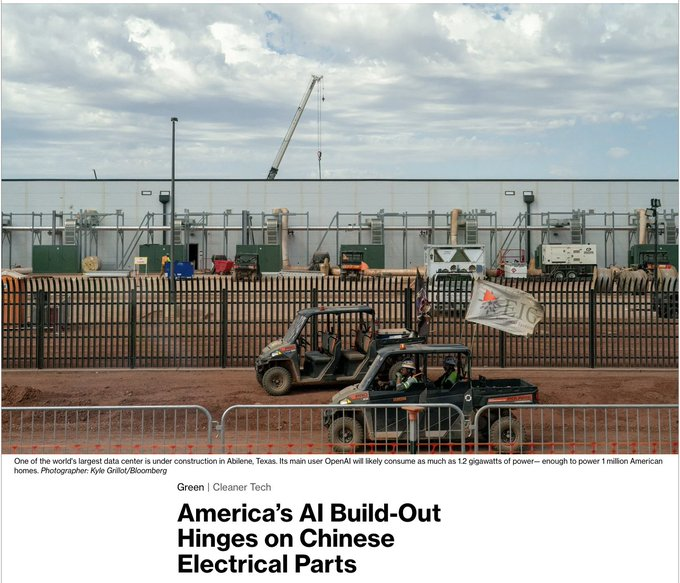
The explosive growth of AI infrastructure in the United States is hitting a major physical bottleneck: nearly half of the data centers planned to come online in 2026 face delays or outright cancellation, primarily due to severe shortages of electrical transformers, switchgear, batteries, and strained power grid capacity.
Despite tech giants committing more than $650 billion in AI-related capital spending this year, the real-world infrastructure needed to support hyperscale facilities simply cannot keep pace, according to a Bloomberg report and analysts at Sightline Climate.
The Scale of the Problem
- Analysts estimate that projects representing up to 12 gigawatts of power capacity were slated for 2026.
- However, only about one-third of that capacity is currently under active construction.
- Between 30% and 50% of planned U.S. data center builds for this year are now at risk of delay or cancellation.
The core issue is not funding, land, or computing hardware — it is the electrical backbone required to deliver massive amounts of reliable power to these energy-hungry facilities.
Key Bottlenecks
- Transformer and electrical equipment shortages: Lead times for large power transformers have stretched from around two years to as long as five years. U.S. manufacturing capacity cannot meet demand, forcing developers to rely heavily on imports (including from China), which face their own supply chain and tariff complications.
- Grid constraints: Many utilities are struggling to upgrade transmission and distribution systems fast enough. The surge in data center demand is compounding pressure already created by electric vehicles, electrified heating, and renewable integration.
- Other factors: Rising costs for critical components, local opposition in some areas, and interconnection queue delays are further slowing progress.
Major hyperscalers — including Alphabet (Google), Amazon, Meta, and Microsoft — are driving the bulk of this investment, racing to build the backbone for advanced AI training and inference workloads that require enormous amounts of electricity.
Why It Matters
Data centers are becoming one of the fastest-growing segments of U.S. electricity demand. Delays in bringing new capacity online could:
- Slow the pace of AI development and deployment.
- Drive up costs for GPUs, servers, and related hardware.
- Force companies to seek creative (and sometimes more expensive) workarounds, such as importing equipment or relocating projects.
- Exacerbate regional power shortages in high-demand areas like Northern Virginia, Texas, and the Midwest.
The situation underscores a broader challenge: the AI boom is colliding with the hard limits of physical infrastructure and the slow pace of grid modernization in the United States.
Reflecto News will continue monitoring updates from Bloomberg, Sightline Climate, Wood Mackenzie, and industry players on how tech companies and utilities plan to address these constraints in 2026 and beyond. The gap between ambitious AI spending and the reality of power delivery infrastructure is emerging as one of the defining bottlenecks of the current technology cycle.
By Reflecto News Desk
Sources: Bloomberg, Sightline Climate, Tom’s Hardware, Reuters, and industry analysts.
Questions people ask
What is China's current share of global manufacturing?
China now accounts for twenty eight percent of global manufacturing. This industrial output exceeds the combined manufacturing production of the United States, Japan, and Germany, making China the leading global industrial power according to recent reports.
Why were Andrew Tate and Tristan Tate arrested in Miami?
Andrew Tate and his brother Tristan Tate were taken into custody in Miami by the United States Marshals Service. They face thirty eight new charges in the United Kingdom, including rape and child pornography offences, and prosecutors are seeking their extradition.
What warning did Moscow issue about oil prices?
Kirill Dmitriev, the Chief Executive of the Russian Direct Investment Fund, warned that a tsunami of skyrocketing oil prices is approaching. Moscow describes this potential energy shock as a major threat to global markets.
What political shift is projected for Benjamin Netanyahu's coalition?
Political polls project that Prime Minister Benjamin Netanyahu's coalition is on track to lose its majority in the upcoming October election. This projection indicates a potential political shift in Jerusalem.
Why did a Russian military aircraft land in Tehran?
A Russian airborne command aircraft, widely known as a doomsday plane, landed in Tehran. The arrival of the aircraft represents a high stakes show of support from Russia for Iran during a period of heightened regional tensions.
What did President Masoud Pezeshkian claim about the United States and Israel?
Iranian President Masoud Pezeshkian claimed that the United States and Israel failed in a forty eight hour plan to topple the Iranian government. He made these statements during a televised address marking two years since his inauguration.